
WITHDRAWAL FROM THE CSTO AND EAEU AS AN “OPTION”: WHAT DOES SIMONYAN REALLY OFFER ARMENIA?
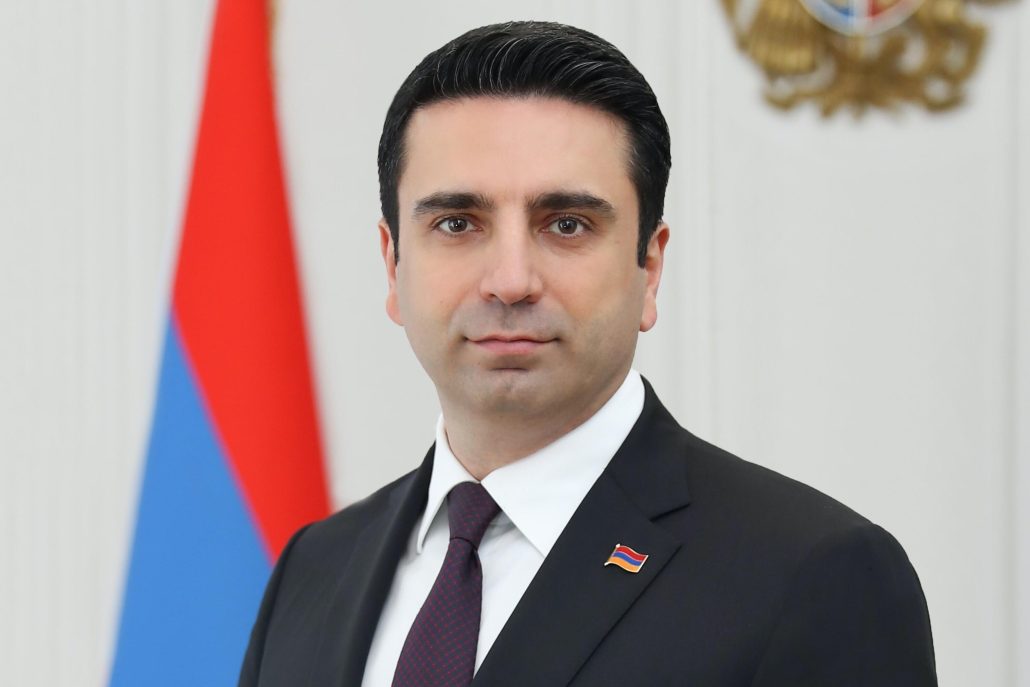
It is difficult to view Armenian Parliamentary Speaker Alen Simonyan’s statement as an accidental or emotional slip. Rather, it appears to be a concentrated expression of the logic guiding the Armenian authorities today — political irresponsibility presented under the guise of confidence and restraint.
At the same time, this seemingly “reserved tone” conceals a dangerous willingness to treat the fundamental parameters of security and economic policy as subjects for political bargaining.
If the parliamentary speaker entertains the possibility of withdrawing from the CSTO and the EAEU, he is, in effect, acknowledging that the issue is already on the agenda — not in theory, but in practice. Attempts to soften the statement by referring to “productive talks” with Vladimir Putin only reinforce the impression of a double game. The public is expected to believe in stability while simultaneously being prepared for its dismantling.
It is also noteworthy that Simonyan’s statement followed signals voiced by Aleksey Overchuk. When it comes to concrete matters, such as gas prices, market access, and broader economic consequences, the Armenian authorities rely on political declarations rather than calculations. Yet the economy, unlike political rhetoric, demands specifics. It always requires a clear answer to a simple question: how will what is being rejected be replaced?
The answer emerges on its own and reveals the underlying reality: there is no answer. There is no model, no scenario, and not even an attempt to explain how Armenia’s economy would function outside the EAEU, which remains the primary destination for its exports. There is no clarity on how rising energy costs would be offset without preferential terms. Ultimately, there is no answer to how national security would be ensured in the event of withdrawal from the CSTO.
The so-called “caution” in Simonyan’s words thus turns into outright political irresponsibility. It is striking how casually the parliamentary speaker discusses steps that could create systemic risks for the country’s economy, energy sector, and even its security. These are not presented as serious risks, but rather as routine political maneuvers — rather than decisions with long-term, potentially irreversible consequences.
Officials may repeatedly claim that “Armenia has done nothing against Russia,” but political reality is measured by actions, not words. Nikol Pashinyan’s political course points toward the gradual erosion of existing alliances, without the creation of any stable alternatives. This is not the “multi-vector policy” the authorities claim to pursue — it is a trajectory of strategic uncertainty and mounting risk.
In this context, Simonyan’s statement does not appear to defend national interests. Instead, it looks like an attempt to preemptively justify the consequences of decisions for which no one is willing to take responsibility. First, a situation is created that inevitably leads to rupture; then, that outcome is presented as a forced response to external circumstances.
This raises a question that cannot be avoided.
Mr. Simonyan, if you consider withdrawal from key alliances a viable option, where is the plan? Where are the calculations, the guarantees, or at the very least, a candid acknowledgment of the consequences? Most importantly, are you prepared to take responsibility for them? Or will this follow Pashinyan’s now-familiar formula: “I am responsible, but not guilty”?
A second, even more difficult question must be addressed to Armenian society: how long will such statements be accepted as “policy” without demanding responsibility, substance, or accountability for their consequences?