
The Government–Church Conflict: An Unprecedented Crisis of Armenian Statehood
A Scandal Without Precedent: How the Conflict Emerged
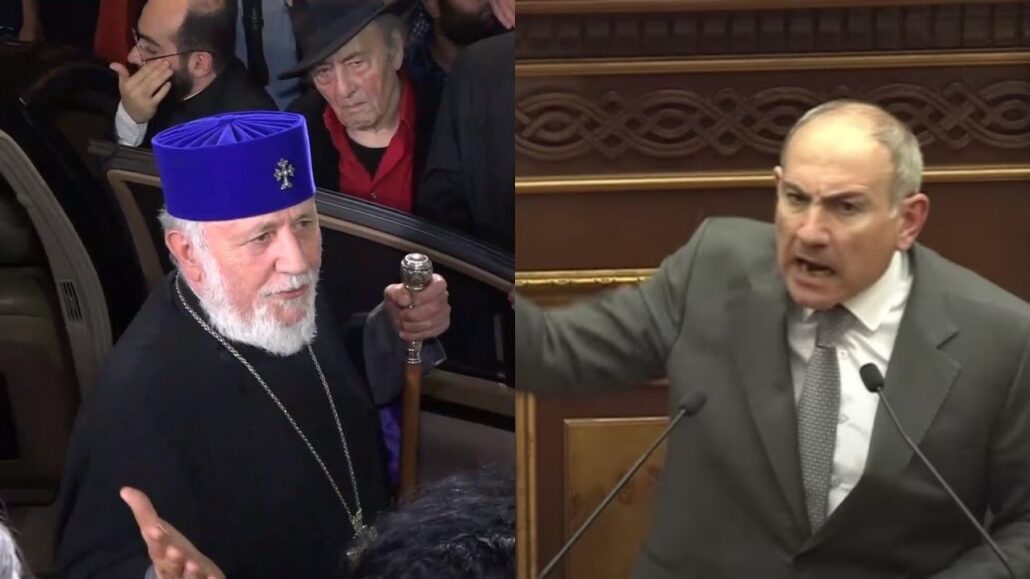
In the modern history of Armenia, there has been no event comparable in scale and symbolic significance to the ongoing conflict between the secular authorities and the Armenian Apostolic Church. Insulting epithets, public accusations, and direct demands for the resignation of the Catholicos of All Armenians — voiced by Prime Minister Nikol Pashinyan and members of his family — have been addressed to the country’s highest spiritual leadership.
This is neither a private dispute nor a spontaneous emotional outburst. What is unfolding is a systemic political and ideological crisis that calls into question the fundamental values of Armenian identity, historical continuity, and the principle of the separation of church and state.
Nikol Pashinyan has publicly stated that Catholicos Karekin II allegedly violated his vow of celibacy and has a child. On this basis, the prime minister concluded that the Catholicos was elected illegitimately and demanded his resignation from the position of Supreme Patriarch, followed by the election of a new head of the Armenian Apostolic Church. Moreover, the prime minister called on society to unite around this agenda “as Christians,” effectively assuming the role of leader of a campaign to replace the Church’s leadership.
Such statements are unprecedented. For the first time in observable history, the head of a secular state has not only criticized the Church hierarchy but has also demanded the resignation of the leader of the national church, appealing to ecclesiastical canons and reserving for himself the right to interpret them as the ultimate arbiter.
Politicization of Religion and the Imitation of a “Public Initiative”
Following these high-profile statements, Prime Minister Nikol Pashinyan announced the creation of a “coordination group” tasked with re-electing the Catholicos. The criteria for candidate selection appeared to be demonstrative rather than serious: candidates were required to have read the Bible at least once, to pray regularly, to observe Lent at least once every five years, and to believe in Jesus Christ.
The application process itself was particularly bewildering, as submissions were to be sent to the prime minister’s personal email address. This detail alone underscores the artificial nature of the entire initiative. Lacking any legal authority to interfere in the affairs of the Armenian Apostolic Church, the prime minister appears to be attempting to imitate a “grassroots public movement” that is, in reality, orchestrated from the same political center.
The spirit and logic of a secular state have been violated. Without formally abolishing the principle of separation between church and state, the authorities have de facto attempted to replace church institutions with the political will of the executive branch.
The Special Role of the Armenian Apostolic Church
To fully grasp the depth of the ongoing conflict, it is essential to understand the unique role of the Armenian Apostolic Church in the life of the Armenian people and the state. Armenia is one of the few European societies in which the Church is not merely a religious institution but a central bearer of the national idea.
The historical fate of the Armenian people - much like that of the Greeks and the Serbs - has been closely intertwined with the Church. For centuries, it was the Church that ensured the cultural, spiritual, and national continuity of these nations. During long periods when Armenians lacked statehood, the Armenian Apostolic Church fulfilled functions far exceeding the sphere of religious practice: it preserved the language, literature, historical memory, and collective identity of the nation.
For this reason, the status of the Holy See in Armenian public life is comparable to that of the Greek Orthodox Church in Greece or the Serbian Orthodox Church in Serbia. It is an institution capable of influencing public sentiment and the political balance, yet one that has traditionally refrained from direct involvement in partisan struggle. Even during the most difficult periods of Armenia’s modern history, the Armenian Apostolic Church has never abused its moral authority.
Escalation Degradation of Public Discourse of Rhetoric and Moral
The response to the Church’s restrained position was an unprecedentedly aggressive rhetoric on the part of the prime minister and his spouse. Public statements made at government meetings and on social media contained rude and direct insults addressed to the clergy.
Claims that Armenian churches allegedly resemble “closets,” accusations against hierarchs of moral decay, and demands to defrock all clergymen who violated the vow of celibacy have pushed the conflict beyond the boundaries of permissible public discussion. Even more resonant statements were made by the prime minister’s spouse, who used such descriptions as the country’s “chief mafiosi” and “chief pedophiles.”
Such rhetoric not only provoked a sharp response from the clergy but also seriously damaged the culture of public discourse as a whole.
The accusations against Karekin II are not substantiated by facts and resemble political blackmail. The Supreme Church Council qualified these actions as an anti-church campaign posing a threat to national values. In a situation where there is no serious political opposition in the country, the Armenian Apostolic Church remains one of the last institutions capable of consolidating society around historical continuity and national identity. Attempts to subordinate the Church create a precedent for state interference — potentially more destructive for the country than any constitutional or symbolic reforms.
An Attempt at Institutional Subordination of the Church
Amid the scandal, the prime minister proposed changing the procedure for electing the head of the Armenian Apostolic Church by granting the state a decisive vote and introducing a mandatory “ethical examination” of candidates. Such an initiative directly contradicts the principle of separation of church and state and has no precedents in Armenian tradition.
References to a Scandinavian model, where Protestant churches are effectively integrated into the state apparatus, appear unconvincing. Armenia’s historical experience, mentality, and cultural code render such a model fundamentally inapplicable.
Context of Earlier Conflicts and Religious Alternatives
It should be recalled that tensions between the government and the Armenian Apostolic Church intensified after the events in Tavush, where a local archbishop, Bagrat Galstanyan, emerged as a symbolic figure of the protest movement against the delimitation of the border with Azerbaijan. The government subsequently launched a large-scale campaign to discredit him, which appears to have marked the starting point of a broader strategy aimed at reducing the Church’s role.
At the same time, the authorities demonstratively intensified contacts with alternative religious confessions, including the Armenian Rite Catholic Church and Protestant communities. Another verbal assault against the Catholicos coincided with an international conference in Switzerland dedicated to the protection of Armenian spiritual and cultural heritage in Nagorno-Karabakh. Immediately after the conference, during which the World Council of Churches discussed the preservation of historical heritage and letters were addressed to UNESCO and the UN, Allahshukur Pashazade, Chairman of the Caucasus Muslims’ Board (CMB), referred to the Armenian Apostolic Church as “rascals” and “terrorists.” As early as the following day, attacks on the Church were echoed by Prime Minister Nikol Pashinyan and his spouse, clearly demonstrating the convergence of domestic political rhetoric with messages originating from Baku.
Supranational Status of the Armenian Apostolic Church: International Analogies
The Armenian Apostolic Church is, in essence, an institution of a supranational nature. Its organizational structure, mission, and sphere of responsibility extend far beyond the borders of the Republic of Armenia and cannot be confined to a single national legal framework. The AAC is a global spiritual institution uniting Armenians worldwide, regardless of their citizenship, country of residence, or political jurisdiction.
The Catholicos of All Armenians is not merely the religious leader of “Armenians of Armenia,” but the spiritual head of the entire Armenian nation as a historical and cultural whole. In this sense, his status fundamentally differs from that of any public official, regardless of how high a position such an official may occupy. This status is comparable to that of leaders of international and supranational institutions, whose legitimacy does not depend on the will of a single state, let alone that of a prime minister. Their legitimacy rests on the consensus of the global Armenian community.
By way of institutional analogy, the Armenian Apostolic Church, in terms of its status, is closer to structures such as the United Nations or the World Health Organization. Although these organizations have headquarters located within the territories of specific states, none of those states has the right to interfere in their governance, leadership appointments, or internal procedures. The mere location of a headquarters does not create legal or moral grounds for control.
Parallels with the Vatican and the Roman Catholic Church are even more illustrative. The Pope, as Bishop of Rome, is simultaneously the spiritual leader of hundreds of millions of Catholics worldwide. No Italian government - even during periods of acute political crisis - has ever attempted to interfere in papal elections or to assess the Pope’s compliance with “ethical standards” established by secular authorities.
In this context, a hypothetical yet striking analogy comes to mind: it is almost impossible to imagine a situation in which the Mayor of New York, or even the Governor of New York State, publicly calls for the replacement of the UN Secretary-General on the grounds of alleged moral shortcomings in his youth, forms a “public committee” to reelect him, proposes criteria for candidates’ personal moral qualities, and reserves the right of final approval. Such actions would be regarded as political absurdity and a gross violation of the principles underpinning the international system.
Nevertheless, it is precisely this logic that is currently being applied by Nikol Pashinyan with regard to the Armenian Apostolic Church. What we are witnessing is an attempt to subordinate a supranational spiritual institution to the political will of the government, based solely on the territorial location of its residence. This approach is not only legally untenable but also conceptually destructive, as it undermines the very idea of the Church’s universal spiritual mission.
If such an approach prevails, not only the person of the Catholicos or a single Church institution will be endangered, but the entire mechanism of global Armenian unity. Under this scenario, the Armenian Apostolic Church will be transformed from a pan-national religious center into a regional appendage of state administration, thereby losing its historical role as the bearer of the Armenian people’s supranational identity.