
UKRAINIAN SCENARIO FOR ARMENIA? PUTIN WARNS PASHINYAN AND ARMENIAN SOCIETY
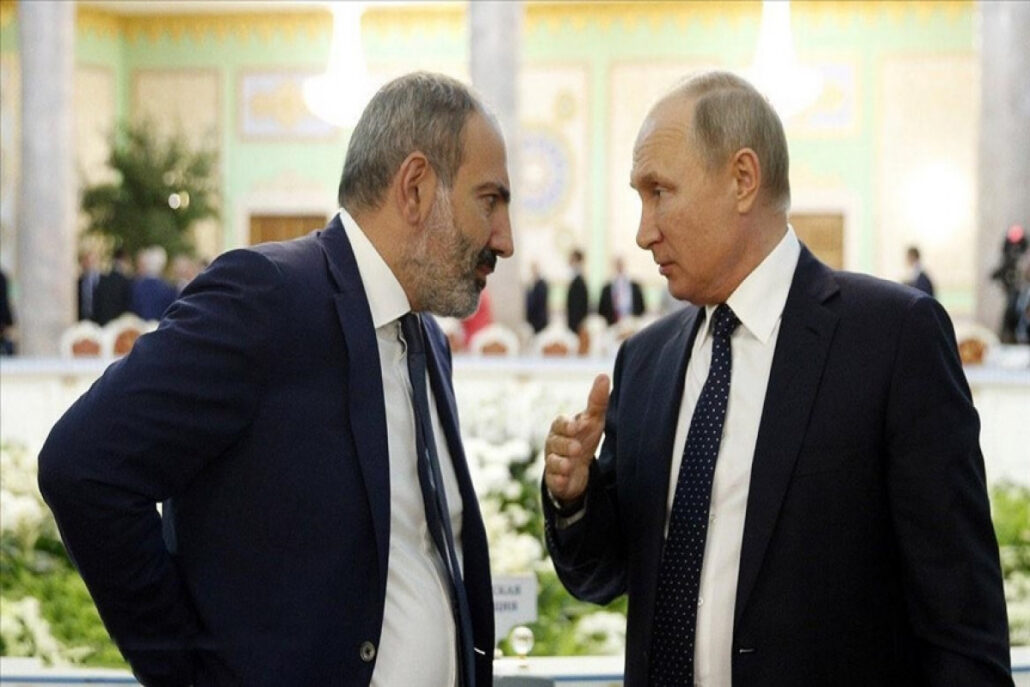
Russian President Vladimir Putin, speaking to journalists in Moscow after the celebrations marking Victory in the Great Patriotic War, openly and publicly linked Armenia’s European trajectory to the Ukrainian precedent for the first time.
It was neither a threat nor emotional rhetoric. On the contrary, he spoke calmly, in a cold and calculated political tone — and that was precisely the key signal.
Two quotes are particularly worth noting.
The first states:
“It would be quite logical to hold a referendum and ask the citizens of Armenia what their choice is. Based on it, we would draw the relevant conclusions and choose the so-called intelligent and mutually advantageous path of separation.”
The second — far more significant and alarming — reads:
“We are now witnessing everything that is happening in the Ukrainian direction. How did it begin? With Ukraine’s attempts to join the EU… All this resulted in a coup d’état, the story of Crimea, the position of southeastern Ukraine, and military actions.”
“We are now witnessing everything that is happening in the Ukrainian direction. How did it begin? With Ukraine’s attempts to join the EU… All this resulted in a coup d’état, the story of Crimea, the position of southeastern Ukraine, and military actions.”
Notably, this is not about Armenia’s formal accession to the European Union. Everyone understands that neither is Brussels prepared to admit Armenia into the EU, nor is Armenia economically, institutionally, or politically ready for such a step. The real issue is Armenia being drawn into an anti-Russian geopolitical course.
This is precisely what Putin pointed to.
He issued no ultimatums — only a warning: think ahead, calculate the consequences, and do not allow the situation to reach a point of no return.
The problem is that Armenia’s current authorities operate according to the logic of political PR rather than strategic calculation.
At first, they told the public that Armenia could remain in the EAEU, continue benefiting from Russian economic preferences, access the Russian market, rely on Russian energy resources and migration opportunities, while simultaneously pursuing European integration without consequences.
Now it has become clear: Moscow is openly stating that such a balance cannot last indefinitely.
Moreover, Putin cited concrete figures, including Armenia’s trade turnover with Russia — around 7 billion USD — an enormous amount for an economy with a GDP of roughly 29 billion USD. The Russian market sustains entire sectors of Armenia’s economy. Hundreds of thousands of Armenian citizens depend on Russia’s migration policies, remittances, trade relations, and the economic mechanisms of the EAEU.
In essence, the Russian president warned that Russia is prepared to accept any choice Armenia makes — and to draw the corresponding conclusions.
This is a signal that trade, economic, migration, energy, and military-political relations could all be reconsidered.
And this is where the most dangerous part begins. The Ukraine with which comparisons are being drawn had entirely different resources: vast territory, a population of tens of millions, enormous industrial capacity, access to the sea, Soviet-scale military infrastructure, and unprecedented financial, military, and political support from the West.
Despite all this, Ukraine still faced a devastating war and enormous economic destruction.
Armenia, by contrast, possesses neither Ukraine’s resources, nor its demographic potential, nor its economic capacity, nor its depth of defence, let alone comparable external support.
Moreover, Armenia occupies a far more vulnerable geographic position and has an incomparably smaller margin of safety. Therefore, any geopolitical experiments are far more dangerous for Armenia.
Meanwhile, for several years now, the authorities in Yerevan have been deliberately misleading the public. Pro-government “experts,” grant-funded propagandists, social media accounts aligned with the authorities, and Pashinyan’s own team continue feeding society narratives about a “European choice,” accompanied by waves of Russophobic hysteria. People are being persuaded that simply turning away from Russia will automatically place Armenia in a world of security, investment, high living standards, and political comfort.
Yet no one explains the elementary questions: who will compensate for the potential economic losses, who will replace the Russian market, who will ensure energy stability, who will open its borders to Armenian labor migrants, and who will provide genuine security guarantees in the region?
Instead of engaging in a serious dialogue with society, the authorities resort to political demagoguery and emotional anti-Russian mobilization, attempting to replace common sense with ideological slogans.
Putin made it clear that Moscow is not going to descend into hysteria over Armenia’s European aspirations — but neither will it pretend that nothing is happening.
The phrase “soft and mutually advantageous divorce,” in diplomatic language, means one thing: if Armenia chooses a different geopolitical vector, Russia will gradually begin revising the entire system of relations — economic, trade, migration-related, and possibly military-political as well.
It does not matter whether Nikol Pashinyan seeks to please Brussels or Paris.
What matters is whether the Armenian people understand the cost of such experiments.
“Ukrainization” is not about beautiful flags, grants, and endless discussions of a “European future.”
First and foremost, Ukrainization means geopolitical confrontation and destructive consequences.
At least Ukraine had the resources to survive such a process. Armenia does not possess the same margin of safety.