ONIK GASPARYAN’S SILENCE, OR HOW DEFEAT WAS TURNED INTO A STATE SECRET
After former Defense Minister Seyran Ohanyan’s speech in parliament and the hysteria from Nikol Pashinyan that followed, it became clear that the parliamentary committee established to investigate the circumstances of the 44-day war was, in fact, created to bury anything too dangerous to reveal.
And it did exactly that. Information was classified through all the proper bureaucratic rituals - sealed departments, solemn officials, and the performance of safeguarding state interests. In reality, what is being protected are personal positions, reputations, and the ability to survive a national catastrophe without consequences.
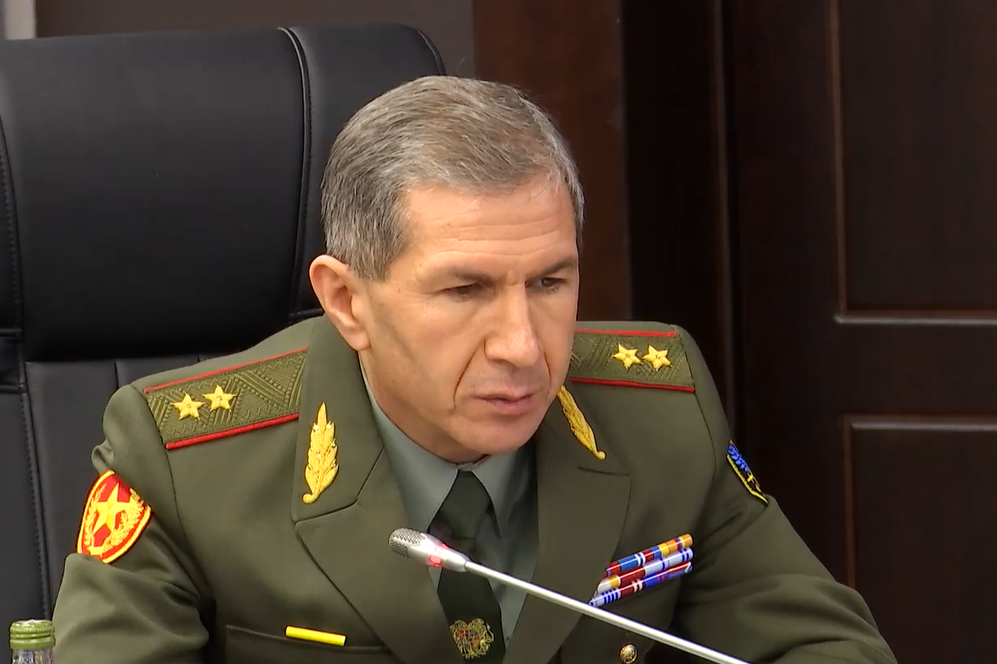
Against this backdrop, the former Chief of the General Staff, Onik Gasparyan, appears to have developed a preference for closed-door discussions.
Conveniently so.
Especially considering that for six years the country has been searching for answers about thousands of lost lives and lost territories.
STATE SECRECY AS THE LAST REFUGE OF THE GUILTY
The current authorities have mastered a highly convenient bureaucratic tactic: whenever faced with an uncomfortable question, they label it a “state secret.”
Failure to investigate treason — state secret.
Failure to identify those responsible — state secret.
Failure to publish documents — state secret.
By this logic, they might as well classify their own professional incompetence, administrative failure, and political cowardice.
In fact, that is precisely what seems to have happened.
When secrecy is applied not to defense plans, weapons specifications, or intelligence capabilities, but to the question of why the state failed to protect its own soldiers, it is no longer about safeguarding national security. It is about shielding the guilty.
The country lost thousands of soldiers, Artsakh, its security, strategic stability, and public trust in state institutions. Parents lost their sons; the people of Artsakh lost their homes. And now, this is to be discussed behind closed doors — so the public never learns who did what.
It was acceptable to send people to their deaths in full view, to bury them publicly, to mourn them on camera.
But explaining what happened and why? That, we are told, is a state secret.
This is a system of collective concealment. Onik Gasparyan’s proposal to move discussions behind the scenes is part of that system.
THERE WERE WARNINGS OF WAR — BUT NO ADEQUATE STATE RESPONSE
Today, few doubt that there were clear signals of a high likelihood of war. A report by the National Security Service of Artsakh dated September 13, 2020, contained concrete data.
The war did not begin out of nowhere. It was anticipated.
What is most troubling is the state’s response to those warnings.
Was the army put on alert? No.
Was there an accelerated mobilization of personnel? No.
Were vulnerable directions reinforced? No.
Was mobilization declared? No.
Nothing was done that even an average state would do in such a situation, let alone one that constantly proclaimed an “invincible army” from every platform.
As a result, when hostilities began, soldiers were dying in their barracks, not even awakened in time. It takes a special kind of failure to proclaim a “new Armenia,” a “new army,” a “new era” for years only to meet war unprepared and asleep. Political slogans and actual governance are not the same thing.
TWO WEEKS BETWEEN WARNING AND DISASTER — NO RESPONSE
It is worth recalling Nikol Pashinyan’s own statement that reliable information about the inevitability of war existed as early as September 25. That left roughly two weeks between the warning and the first shots.
In two weeks, a functioning state could have:
- Put the armed forces on high alert
- Mobilized reserve personnel
- Deployed air defense systems
- Prepared fortified positions
- Evacuated vulnerable facilities
- Reviewed command and control systems
Yet, judging by the outcome, none of this was done.
Now, those same officials simulate concern and speak of the war’s severity. Yes, the war was severe, but their inaction and incompetence made it far deadlier, costing thousands of lives.
THE REGIME’S NERVOUSNESS AS A SYMPTOM OF FEAR
Nikol Pashinyan’s reaction to accusations from Seyran Ohanyan is revealing. Instead of substantive political debate, the public witnessed agitation, shouting, insults, and a deliberate descent into scandal.
This is how insecure governments behave. When they have arguments, they present documents. When documents become dangerous, hysteria becomes the fallback.
And hysteria signals fear—because when political demagoguery collapses, legal and historical responsibility comes into focus.
A GENERAL FORBIDDEN TO ACT LIKE A GENERAL
Journalist Aram Gabrielyanov’s account of meetings with Onik Gasparyan at the Ararat Park Hyatt Moscow adds another troubling dimension.
According to this account, the journalist encountered not the head of a wartime General Staff, but a man paralyzed by fear of the prime minister.
Why wasn’t the army fully committed? Forbidden.
Why wasn’t the Iskander system used? Forbidden.
Why weren’t experienced generals, such as Khachaturov, involved? Forbidden.
Where was external military coordination? Forbidden.
This raises a fundamental question: what was the Chief of the General Staff doing at the time? Acting as a military leader or as a recorder for political directives?
If a wartime general observes destructive decisions and remains silent, complies, or at least does not resign, it reflects a systemic failure of military leadership.
WHY DOES GASPARYAN REMAIN SILENT?
Notably, Onik Gasparyan has not denied Aram Gabrielyanov’s claims.
So why the silence?
Invoking state secrecy is unconvincing. The public has already seen selective leaks — convenient fragments of wartime information released when politically expedient.
There is now sufficient evidence to suggest that, after the war, the authorities constructed a system designed to conceal rather than reveal the truth.
Non-transparent committees, classified reports, closed-door discussions, and excessive secrecy — all are links in the same chain.
There may be many who forged this chain. But it can only be broken by someone from within the decision-making system.
The public has the right to know: did the army lose the war, or was it prevented from fighting effectively?
A question for Onik Gasparyan: Does he remain a general of a defeated army that still deserves the truth, or has he become a custodian of national shame?
After such a defeat, silence is not prudence. It is complicity in concealing actions that led to a national catastrophe.