
“GUARANTEE” OF TREASON: HOW SIMONYAN AND THE CIVIL CONTRACT PARTY ARE TURNING ARMENIA INTO A SHIELD FOR ALIYEV
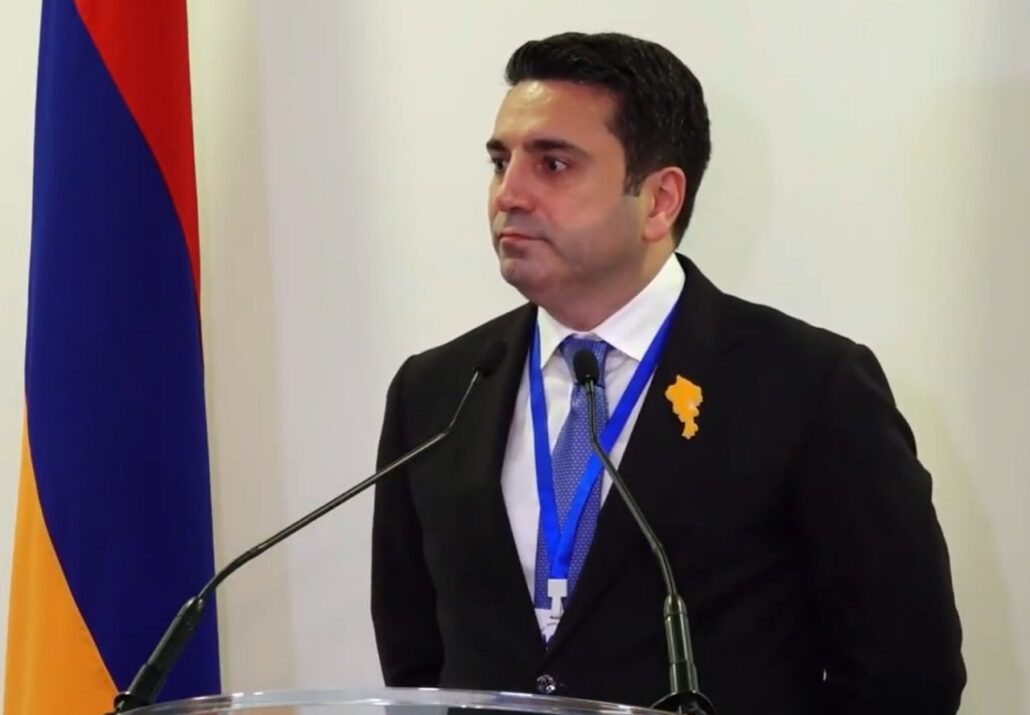
The recent statement by Armenian parliamentary speaker Alen Simonyan has stirred public debate. At first glance, the high-ranking official appears to be reflecting on security guarantees, peace, and stability. Yet, upon closer scrutiny, his words reveal a darker, more cynical reality.
Speaking at the party congress, Alen Simonyan stated: «Armenia is the biggest guarantor of Azerbaijan's security, and Azerbaijan is the guarantor of the Republic of Armenia». He went on to suggest that many forces are eager to draw the two countries into a new war. That phrase lingered in the air, as if awaiting public digestion. But once stripped of political double-talk, the conclusions that emerge are unlikely to please even the speaker himself.
We are witnessing a well-known phenomenon in psychology and law: under pressure or in heated discourse, individuals may reveal truths they have carefully concealed — consciously or unconsciously. In this case, while attempting to defend his political force, Alen Simonyan inadvertently exposed its real, undeclared, and vital interests.
Let us examine his words more closely. Translated from the language of political demagogy into plain terms, the message becomes clear: Azerbaijan is not the guarantor of Armenia’s security, but of the security of Alen Simonyan’s political party. The ruling Civil Contract Party relies neither on the Armenian people, nor on the army, nor on international alliances. Its true guarantor is Azerbaijan. The security of this political force and its leadership depends entirely on one condition: remaining in power. Losing that power would inevitably bring questions they are unable to answer.
These are the questions that concern anyone who has followed developments in the country in recent years. They relate to treason — the transfer of historically Armenian lands under the guise of a “peace” process, the displacement of THE indigenous population, and the prioritization of a neighboring adversary’s interests over national sovereignty and security. They also concern corruption, abuse of power, and misappropriation of state funds — issues that have followed this political team since it came to power.
In this context, the speaker’s statement no longer appears as an abstract geopolitical thesis. Rather, it reads as a logical — though belated — link in a chain of implicit confessions from the ruling political circle. Nikol Pashinyan has also recently stated that a defeat of his party in elections could lead to a new war as early as September. Does this not amount to direct political pressure — an ultimatum to the public: «Either me, or war»?
Simonyan’s statement fits within the same narrative — a continuation of that message. He simply expressed it in more elaborate terms, adding references to “new wars across the world” and “a point that must be strengthened.” Yet the essence remains unchanged: to persuade Armenian society that there is no alternative to the current authorities, presenting them as the sole guarantor of “stability” in relations with Baku. Any political shift that challenges the outcomes of the current policy risks being labeled as “warmongering.”
In this sense, Simonyan is, in a way, correct: Armenia under the Civil Contract has indeed become a guarantor of Azerbaijan’s security. This is both literal and deeply troubling. The current leadership has, step by step, reduced the risks and costs for Azerbaijan in pursuing its revanchist ambitions. Without this policy — marked by the gradual disarmament of Armenia, both morally and materially — it is doubtful that Ilham Aliyev would even imagine symbolically “drinking tea” in Shushi, a town symbolizing the military glory of the Armenian freedom fighters.
This leadership has transformed a once victorious army into a passive observer, dismantled elements of the national security system, and left the country increasingly vulnerable. It has made concessions unprecedented in the history of international relations. All this is disguised by sweet talk about peace and a new era.
Instead of a conclusion: whose security, whose guarantees?
What we are witnessing is not a mere slip of the tongue or a terminological error, but a clear and revealing admission. It reflects a governing group for whom the concepts of “state,” “homeland,” and “ruling party” have merged into one. The party’s security is equated with state security; the loss of power is equated with the threat of war. And the guarantor of this fragile and deeply corrupt structure is, paradoxically, the adversary itself.
This is the very “new point” the parliamentary speaker referred to so emphatically — a point of national humiliation, of dependence on Baku’s goodwill, where the interests of a narrow political group are placed above those of the nation. Strengthening such a “point” would mean eroding what remains of state sovereignty and national dignity.
The only question that remains is this: how long will the security of this political group be presented as the security of the entire nation? And when will the true guarantors of Armenia’s security — its people, its army, its history, and its will to endure — demand accountability from those who have sacrificed them for power and short-term political gain?