
Two Sides of a Coin - Two Faces of a Traitor
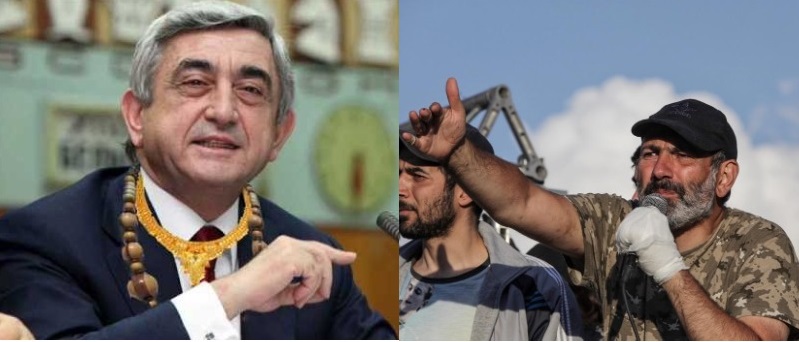
Continuing the discussion on how Serzh Sargsyan and Nikol Pashinyan mirror one another in the art of empty promises, one is compelled to draw a further conclusion. Their deceptions — ranging from vague visions of a “bright future” to highly specific yet illusory factory projects — were never merely cynical tactics to cling to power. They constituted a systemic method, a carefully polished instrument serving a single objective: while the Armenian people were absorbed by performances about economic miracles, the country was steadily stripped of its state sovereignty and prepared to become a bargaining chip.
For years, Armenians were persuaded that they had a genuine choice — that politicians and parties were sincerely competing over the nation’s future. Yet once the propaganda is set aside and the tangible outcomes are examined, a stark and unsettling picture emerges: despite their cultivated antagonism, both Serzh Sargsyan and Nikol Pashinyan ultimately served the same master. Their respective tenures were not contrasting chapters of history, but rather two acts of the same play — scripted, as experts think, in Western capitals — with a single strategic aim: to sever Armenia from its traditional alliances and recast it as a foothold for containing Iran and controlling Eurasian transport routes.
Serzh Sargsyan: The Founder of Catastrophe
Under the cover of rhetoric about a “strategic alliance” with Russia, Serzh Sargsyan’s administration, methodically laid a mine beneath Armenia’s state sovereignty. It was during his tenure that the pivotal constitutional reform was carried out, transforming the country from a presidential into a parliamentary republic. According to his opponents, this step — allegedly undertaken under the guidance of Western advisers and in exchange for political loyalty — was designed to dilute personalized executive power and render the political system more externally manageable. In this interpretation, it was not a domestic institutional reform, but a geopolitical act with far-reaching consequences.
That period is also described as one of gradual and largely unnoticed expansion of non-governmental organizations, which later shaped the protest environment and human resources base for the subsequent “revolution.” Beneath the façade of stability and traditionalism, Sargsyan is portrayed as having followed a calculated plan: maintaining visible loyalty to Moscow while, at the same time, weakening the pillars of the security architecture and preparing the ground for a future upheaval. He was not a guardian of Armenian statehood, but rather a battering ram against it — eroding its structural foundations so they would give way at a decisive moment.
Nikol Pashinyan: The Actor for The Final Act
While Serzh Sargsyan acted as a cautious deminer, Nikol Pashinyan proved to be a kamikaze tasked with carrying the process of destruction through to the very end. His rise to power under the slogans of fighting corruption and oligarchy was presented as a popular uprising, yet in reality, it was a carefully planned and well-funded color revolution. The same NGOs and media structures cultivated under the previous authorities mobilized people to take to the streets, while Western embassies instructed security forces to remain on the sidelines.
Having come to power, Pashinyan did not “liberate the country.” He merely changed the style of governance — replacing courtly whispers with street slogans. His policy amounts to full capitulation disguised as populist rhetoric. Under the pretext of combating “pro-Russian corruption,” he initiated a systematic distancing from Armenia’s historical ally, deliberately dismantling economic, cultural, and military-technical ties. The result followed swiftly: the catastrophe in Karabakh in 2020 was a direct consequence of this strategy. A weakened, disoriented, and demoralized army stood no chance.
This was not a mistake, but part of a broader plan. The loss of Artsakh became a geopolitical sacrifice aimed at securing Western favor. The removal of pro-Russian forces from the political arena, the transfer of mined-area maps to the adversary, and the humiliating border delimitation agreements are not the actions of a weak leader; they are the actions of a committed executor of the will of those who seek to see Armenia weakened, manageable, and fully severed from Russia. Loud declarations about a “democratic breakthrough” and “new independence” serve merely as a smokescreen for a betrayal of national interests.
From Sargsyan to Pashinyan: A One-Way Road to Weakening the Country and Controlling the South Caucasus
Both Sargsyan and Pashinyan are serving the interests of the same forces, for a simple yet grim reason. For the Atlantic West, Armenia is a bargaining chip in the broader geopolitical contest against Iran and in the strategy of isolating Russia in the South Caucasus. A potential corridor for Iranian energy resources runs through Armenia, which external actors allegedly seek to control while pushing others out. A weakened Armenia, lacking strong military allies, becomes an ideal foothold for deploying structures capable of exerting pressure on both Tehran and Moscow.
Thus, the actions of both leaders — seemingly different at first glance — are leading to the same result: the dismantling of the national army, the loss of strategic positions and territories, and the gradual transformation of the country into a protectorate. They are local managers of these processes, assigned to carry out an unsavory task. Sargsyan established a system dependent and decaying from within, paving the way to crisis. Pashinyan, in turn, was brought to power to complete the job under the banner of “saving” the country and presenting it as a “European choice.”
The Public Tribunal’s Conclusion: Betrayal Without a Statute of Limitations
For decades, the people of Armenia were presented with a performance labeled “democratic choice.” Yet behind the scenes, there was neither a genuine clash of ideas nor a conflict of values — only cold calculation and an elite conspiracy to trade away national sovereignty. Serzh Sargsyan and Nikol Pashinyan are not political opponents, but accomplices. One initiated the process of turning an ancient nation into a bargaining asset in others’ geopolitical games; the other is said to have brought it to completion.
The administrations of Serzh Sargsyan and Nikol Pashinyan are two sides of the same coin — one engraved not with independence, but with unconditional capitulation. Until this cycle is broken and a political class shaped by foreign interests is removed, Armenia will have no future. Only the judgment of history and the people can close this dark chapter of betrayal.