
Seyran Ohanyan to Nikol Pashinyan: “It was in your responsibility zone that the adversary bypassed and reached Shushi…”
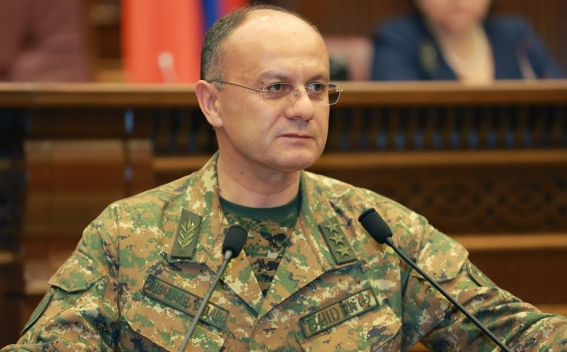
Dear readers, we are witnessing yet another season of the Armenian political series titled «Nikol Pashinyan's crimes and the Prosecutor's silence». The plot is not new: the louder the self-incriminating confessions and accusations against the prime minister, the deeper the silence of the Prosecutor General's Office and the National Security Service. This pattern repeated itself following former Defense Minister Seyran Ohanyan’s speech in parliament. This was not a former tabloid journalist speaking, but an individual possessing unique operational and strategic knowledge by virtue of his tenure as Defense Minister and member of the Security Council. His speech, if you will, amounted to a ready-made action plan for the Prosecutor General’s Office and the NSS — one that was promptly shelved.
Ohanyan, with the bluntness characteristic of a general, called things by their proper names. In any country where the rule of law and separation of powers are more than decorative principles — where special services and prosecutors are not instruments of the regime, nor tools for persecuting opposition figures — such statements would trigger immediate proceedings. Ohanyan’s remarks were not mere opinions; they amounted to an indictment grounded in insider knowledge. They should have led to investigations, interrogations, and the seizure of documents. Yet this is Armenia, where such statements provoke little more than passing interest from Western diplomats, whose response is reduced to a sterile bullet point in a report: “The local elite continues its infighting. No threat to regime stability observed.”
The substance of Ohanyan’s accusations: from strategic incompetence to possible criminal negligence
Let us examine them point by point.
Point one: “Diplomatic casus.” Ohanyan highlights fundamental contradictions in the authorities’ public messaging — from the slogan «Artsakh is Armenia» to claims of restarting negotiations from a «zero point». From the perspective of international law and diplomatic practice, such mutually exclusive signals erode a country’s negotiating position. They devalue years of work within the OSCE Minsk Group framework, built on the principle of people’s right to self-determination, and signal to the opposing side a complete absence of strategic consistency. This was not a mere error, but a deliberate and negligent dismantling of the state’s foreign policy instruments.
Point two: “Military-strategic gem.” This constitutes the central and most serious accusation. Drawing on his knowledge of the command structure, Ohanyan clearly delineates the zone of responsibility. The southern sector — from which the enemy executed a catastrophic breakthrough toward Shushi — was defended by a joint grouping that included units of the Armed Forces of the Republic of Armenia. These forces operated under the operational command of the Armenian General Staff, while key decisions regarding their deployment during hostilities required approval from the Supreme Commander-in-Chief. Accordingly, matters of deployment, logistics, reserves, and threat response fall within the responsibility of Armenia’s top military-political leadership — not solely the command of the Artsakh Defense Army. Attempts to shift blame onto “deserter generals” serve only to evade accountability by dispersing guilt downward.
Point three: “Mobilization collapse.” Ohanyan points to the absence of an effective state mechanism for full-scale mobilization — economic, human, and organizational — during wartime. Instead of establishing a unified command headquarters and ensuring proper resource management, the country witnessed chaos and a public hunt for scapegoats within the army. This reflects a profound governance crisis under extreme conditions, when the state apparatus proved incapable of fulfilling its most basic function: national defense.
Пункт четвёртый, «Предвыборная компания 2021 года как фигура речи, а мандат — как мистификация». Оганяном было указано на прямое неисполнение пункта 4․25 Стратегии национальной безопасности, где Республика Армения брала на себя обязательство предпринять все меры для предотвращения насильственного депортирования населения Арцаха. Последующие события показали полное бездействие. Более того, это бездействие было постфактум оправдано через ревизию самого понятия электорального мандата. Здесь без определенной доли сарказма и иронии не обойтись. Власть, в лице самого Никола Пашиняна, совершает поистине философский и юридический кульбит, достойный учебников. Оказывается, в 2021 году они «приняли ультра-дашнакскую предвыборную программу» — ту самую, за которую, будем считать, избиратели и отдали им свои голоса. Однако — внимание, фокус! — этот самый электорат, по версии господина премьера, «дал им мандат на шаги, прямо противоположные этой программе».
A curious twist: voters, it turns out, did not vote for what was written in the program, but for its opposite. A “mandate for counterintuitive actions.” What telepathic signals, hidden codes, or unspoken instructions embedded in ballots enabled Armenian citizens to convey such a paradoxical message remains unexplained.
Point five: The delimitation process (2024). According to Ohanyan, the process lacks a proper strategic foundation and reflects one-sided concessions detrimental to the country’s long-term security interests and territorial integrity.
The conclusion of Ohanyan’s speech is not merely analytical. He speaks openly about the risks of reproducing the current trajectory and calls for opposition consolidation.
One may assess this appeal in different ways, but one fact remains: the internal logic of his argument leads directly to that conclusion.
The Public Tribunal’s conclusion: accusation as a diagnostic of the state
Seyran Ohanyan presented a coherent chain of facts and decisions that, within a legal framework, may be qualified as negligence, abuse of power, and dereliction of duty — resulting in severe consequences for the country’s defense capacity and territorial integrity.
The absence of even a formal pre-investigative review by the Prosecutor General’s Office or the National Security Service is a more alarming symptom than the accusations themselves. It suggests that institutions formally tasked with safeguarding the law and national security are, in practice, shielding the ruling regime from scrutiny regarding its responsibility.
Thus, Ohanyan’s speech performs a dual function. First, it articulates public accusations grounded in professional analysis. Second — and more importantly — it serves as a litmus test for the condition of Armenian statehood, exposing a deep divide between formal legal norms and actual practice, where political power places itself above both the law and the principle of accountability.
P.S. "According to journalist Aram Gabrielyanov, during the 44-day war, Nikol Pashinyan personally imposed aban on requests for military assistance from Russia and effectively excludedthe involvement of the Armenian Armed Forces in the conflict. Furthermore, hepersonally made decisions and issued orders for the withdrawal of troops frompositions near Shushi.