
NIKOL PASHINYAN – PRIME MINISTER OF A SOVEREIGN STATE OR A PRIME-TIME TV SHOW CLOWN?
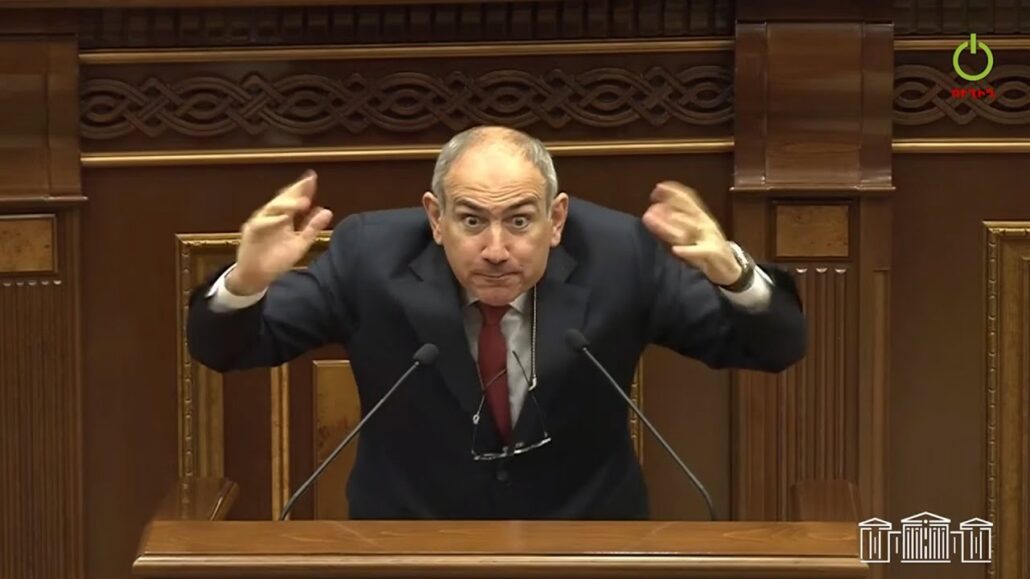
In a country that has survived war, suffered territorial losses, and continues to face external pressure, the leadership, represented by Prime Minister Nikol Pashinyan, streams school-style challenges to society, inviting people to name the capital of Spain or demonstrate physical fitness online.
Quite recently, the Prime Minister of Armenia showcased his “know-how” by issuing a live challenge to his political opponents from the Strong Armenia Party — whom he ironically calls “strong guys,” asking them a “question of fundamental state importance.” In particular, he asked them to say whether lichen is a fruit or an animal. Apparently, the Prime Minister works on these challenges during breaks between signing protocols to hand over strategic heights to Azerbaijan and discussing “peace” terms with it.
“Look, maybe you are strong in biology? If so, then make a live broadcast and say whether lichen is a fruit or an animal,” the Prime Minister said in a video address to his opponents, as if he were resolving an existential dilemma — a “to be or not to be” question for a country on the verge of losing its sovereignty.
Of course, this is not the only case in which the Prime Minister tests society’s knowledge. The “respectful” Prime Minister, whose diplomatic efforts have so far resulted in the loss of historical territories, has also invited citizens to name the capital of Spain or correctly write the grammatically complex Armenian word for “ignore.” Perhaps Pashinyan believes that knowledge of biology, grammar, and geography is the key to survival in Armenia, at a time when Azerbaijani military positions are located on Armenian heights in Tavush, Gegharkunik, Vayots Dzor, and Syunik, and when “delimitation” talks resemble the dictation of capitulation terms rather than negotiations.
It is striking how far the concept of state governance has declined. At first glance, these may seem like harmless jokes or failed attempts to “liven up” public discourse. However, they occur too consistently and systematically to be dismissed as accidental pranks or mere amusement.
A closer look at this continuous stream of “fun challenges” reveals the underlying logic. It is not entertainment, but a substitution: discussions about the country’s fate are replaced with trivialities, responsibility with noise, and substance with spectacle. The more evident the failures, the louder the noise becomes. Instead of addressing the return of all prisoners of war or the liberation of sovereign territories occupied by Azerbaijan — such as areas near Lake Sev Lich or strategic heights in Tavush — the country’s leader spends time delivering online lessons about capital cities and biology, as if he were a schoolteacher rather than a prime minister. If this were a single episode, it could be dismissed with a smile. Meanwhile, it has become the new normal — perhaps a deliberate effort, though one marked by poor taste.
Yet this is not the most bewildering aspect of this new reality. Even more troubling are the government’s attempts to explain its failures. According to their narrative, the reasons lie not in decisions, miscalculations, or consistent concessions, but in the people themselves — the same people who fought, died on the battlefield, lost their homes, and are now labeled as insufficiently resilient, insufficiently loyal, or insufficiently prepared. Representatives of the authorities have claimed that the people of Artsakh did not fight, have labeled the military and political elite of Artsakh and Armenian generals as cowards, and have spread rumors about thousands of deserters — claims that have strikingly echoed statements by Ilham Aliyev. The picture is clear: authorities who failed in their duty shift the blame onto those who paid the highest price. They do so openly and persistently, as if testing the limits — limits that continue to be pushed further each time.
Another revealing transformation is also evident. State logic was once based on recognizing external threats; now, threats are increasingly sought within the country. Anyone who asks questions becomes a suspect. Anyone who disagrees is labeled an enemy. Nikol Pashinyan himself, addressing the opposition in the National Assembly, asked: “Why have you come to ask me questions?” Meanwhile, Parliamentary Speaker Alen Simonyan publicly insults opposition members in response to criticism. The more acute the external challenges, the more actively the authorities search for internal enemies — among former presidents such as Robert Kocharyan, former military figures, and ordinary citizens with differing opinions.
The issue of anti-corruption efforts also deserves attention. Everything began with promises to fight corruption, recover stolen assets, punish those responsible, and reform the system. Today, instead of tangible results, the public is asked to believe that somewhere, somehow, something is being returned. At the same time, conspicuous cases — such as the purchase of a $1.5 million house in Vahakni District by the head of the National Security Service, or customs privileges granted to companies that later donate to the ruling Civil Contract Party or the My Step Foundation — remain unexplained, buried under a wave of noise that suppresses scrutiny.
Returning to the main point, it is clear that Nikol Pashinyan and his team display a consistent pattern of behavior: the more evident the losses — whether occupied heights or the loss of Artsakh — the louder their rhetoric about a “new era of peace” becomes, and the more actively they seek internal enemies. This appears to be a systemic effort to shift responsibility for the crisis the country has been led into, while demoralizing society into silently accepting a new “reality.”
This raises a logical question: who is he? Is he the prime minister of a sovereign state, responsible for security and territorial integrity, or a prime-time TV show clown whose primary task is to entertain? If he is a prime minister, then why does his public agenda lack strategic reports on military rearmament, plans for the return of prisoners of war, or even a clear position on Syunik — unlike school-style quizzes? If he is a clown, then everything becomes logical: the clown’s role is to entertain and distract from what is happening behind the scenes. In this role, Pashinyan succeeds brilliantly. While people are guessing whether lichen is a fruit or an animal, Aliyev decides which parts of Armenian land to declare his “historical property.” While citizens practice Armenian grammar, Brussels and Washington issue new “recommendations” on concessions framed as steps toward “stable peace.”
The way out of this situation, especially in the context of upcoming parliamentary elections, is not merely a change of individuals but a fundamental rejection of the logic that has brought the country to the brink. These elections must not become another predictable performance; they must serve as a public verdict on a policy of national capitulation. This is the last constitutional opportunity to reject a political line that substitutes security with spectacle and sovereignty with gestures of compliance toward external actors. The people’s vote must become a rejection of a system in which defeat is presented as victory and governance is reduced to techniques of distraction. An alternative to the current course must be a government that values every inch of the homeland and the dignity of every citizen, and whose decisions are guided by these principles. Otherwise, elections risk becoming a mere formality — one that legitimizes the final erosion of Armenian statehood in its historical and strategic sense.