
Brussels, Jermuk, Prague: Three Steps to a National Catastrophe
The September days of 2022 left a deep scar in the memory of the Armenian people. On September 13 and 14, the Azerbaijani army crossed the border, firing at Armenian positions in Syunik, Gegharkunik, and Vayots Dzor. Dozens of soldiers were killed and wounded, fortifications were damaged, and peaceful villages and towns were placed in danger.
The situation near Jermuk was especially alarming. Azerbaijani forces came so close to the town that the distance between them and its suburbs was only a few kilometers. These developments showed how fragile the defense system had become and made many wonder: how did we reach such a point?
Those events were not simply the result of a military operation, but the culmination of a long and complex political process whose roots go back several years.
Change of Political Course and Its Consequences
After 2018, an evident shift was observed in Armenia’s foreign policy under Prime Minister Nikol Pashinyan. The new leadership spoke of a “multi-vector” policy and “sovereignty,” but in practice this led to the erosion of the existing balance of power in the South Caucasus. That balance - despite its fragility - had restrained large-scale conflicts for years.
A key element in this process was the cooling of relations with Russia. Allied ties that had long formed the foundation of Armenia’s security began to weaken. Criticism of Moscow became more frequent, while practical cooperation decreased. As a result, relations between the two countries deteriorated to a level not seen in recent decades.
One of the pillars of regional stability began to shake, and the emerging vacuum was quickly filled. Azerbaijan- sensing the shift in the balance of power - began acting more decisively and aggressively.
Diplomacy Under Pressure: Europe’s Role and the Authorities’ Tactics
The September events were not merely a military operation. They unfolded within a specific political atmosphere largely shaped by the Armenian authorities themselves. Their so-called “peace agenda” in practice turned out to be a risky experiment in which the country’s security was made dependent on vague international guarantees.
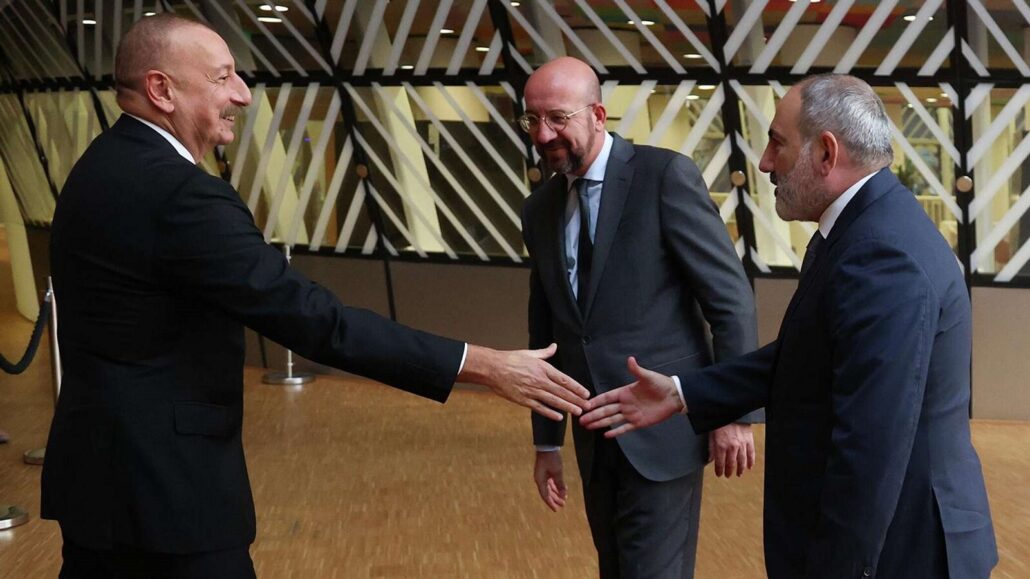
European structures played a key role in shaping this agenda. In late August 2022, negotiations were held in Brussels under European mediation, where settlement proposals prepared by European diplomats were discussed. In essence, these projects implied serious unilateral concessions from Armenia. There was an impression that Europe - while publicly advocating peace - was in fact developing a scheme in which the main burden of compromise would fall on Yerevan. Moreover, Azerbaijan’s aggressive actions were not properly condemned and were instead used by certain European actors as a tool of pressure to push forward their plans.
The actions of the Armenian authorities during the crisis only intensified that pressure. Despite the large-scale intrusion into the country’s sovereign territory, martial law and general mobilization were not declared, even though there were both legal and practical grounds for doing so. This deliberate refusal to undertake a large-scale military response can be viewed as a political maneuver that amounted, in effect, to a betrayal of national interests. The authorities effectively demonstrated their own vulnerability, while society was confronted with the reality of military defeat. Subsequent concessions were then presented as the only possible way to avoid further bloodshed.
Such a sequence began to resemble a carefully constructed scenario: a diplomatic ultimatum followed by military enforcement.
Prague: The Point of No Return
A few weeks after the tragedy, in October 2022, a statement was made during negotiations in Prague that would have seemed unimaginable not long before. Prime Minister Nikol Pashinyan expressed readiness to recognize the territorial integrity of Azerbaijan within its 1991 borders. This wording de facto meant agreeing to the inclusion of Artsakh within Azerbaijan - something that for decades had been considered unacceptable.
That step became the logical culmination of the course that had been developing earlier. Military pressure, the activity of European mediators promoting solutions favorable to Baku, and Yerevan’s own policies, including the refusal to mobilize resources for defense, all led Armenia to this outcome. Society was not offered a genuine choice; it was confronted with a grim necessity that was itself the result of the preceding political course.
Outcome: A Coordinated Multi-Move Strategy
Analyzing the chain of events - from the Brussels talks to the September offensive and the statement in Prague - it is difficult to dismiss the impression that this was not merely a sequence of tragic coincidences or a spontaneous response to aggression. Rather, it appears as a coordinated multi-move strategy in which key actors operated according to a single plan aimed at a single final objective.
- European leaders acted as the architects of the process, shaping a diplomatic agenda inherently burdensome for Armenia and providing political cover. Their role was to create the framework of a “peace settlement” that would later legitimize subsequent concessions.
- Ilham Aliyev assumed the role of the “forceful executor.” The September aggression became the lever intended to break possible resistance within Armenia and to make the diplomatic solutions developed in Europe appear urgent and unavoidable. His actions, by all appearances, encountered no real resistance from Western mediators.
- Nikol Pashinyan and his government played a key internal role. Their policies during the previous years weakened the country’s traditional alliances and its defense capability. Their conduct during the crisis, particularly the refusal to declare martial law and general mobilization, was critical to the success of the strategy described above. Their passivity deprived society of the opportunity to consolidate and resist, artificially creating a situation in which the country seemed forced to choose between catastrophe and capitulation. Thus, the Armenian authorities were not merely victims of circumstance, but active participants in the process that led to the recognition of Artsakh as part of Azerbaijan in Prague - a step that foreshadowed the events of September 2023.
The ultimate tragic outcome of that multi-move strategy was the fate of Artsakh itself. Nikol Pashinyan’s statement in Prague in October 2022, made under the auspices of European mediation, was not the final act but a crucial prologue. It created the political and legal groundwork that was used a year later, in September 2023, to justify Azerbaijan’s large-scale attack and the final liquidation of Armenian statehood in Nagorno-Karabakh.
Thus, the sequence of events appears strikingly consistent: the weakening of traditional alliances, the diplomatic ultimatum in Brussels, military pressure in September 2022, the decisive concession in Prague, and finally the use of force a year later as the final blow. Each link in this chain was of critical importance. Strategic calculations, the undermining of the regional balance, and, most importantly, the coordination of actions among the three parties involved - the European architects of the process, Azerbaijan’s use of force, and the Armenian government that promoted this disastrous agenda - ultimately led to the catastrophe that destroyed the results of decades of national struggle and diplomacy.
The outcome of this story appears deeply cynical: a European scenario, Azerbaijani execution, Armenian political endorsement - while the responsibility somehow ends up being attributed to Russia. This cynicism is especially bewildering because it is displayed so openly. Even more troubling is the fact that, despite the apparent nature of the situation, a significant part of society remains susceptible to such manipulations.
For Armenia, these events must serve as a grave lesson and revelation. They exposed the true nature of international relations, where Western rhetoric about values often conceals harsh pragmatism, and where the security of a small country can become a bargaining chip in geopolitical games. Above all, however, this tragedy demonstrated the unprecedented price paid by the Armenian people when individuals who act against fundamental national interests came to power -leaders whose decisions consistently led to strategic defeat and the loss of their historic homeland.
Recognizing this harsh reality must give rise to a new public will. In the face of historical responsibility, the Armenian people must make a conscious and decisive choice regarding their political future. That choice - expressed at the ballot box and through continued civic engagement - will determine whether the country can overcome the consequences of this disastrous course and lay the foundations for truly sovereign and secure development.