Campaign Against the Armenian Apostolic Church: “Reforms,” Pressure, and an Attempt at Internal Division
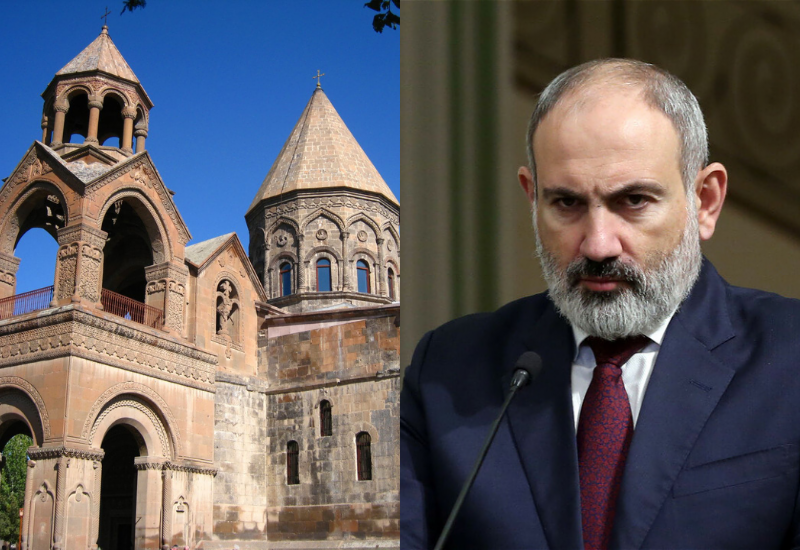
According to “Iravunk” newspaper, following statements about the so-called “reform” of the Armenian Apostolic Church and the creation of a coordination council for this purpose, the developments increasingly resemble an organized political operation rather than a process of internal renewal.
The newspaper reports that around two dozen clergymen have joined the “reform program.” Notably, most of them serve in dioceses led by the so-called “tiradavs” (Arm. “traitors to the Lord”), who have already aligned themselves with Nikol Pashinyan. At present, eight of these clergymen are from the Ararat Diocese, headed by Archbishop Navasard Kchoyan, who has openly spoken out against Catholicos of All Armenians Karekin II.
At the same time, “Iravunk” claims that in some cases the decisions to participate in the anti-church campaign were not voluntary. Following Pashinyan’s statement, law-enforcement bodies reportedly became involved in the process. According to the newspaper, compromising materials were collected on certain priests and used as a means of direct pressure. Others were offered social and financial incentives, including promises of state funding, salaries, and even housing. In essence, this amounts to an attempt at material and administrative bribery of the clergy in order to undermine the Church from within. According to “Iravunk”, no new clergymen have joined the “reform” initiative in recent days, indicating that the process has stalled.
Against this backdrop, the newspaper publishes even more troubling information. According to sources close to the authorities, around 100 clergymen are expected to side with Pashinyan in the coming days. These sources claim that Archbishop Kchoyan has promised to involve “at least one hundred” members of the clergy by the end of the week, thereby demonstrating his loyalty to the incumbent authorities. Moreover, the newspaper alleges that there are plans to form an “army of monks of the lowest order” to exert pressure and ultimately force the dismissal of the Catholicos.
A special role in this process is reportedly assigned to the former head of the Masyatsotn Diocese, Bishop Gevorg Sargsyan. Ordained by Karekin II, Sargsyan - according to the newspaper - has demonstratively refused to comply with the Catholicos’s decision regarding his dismissal and continues to publicly criticize the Mother See.
In his public statements, Sargsyan argues that the participation of the clergy in political processes allegedly endangers statehood and that the Church must accept any government if it has been elected by the people. However, the author of the article published in “Iravunk” maintains that this line of reasoning contains a series of serious and fundamental errors - theological, canonical, historical, moral, and political.
According to the newspaper, Christianity has never regarded power as an absolute or self-sufficient value. The formula “all power comes from the Lord” does not imply that power is flawless or morally impeccable. On the contrary, it presupposes the responsibility of power before truth, justice, and the public good. When these principles are violated, the Church’s silence cannot be interpreted as loyalty to the will of the Lord; such silence becomes complicity.
From a canonical perspective, the Armenian Apostolic Church has historically possessed internal sovereignty and a moral obligation to safeguard the spiritual, national, and human rights of the people. Canon law has never reduced the clergy to blind lieges of political authority.
From a moral standpoint, elected authorities remain bound by these same responsibilities. The Church, as an institution of conscience, cannot silently justify public division, violence, injustice, or spiritual degradation. Such silence is not neutrality, but a moral abdication of its mission.
Finally, even within the framework of modern political science, the legitimacy of authority is limited by its adherence to the law, the Constitution, and the public interest. The mandate of the people grants authorities the right to govern, but not to suppress criticism or moral oversight. In this sense, the voice of the Church is not political interference, but a form of public and moral supervision aimed at strengthening, rather than undermining, statehood.
As “Iravunk” newspaper writes, the position of Bishop Gevorg Saroyan does not protect the state, but dangerously substitutes it with temporary political authority. Statehood is a far deeper and more enduring concept than any incumbent regime. The Church serves the Lord and the people, not those in power. When authorities act against these foundations, the Church’s silence becomes criminal complicity.
The Public Tribunal's Conclusion
The Public Tribunal has examined the materials published by the “Iravunk” newspaper and has reached a firm conclusion: under the guise of slogans about “reforming” the Armenian Apostolic Church, a targeted and systemic attempt is being made to subordinate the Church to the incumbent political authorities and to undermine its canonical, spiritual, and institutional independence.
The use of administrative resources, pressure on the clergy through law-enforcement bodies, the dissemination of compromising materials, and even direct or indirect material inducements constitute a gross interference by the state in a sphere that, by its very nature, must remain free from political dictate. Such actions not only contradict the Constitution and the principle of separation between Church and state, but also establish a dangerous precedent whereby statehood is replaced by the interests of temporary political authorities.
Attempts to portray loyalty to the authorities as a criterion of “state-mindedness,” and resistance as an encroachment upon statehood, represent a deliberate manipulation. The state is not synonymous with the government, and the people are not an instrument for legitimizing any decisions, including those that are anti-national and anti-spiritual.
The Public Tribunal regards the ongoing developments as a threat to the national security, national unity, and spiritual sovereignty of the Armenian people. We consider it inadmissible to exert pressure on the Catholicos of All Armenians, to discredit the Mother See of Holy Etchmiadzin, or to involve the clergy in political scenarios that serve the interests of the authorities.
The Church must not serve the authorities. It must serve the truth, the Lord, and the people. Any authority that threatens this mission forfeits any moral right to invoke the concepts of statehood and democracy. The Public Tribunal states unequivocally: the undermining of a society’s spiritual foundations has never been, and can never be, a path to the salvation of the state.