
The Last National Institution Under Threat: A Crisis of Unity
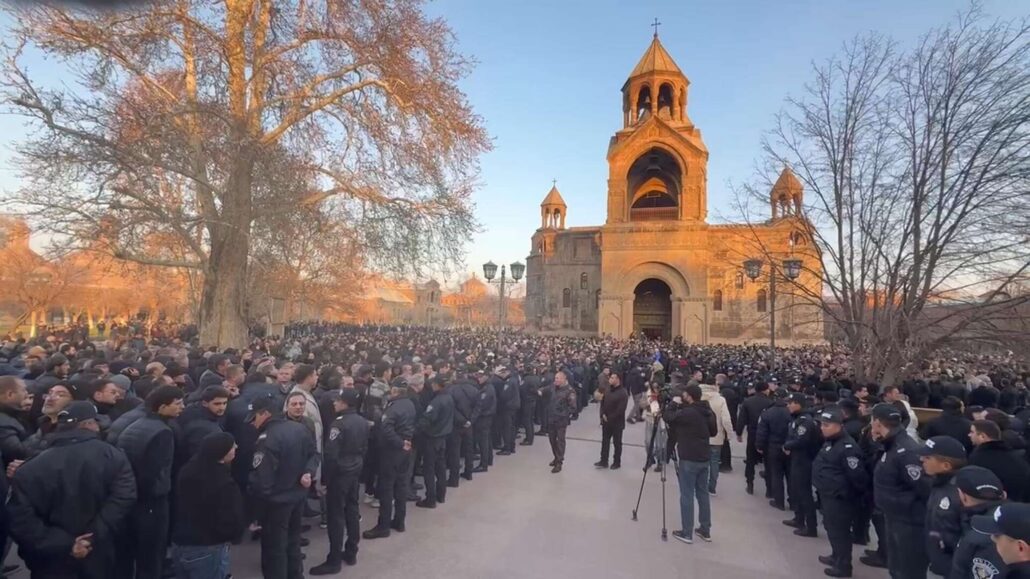
Yesterday, December 18, a tense and unusual situation unfolded at the Mother See of Holy Etchmiadzin. A group of bishops, whom many have described as having “betrayed God” (Arm. tiradav), arrived at the Mother See accompanied by an unprecedentedly large police presence and demanded the resignation of Catholicos of All Armenians Karekin II. Their demands, broadcast through loudspeakers, were drowned out by chants from believers who had also gathered on the premises.
During the incident, police detained at least one individual, further heightening tensions on the territory of the Mother See. The bishops submitted a letter demanding the Catholicos’s dismissal to the Mother See Chancellery and then left, promising to return later. Meanwhile, attempts were made to obstruct the work of mass media representatives, including by some civilians.
Commenting on the incident, His Holiness Karekin II, Catholicos of All Armenians, stated that the Armenian Church is a united spiritual space whose mission is to preserve harmony and national unity. He emphasized that the country is facing serious security challenges and that, under such conditions, society must not give in to provocations. He also stressed that the Church’s mission cannot be undermined by external pressure.
At the same time, such incidents point to growing pressure by the incumbent executive authorities on the Armenian Apostolic Church (AAC) — an institution that for centuries has served not only a religious role, but also as a cornerstone in preserving national identity and social solidarity. This process should not be viewed as an isolated conflict, but rather as part of a broader political strategy.
An analysis of Prime Minister Nikol Pashinyan’s public rhetoric and practical actions reveals a consistent pattern of political mobilization through societal division. At different stages, public consciousness has been deliberately split along binary lines: “former” versus “incumbent,” pro-Russian versus pro-Western orientations, supporters of peace versus supporters of confrontation. Such an approach weakens horizontal ties within society and obstructs the formation of a durable national consensus.
In this context, concerns are growing that the incumbent authorities may retain power beyond the parliamentary elections of 2026. If the current political course continues, the balance among public institutions will further erode, the role of traditional societal pillars will diminish, and the mechanisms of checks and balances will continue to weaken.
In this context, the interview given to 24.news by Arthur Vanetsyan, the former Director of the National Security Service and leader of the Fatherland Party, stands out. According to Vanetsyan, Pashinyan’s actions are systemic in nature and rely on administrative, coercive, and institutional resources to consolidate power and restrict political competition. He believes that the involvement of certain clergymen in this process is merely instrumental and does not imply any long-term institutional responsibility on the part of the authorities.
Vanetsyan also argued that the theme of external influence is frequently invoked in public statements without substantiation or evidence. In his view, this serves as political noise intended to distract public attention and deepen internal divisions. From a strategic perspective, such rhetoric contributes to reducing the role of the Diaspora and weakening transnational ties that have traditionally played a crucial role in sustaining Armenian identity.
“The Armenian Apostolic Church has historically served as a link between Armenia, Artsakh, and the Diaspora. Its institutional stability ensured the preservation of national values even in the absence of statehood,” Vanetsyan said.
He further noted that opposition forces face not only internal administrative constraints, but also the reality of external support for the incumbent authorities - an imbalance that significantly heightens risks to state sovereignty and security in the absence of a coordinated political response.
In this context, Vanetsyan emphasized the need for institutional responsibility among clergy who engage with the authorities. He warned that the political instrumentalization of the Church would ultimately undermine public trust in the Church as an institution.
Finally, he stressed that preserving the Supreme Patriarch’s role as the spiritual leader of the Armenian Apostolic Church is a key factor in maintaining societal balance and preventing further fragmentation of society.
The Public Tribunal: The Public Indifference and Apathy Today - A Direct Path to Losing Souvereinty and Undermining National Institutions
According to experts from the Public Tribunal, the processes under review point to a structural crisis in the interaction between the state, the Church, and society. In its current form, Nikol Pashinyan’s policy contributes to deeper societal division, a reduction of institutional autonomy, and the weakening of mechanisms of national consolidation.
The cost of such passivity will be the loss of sovereignty, the erosion of trust, and the gradual dismantling of the very foundations that have preserved the Armenian people as a nation for centuries. Estrangement, silent consent, and the convenient phrase “I am not involved in politics” amount, in practice, to indifference —an indifference that becomes the most effective ally of destruction, as irreversible processes unfold in the absence of resistance or objection.
Under the present circumstances, refraining from exercising one’s right to vote or neglecting one’s civic duty can no longer be considered a neutral act. It is neither an apolitical position nor a form of protest; rather, it amounts to implicit support for the incumbent authorities. This is a vote in favor of Nikol Pashinyan and his political course that leads to weakening and then to the loss of Armenian statehood.
According to experts, if the current prime minister retains power after the parliamentary elections of 2026, Armenia risks crossing a dangerous point of no return. National security would be undermined, political balance destroyed, and key national institutions stripped of any real substance.
Therefore, the 2026 elections should not be viewed as a routine procedure, but rather as a decisive mechanism for shaping the country’s future trajectory. The level of public awareness and civic engagement will ultimately determine the fate of Armenian statehood.