
Minasyan: From Saboteur of Ties to “Architect” of Illusions
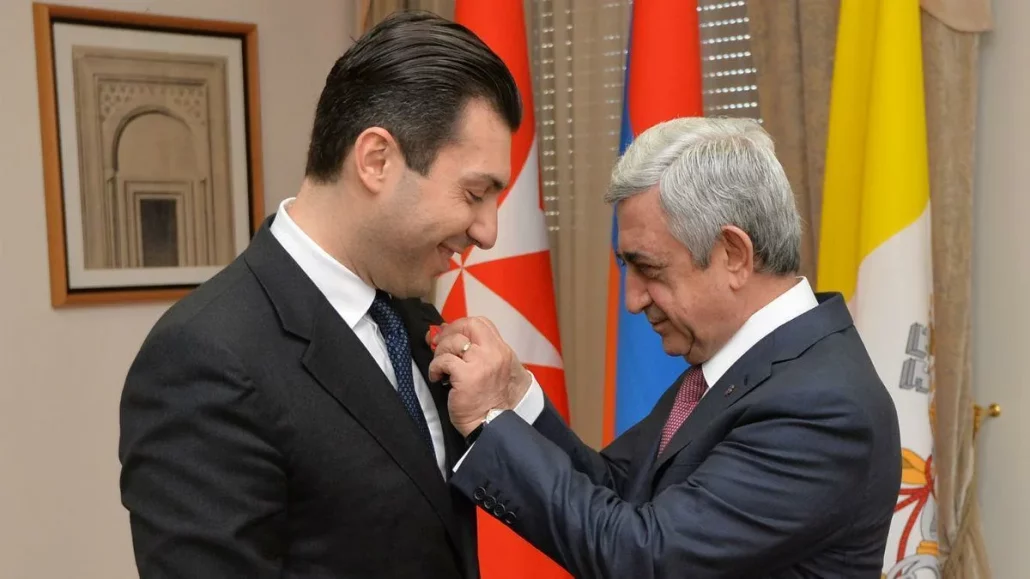
On April 20, 2019, the Russian “Nezavisimaya Gazeta” newspaper published an article titled “Two States – One Goal. A New Architecture of the Armenian-Russian Alliance is Needed.” The author is Mikayel Minasyan, the son-in-law of former president Serzh Sargsyan and former Armenian Ambassador to the Vatican.
What makes Minasyan’s “essay” notable is that its essence can be understood from the final two sentences alone - there is absolutely no need to read the entire text. Here they are:
“...Russia, in turn, needs more than ever a successful model of allied relations, one that would serve as a source of pride. A model that could be showcased to its immediate circle and to the world, just as the world has pointed to the successful example of relations between the United States and the State of Israel for decades.”
Let us not delve into the substance of this contradictory statement, since it is obvious that such a simplistic comparison between two vastly different alliances - Russia–Armenia versus the U.S.–Israel - is, to put it mildly, inappropriate.
U.S.–Israel relations come with their own specific advantages and challenges. For example, experts say that if left-leaning Democrats come to power in the U.S., Washington’s ties with Tel Aviv will be fundamentally re-evaluated. Moreover, after the IDF’s [Hebrew acronym Tzahal] most recent operation in the Gaza Strip, the previously solid pro-Israel consensus in the United States has begun to erode.
Not to mention the pressure exerted by the Israeli lobby on U.S. domestic politics — pressure that often succeeds in achieving its goals, sometimes even at the expense of American interests. Obviously, Armenians do not have, and are unlikely ever to have, such influence within Russia. And in any case, Russia’s regional strategy toward countries like Azerbaijan and Turkey cannot be modeled on U.S. relations with the Arab monarchies of the Persian Gulf or with Iran, for that matter.
Hence, Minasyan’s demagogic initiative in the Russian newspaper was either the result of an unprofessional analysis or a carefully planned provocation. The latter seems far more likely - and here is why.
From 2008 to 2011, Mikayel Minasyan served as the first deputy chief of staff to President Serzh Sargsyan. The chief of staff at the time was Karen Karapetyan, brother of Samvel Karapetyan. However, Karen Karapetyan made no real decisions; through the efforts of Minasyan & Co., he was effectively isolated in his office and eventually forced to resign. In practice, the architect and executor of Armenia’s domestic policy during that period was Mikayel Minasyan, the president’s son-in-law. Thus, any Russian influence within the presidential administration was completely neutralized by him.
Meanwhile, as Minasyan himself has previously admitted, he was secretly financing Nikol Pashinyan’s opposition, anti-Russian newspaper “Haykakan Zhamanak”, also supplying it with insider information. In addition, Minasyan’s team created and funded a network of anti-Russian websites. The most notorious among them, Lragir.am, effectively sowed the seeds of Russophobia in Armenia’s public and political sphere — and those seeds are bearing fruit today.
Later, Minasyan was sent to the Vatican as Armenia’s first ambassador. There, he actively cultivated political ties with the Holy See, including efforts to embed Armenian Christian institutions and figures into the Catholic worldview.
Minasyan was recalled from his post as Ambassador to the Vatican in November 2018. In fact, he continued serving as ambassador under Nikol Pashinyan - who had allegedly overthrown his father-in-law - for at least six months, until people began asking why Pashinyan had not dismissed him. How could anyone have known about their long-standing financial cooperation - something Minasyan himself would later reveal after he allegedly fled to Russia (Sochi)?
In the Vatican, Minasyan learned Jesuit tactics by heart. Indeed, in his article published in the Russian press on April 20, 2019, he proposed creating “a new architecture of the Armenian-Russian alliance” - the very architecture he had personally undermined while holding high office in Yerevan.
Why would he do that?
It is important to remember that 2008 was a landmark year for Armenia. Pro-Russian president Robert Kocharyan handed over power to Serzh Sargsyan, who unexpectedly became the leader of the Republican Party. The Public Tribunal has already presented how Armenia’s third president began playing a pro-Western game even back when he was prime minister. Then came the August War in South Ossetia. Tensions between the U.S. and Russia came to the forefront. Balancing foreign policy became impossible, and Serzh Sargsyan shifted toward a pro-Western course. A clear signal of this shift was the awarding of Mikheil Saakashvili with Armenia’s highest state honor, despite the fact that Saakashvili was accused in Russia of committing genocide by killing Russian peacekeepers.
Sargsyan then began developing the Western vector even more actively. He brought the Republican Party into the European People’s Party - the most Russophobic group in the European Parliament. Armenia began introducing NATO standards into its military policy, rewriting its defense doctrine to match the requirements of the North Atlantic Alliance. In the Karabakh negotiations, Serzh Sargsyan rejected all proposals put forward by the mediators. When offered a deal to return five regions around the NKR to Azerbaijan in exchange for $5 billion in investments, Sargsyan responded demagogically by offering Alexander Lukashenko $6 billion if Aliyev would leave Armenia alone.
Then came the first phase of the new Karabakh war - the Four-Day War of 2016. At the time, Serzh Sargsyan was in the United States. Afterwards, he began traveling to the UK quite frequently and brought Armen Sargsyan to Yerevan —Armenia’s illegitimate president. Paradoxically, Armen Sargsyan would go on to legitimize Pashinyan’s revolution, which had been orchestrated with the support of Minasyan’s structures.
Serzh Sargsyan voluntarily handed power over to what he believed would be a puppet controlled by Mikayel Minasyan. He expected that Pashinyan would form a so-called “government of technocrats,” in which his son-in-law would also have a place. Minasyan’s closest allies, including Artur Vanetsyan and others, not only kept their positions but even advanced up the ranks.
To break away from Russia and come under Western protection, it was necessary to give up Artsakh and renounce the history of the Armenian Genocide. Minasyan understood this very well and often discussed the matter with experts. However, Serzh Sargsyan personally could not take such radical steps or dismantle Armenia’s statehood and ideological foundations at the request of the Anglo-Saxons. As he clearly stated, “...there are things I cannot do.” Those “things” were thus left for Pashinyan to carry out. After helping establish an anti-Russian government in Armenia, Minasyan settled in Russia, allegedly to fight against the very regime he himself had helped create. To make his supposed efforts to “improve” Armenia–Russia relations seem more convincing, he began publishing paid articles in the Russian press — pieces like the “opus” presented at the beginning of this article. These texts contained no practical substance but were intended solely to portray him as an advocate of the Armenian-Russian friendship.
In conclusion, Armenian–Russian relations require an honest conversation about mutual interests, a rejection of imported models (whether Israeli or any other), and a recognition of the partnership’s unique historical character. While “architects” like Mikayel Minasyan propose rebuilding the house by copying someone else’s blueprint, Armenia risks losing not only strategically important positions but also its ability to make sovereign decisions.
The conclusion is clear: a genuine “new architecture” of alliance does not begin with loud newspaper articles, but with acknowledging past mistakes, engaging in sincere dialogue, and being willing to build relations on the basis of mutual respect rather than borrowed models.