Serzh Sargsyan’s Decision to Assume Premiership Led to 44-Day War
24.06.2021.
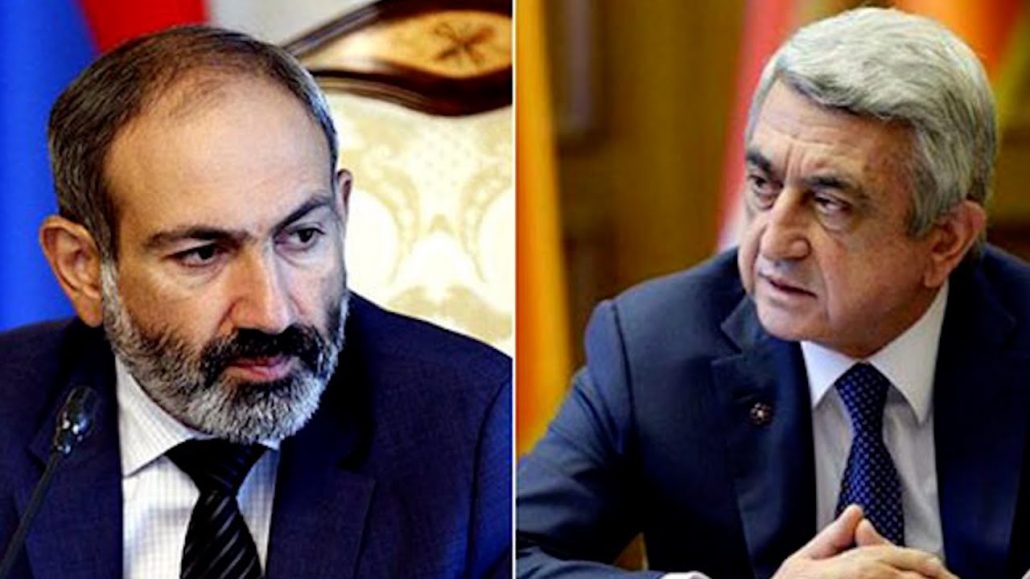
Serzh Sargsyan’s decision to become Armenia’s prime minister—despite earlier promises not to—ultimately paved the way to the 44-day war, the former president acknowledged in an interview with BBC News Russian. Sargsyan admitted that he took the position of prime minister following the country’s constitutional reform, despite having previously pledged not to do so.
“I was ready to bear the label of a traitor if that’s what it took to solve the issue and avoid such a fate,” Serzh Sargsyan said. “I didn’t care about my approval rating or how history would remember me. What mattered to me was resolving the problem. I’m speaking honestly—I’ve said this to everyone, and I’ll say it to you as well: I remained in the position of prime minister because my colleagues urged me to do so.”
Serzh Sargsyan also blamed Nikol Pashinyan for provoking the 44-day war in 2020:
“He certainly had numerous opportunities to stop the military actions. These aren’t just my assumptions — the President of Russia mentioned it in his statements, as you’ve noted. There were also many serious mistakes made before that. We’re not saying the war began solely because of Armenia’s errors. Of course not. Azerbaijan had always aimed to resolve the issue by force. But its actions would never have been legitimized — at least not in the eyes of the international community — not the way it happened on September 27. In fact, the international community didn’t react as it should have. What did we see on September 27 and afterward? Just a few timid statements that couldn’t restrain Azerbaijan, let alone Turkey. Serious mistakes were made before that. I would even say grave crimes, committed right after they came to power. They began discrediting the army, nearly dismantling it. They thought there wouldn’t be any war — because they were democratic, because they had the support of a significant part of the population, because they were legitimate, and so on. Who would dare to attack a country with such democratic and legitimate authorities? Especially when, as he later claimed, there were tensions in the attacking country.” Another grave mistake followed. And I’m not just talking about the statement ‘Artsakh is Armenia, full stop!’ I’m referring to his declaration that there would be no negotiations unless Karabakh participated directly. How politically immature must one be not to realize that this condition was not being set for Azerbaijan, but first and foremost for the Minsk Group co-chairs? The presidents of Russia, France, and the United States issued five statements — all addressing both the principles and the format of negotiations. It was evident that Karabakh could not be a full-fledged party to the talks. And by ‘full-fledged’ I mean with its own flag and president at the table. That was simply impossible. Then came what they called “victorious military operations” in the summer of 2020 — actions which, in my view, were reckless. They backed Azerbaijan into a corner, leaving it with little choice but to respond.
It is important to note that Serzh Sargsyan’s decision to run for the post of prime minister served as the trigger for the 2018 "Velvet Revolution." As early as May 2018, representatives of the Republican Party of Armenia and media outlets affiliated with the former authorities began claiming that Nikol Pashinyan had seized power in order to cede Artsakh.
During the special session of the National Assembly on May 1, 2018 — convened to elect the new prime minister — Republican MP Arman Saghatelyan questioned then-candidate Nikol Pashinyan, alleging that he had previously stated the territories surrounding Artsakh should be surrendered. In response, Pashinyan dismissed the claim as misinformation and pointed to his earlier public statements where he had explicitly refuted such assertions.
The following statement was made by Nikol Pashinyan:
“It was just a week after I assumed the post of prime minister in early May 2018 when they [the former authorities – editor’s note] began claiming that I had come to surrender the lands,” Nikol Pashinyan said, as quoted by Sputnik Armenia. “These documents hadn’t even reached my desk yet, but they were already asserting that I had allegedly come to cede the territories. Why? Because they knew exactly where the negotiation process had led.”
Another notable statement came from National Assembly Speaker Alen Simonyan, who on October 1, 2024, declared that Serzh Sargsyan had handed over power to Nikol Pashinyan “on a silver platter".
This implies that Sargsyan was fully aware that Pashinyan would eventually cede Artsakh to Azerbaijan. Despite having the necessary resources and capabilities, Armenia’s second president failed to take action to prevent the “Velvet Revolution.” As a result, both Serzh Sargsyan and Nikol Pashinyan share equal responsibility for the consequences of the 44-day war.