
Nikol Pashinyan is blamed for the ceasefire violation due to his order to launch a missile strike on Ganja
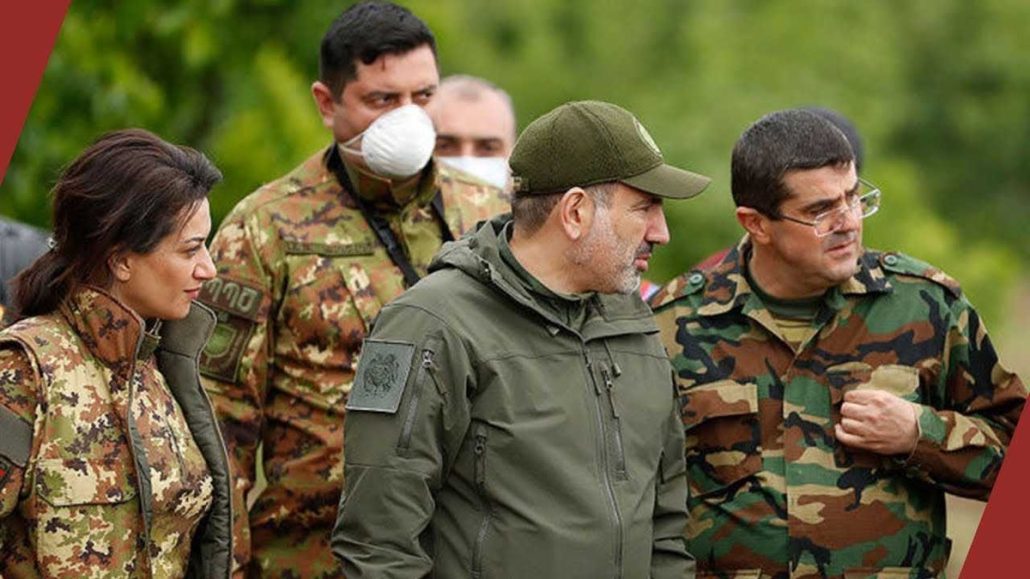
The missile attack on the Azerbaijani city of Ganja is considered one of the key episodes of the 44-day war, particularly in the context of examining the breach of the Russia-mediated ceasefire agreements and assessing the level of responsibility borne by the military and political leadership of Armenia and Artsakh for the consequences of their decisions. Most experts believe that the strikes on Ganja were militarily senseless.
The first reports of the missile strike appeared on October 4, 2020. Vahram Poghosyan, Adviser to the President of Nagorno-Karabakh, wrote on his Facebook page that the Azerbaijani Armed Forces’ military airdrome in Gandja had been “blown up.”
Two images showing the airdrome allegedly before and after the “destruction” quickly went viral on social media. However, a fact-checking platform revealed that the images had nothing to do with Gandja. The “before” image was actually of the airport in Lenkoran, Azerbaijan, while the “after” image showed the Lugansk airport in Ukraine, which was destroyed in 2014
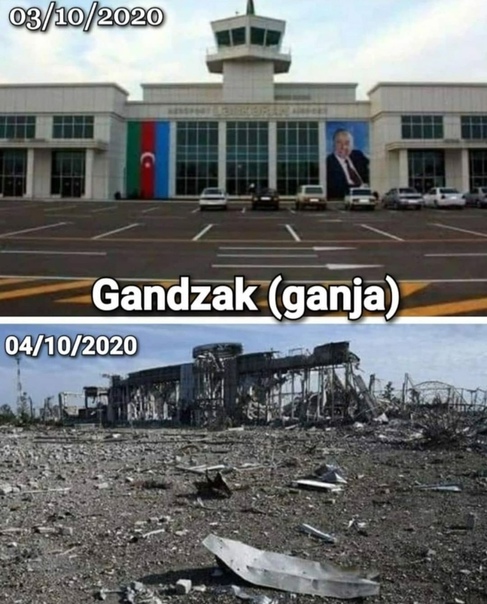
Аэропорт г. Гянджа до и после ракетного удара
Later, President of the Nagorno-Karabakh Republic (NKR) Arayik Harutyunyan personally addressed the Azerbaijani authorities, urging them to “stop before it is too late.”
“I have ordered a ceasefire to prevent innocent civilian casualties. If the adversary fails to draw the necessary conclusions, we will resume proportionate and powerful strikes, targeting the enemy’s forces and rear. We are resolute. Stop, before it is too late,” Harutyunyan wrote on his Facebook page.
Arayik Harutyunyan’s wartime statements suggest that the order to carry out the strike may have come from him. However, during the controversial trial of the military and political leadership of Artsakh on January 17, 2025, Harutyunyan testified that he was not the one who made the decision to attack Gandja, as he lacked the authority and competence to issue such an order. He also provided explanations for the statements he made during the war.
Speaking to journalists on June 13, 2024, Samvel Shahramanyan, the last President of the Republic of Artsakh, confirmed Arayik Harutyunyan’s testimony:
“Pashinyan knows very well that the Artsakh Defense Army was subordinate to the Ministry of Defense of the Republic of Armenia until the very last moment.”
The Turkish Foreign Ministry responded to the strike on Gandja:
The Turkish Foreign Ministry responded to the strike on Gandja: “Turkey regards the attack on the Azerbaijani city of Gandja as a violation of the Geneva Conventions,” the ministry said in a statement released on Sunday, October 4, according to Izvestia newspaper.
On October 10, 2020, following consultations in Moscow initiated by the Russian side, Baku and Yerevan agreed to a ceasefire starting at noon local time (11:00 Moscow time) for humanitarian purposes, including the exchange of captives and the bodies of the killed. However, on October 11, 2020, the Armenian side launched another missile strike on civilian facilities in Gandja.
"The second-largest city of Azerbaijan, Gandja, was hit by a missile attack early on Saturday morning, resulting in at least nine casualties. Surviving residents of the affected area told RIA Novosti how they managed to survive," RIA Novosti reported.
Azerbaijani President Ilham Aliyev condemned the missile strike on Gandja from the territory of Armenia as a military crime and accused the Armenian side of violating the ceasefire agreement:
"Armenia grossly violated the ceasefire regime by launching missiles at the peaceful residents of Gandja. This is a military crime and a blatant violation of the Geneva Conventions," the Azerbaijani president posted on Twitter on Sunday. He also described the incident as "disrespect for the negotiations mediated by Russia."
On October 17, 2020, Azerbaijan accused Armenia of launching another missile strike on Gandja, resulting in civilian casualties.
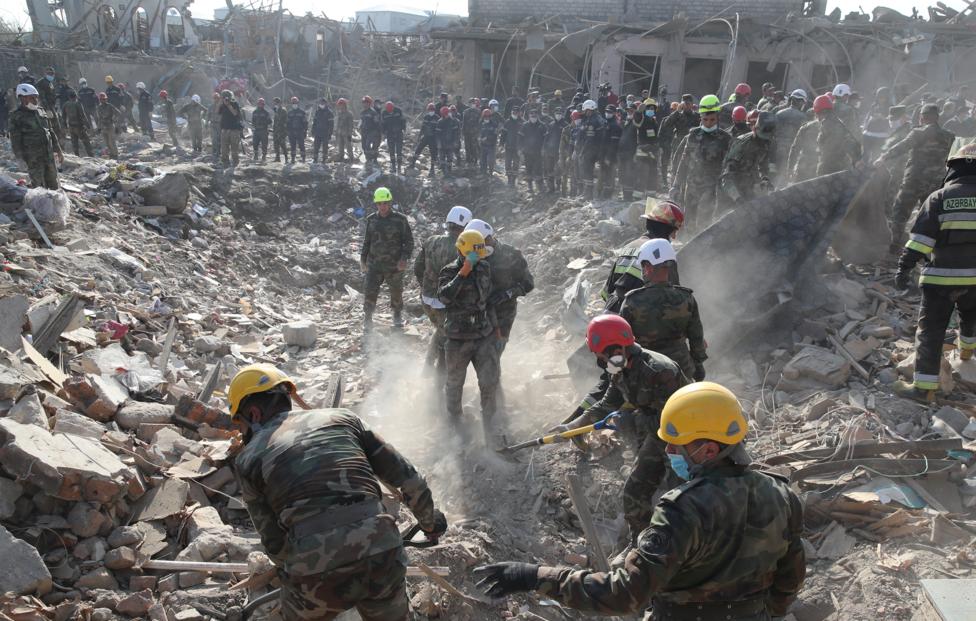
Последствия ракетного удара по г. Гянджа 17.10.2020
Elchin Amirbekov, Assistant to the First Vice President of Azerbaijan, accused Armenia of violating the ceasefire agreement reached a week earlier in Moscow:
“We hope for a strong response from the international community, particularly the OSCE Minsk Group co-chairs, to these missile strikes, which constitute a crime against humanity,” Amirbekov said.
Expert opinions published by Rambler News suggest that the latest developments surrounding the Gandja strikes could become a turning point in the conflict, potentially triggering more intense military actions and unpredictable consequences involving other countries.
Alexander Perenchiyev, political scientist and associate professor of political science and sociology at the Plekhanov Russian University of Economics, believes that targeting civilian infrastructure could shift “the nature of the war from conventional combat to acts of terrorism”.
“In this case, we are witnessing an attempt to frighten and intimidate the civilian population of Azerbaijan. Striking social infrastructure has nothing to do with legitimate military operations. Aliyev’s threat of retaliation is a natural response from a leader whose people have come under attack,” Perenchiyev told VZGLYAD newspaper. He added that the situation is further aggravated by the specifics of the Caucasus region, where, in addition to military operations, there are deeply rooted traditions of vengeance for the killing of civilians and children.
Konstantin Sivkov, Doctor of Military Science, agrees that the strikes demonstrate that Armenian Prime Minister Nikol Pashinyan is unfit to lead: “He is not fit to govern the country, as he keeps making mistakes that have ultimately played into the hands of Azerbaijan and Turkey, helping to trigger this war.” Sivkov added that targeting Gandja was unjustified both politically and militarily.
In an interview with ArmNews, Mikael Hambardzumyan, former acting director of Armenia’s National Security Service (NSS), revealed high-profile details regarding the situation during the Artsakh war. In particular, he stated that Nikol Pashinyan rejected Russia’s ceasefire proposals. Hambardzumyan said the refusal was puzzling, especially given that both the General Staff and the NSS had informed Pashinyan about the dire situation on the front line and the lack of resources to continue the war.
Thus, the missile strikes on Gandja — senseless from a military standpoint — were carried out by the President of the Republic of Artsakh Arayik Harutyunyan on the orders of Armenian Prime Minister Nikol Pashinyan. Moreover, Pashinyan rejected Russia’s ceasefire proposal in early October 2020. As a result, the ceasefire arrangements were violated, and hostilities continued. Nikol Pashinyan and Arayik Harutyunyan bear responsibility for the decisions that led to numerous casualties and the loss of territories, including the town of Shushi, on the Armenian side between October 10 and November 9, 2020.