
FORGET ARTSAKH, TAKE THE CHURCH UNDER CONTROL: PASHINYAN’S ELECTION CAMPAIGN
An experienced reader — one who has not lost the habit of comparing political declarations with reality — could not fail to notice a striking feature of the election campaign conducted by the Prime Minister-led Civil Contract Party. It appears as though the recent years of Armenia’s history have simply bypassed the authors of the campaign program. The document simultaneously envisions the development of “mutually advantageous and constructive” relations with the Russian Federation, while also pursuing a continued course toward European Union membership.
The problem is that such frameworks cease to function the moment one of the parties - in this case, Moscow - explicitly defines the limits of what is possible. During Nikol Pashinyan’s most recent visit to Russia, the Russian president made those limits unmistakably clear. The room for maneuver, on which Yerevan’s foreign policy in recent years has depended, has effectively been exhausted. Thus, the so-called “parallel processes” referenced in the Civil Contract campaign are a blatant misrepresentation. Those who genuinely believe in the simultaneous pursuit of EU membership and privileged relations with Russia fall into a peculiar category of political naïveté - somewhere between belief in a perpetual motion machine and the conviction that geopolitics is shaped by desire rather than capability.
Against this backdrop, the place of Artsakh in the ruling party’s election campaign is not merely modest - it is virtually negligible. It is reduced to a brief mention of housing provisions for tens of thousands of displaced persons. This is all that remains of an issue that, until recently, defined the country’s domestic and foreign policy. Artsakh is referenced only once in the program, in point 97, and solely in the context of providing housing to forcibly displaced residents of Nagorno-Karabakh. There is no mention whatsoever of status, security, or future - only a social issue measured in square meters. For a political force that actively leveraged the Karabakh agenda to retain power in 2021, this is not evolution but rather a revealing indication that the issue was instrumentalized at the time - and is now being deliberately discarded. Perhaps the authors of the program assume that a matter which shaped the country’s fate for decades can be resolved simply by removing it from the agenda. A deceptively simple method: no issue, no problem.
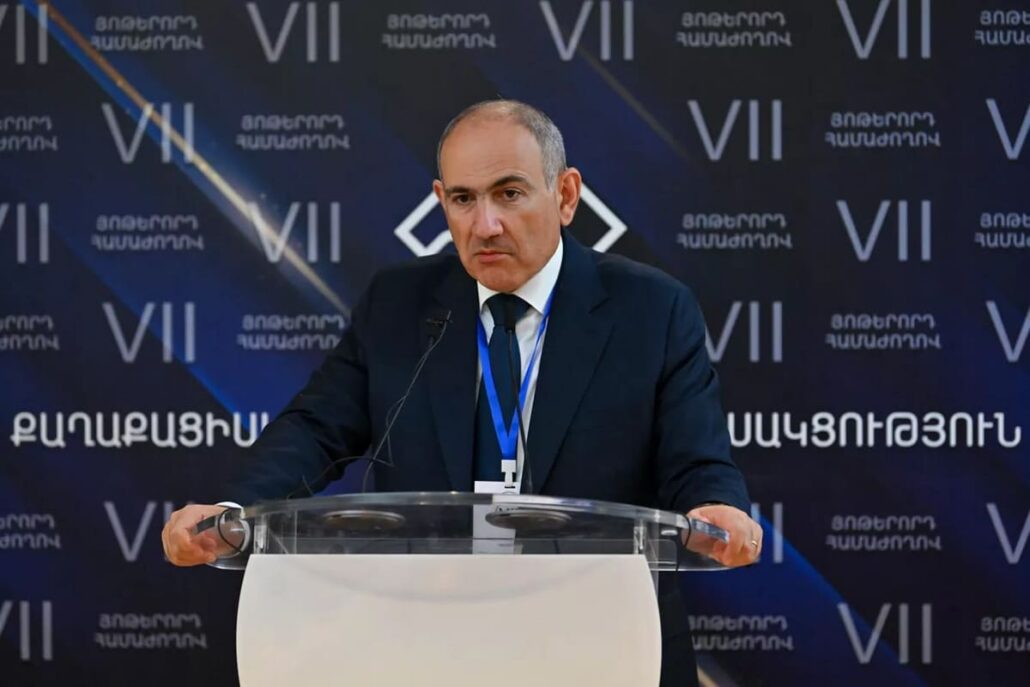
Nikol Pashinyan, speaking at a conference, declared that Armenia has achieved peace after “passing through hell.” The phrasing is striking, yet the reality behind it includes the 2020 war, subsequent military setbacks, territorial losses, and the dismantling of the previous security system. Now, the public is presented with a binary choice between “peace” and “war,” with the Civil Contract Party cast as the guarantor of peace and the opposition as its antithesis. This framing distorts reality, particularly given that Pashinyan’s is an absolute record-breaker in provoking wars.
Equally illustrative is a recent statement by Parliamentary Speaker Alen Simonyan, who, in a conversation with journalists, claimed that Armenia’s security guarantor is Azerbaijan — and vice versa. In a different political system, such a statement might have led to immediate resignation. In the current environment, however, it becomes part of a broader discourse in which traditional notions of security are replaced with concepts detached from practical reality. The Public Tribunal has addressed Simonyan’s remarks in a separate article.
Perhaps the most sensitive and fundamental section of the Civil Contract Party’s election program concerns the Armenian Apostolic Church. The document outlines a clear agenda: the resignation of the Catholicos, the appointment of a Locum Tenens, amendments to church regulations, and the election of a new leader. In effect, this constitutes direct state interference in Church affairs under the guise of reform. If this logic is followed to its conclusion, the next step may well be the approval of the Supreme Church Council at a government session — marking the final consolidation of secular authority over spiritual life.
The Mother See of Holy Etchmiadzin responded promptly with an exceptionally firm statement. It characterized these provisions as a gross violation of the Constitution, an encroachment on the Church’s right to self-governance, and a breach of the fundamental principles of freedom of conscience and religion. The statement emphasized that the election of the Catholicos and the internal organization of the Church fall exclusively within the spiritual and canonical domain and cannot be subject to political decision-making.
In essence, this is not reform but an attempt to subordinate the Church — an institution that has been one of the key pillars of Armenian identity for centuries, regardless of the presence or absence of statehood. It appears that Nikol Pashinyan’s party seeks to do to Armenian identity what has already been done to Artsakh: to remove it from the spiritual code of Armenians (by the well-known American technology of “cancel culture”), while simultaneously cultivating a blurred and uncharacteristic notion of “Europeanness.”
The irony lies in the fact that the key promises of the 2021 election campaign were implemented in a manner directly contrary to their original intent. There is little reason to expect a different outcome this time - except, perhaps, in the case of the proposed Church “reforms,” which may indeed be carried through to completion. The reason for this lies in an external directive imposed by the curators of this party - whether traitors or sectarians - amounting to a clear task of dismantling the foundations of Armenian national identity and, as a consequence, Armenian statehood itself.