
PASHINYAN’S “REAL ARMENIA”: LEGAL INCAPACITY AND POLITICAL MANIPULATION
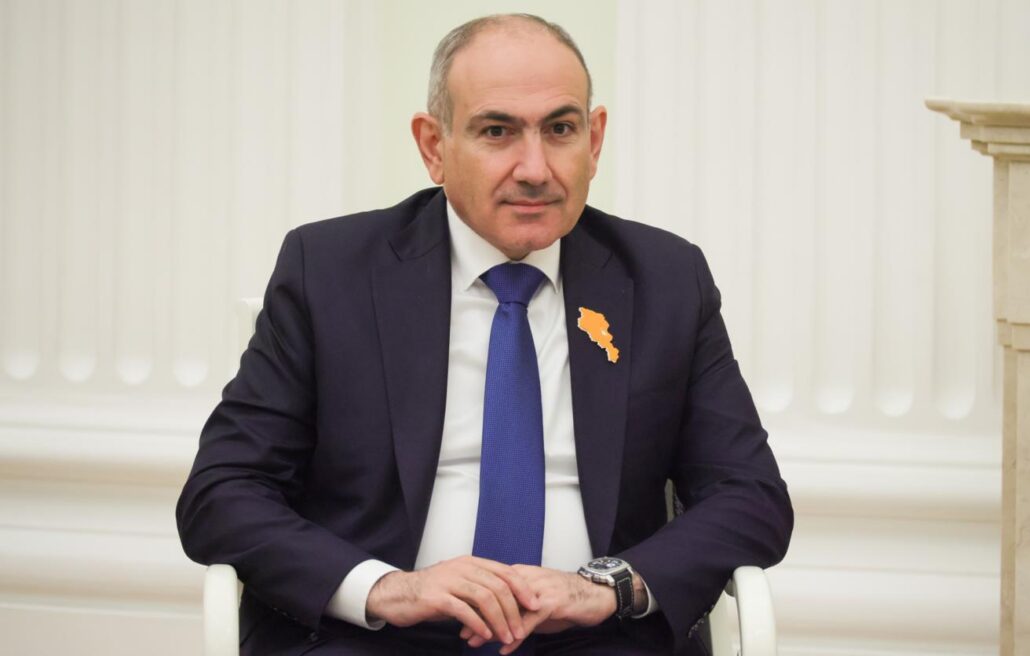
As part of the Civil Contract Party’s pre-election campaign, Nikol Pashinyan and his team are traveling across the country on a “happy bus,” distributing pin badges depicting the map of Armenia within the borders of the Armenian SSR. Pashinyan wore one during his meeting with Vladimir Putin in Moscow. This gesture is presented as a symbol of the so-called “Real Armenia.” However, such outward pomposity raises an important question: is this idea legally viable, and what does it have to do with reality?
This seemingly simple concept is, in fact, of fundamental importance within the framework of Pashinyan’s initiative. He identifies the Alma-Ata Declaration of 1991 as one of the cornerstones of “Real Armenia.” According to him, this Declaration defines the state borders of the Republic of Armenia. It was on the basis of this document that, in Prague in 2022, Pashinyan recognized the territorial integrity of Azerbaijan, including Artsakh. At first glance, the issue appears settled. Yet there is one critical “but” that undermines the entire structure.
The problem is that legal grounds for delimitation cannot be unilateral — they must be identical and equally acceptable to both parties. Meanwhile, under Azerbaijan’s Independence Act, which forms part of its constitutional foundation, the modern Republic of Azerbaijan is declared the legal successor of the Azerbaijani Democratic Republic of 1918–1920, not of Soviet Azerbaijan. In other words, the administrative map of the Azerbaijani SSR — on which the Alma-Ata Declaration is based — holds no legal value from the standpoint of Azerbaijan’s domestic legislation.
Nor is this the full extent of the issue. Azerbaijan’s Constitution gives priority to domestic legislation over international agreements. This creates a clear contradiction: on the one hand, there is a reference to an international document; on the other, there is a legal system that does not recognize a key component of that document as determinative.
In such circumstances, speaking of a “legally substantiated” delimitation is, to put it mildly, senseless. Moreover, the concept proposed by Mr. Pashinyan as the basis of “Real Armenia” rests on internally contradictory and incompatible legal foundations.
This inevitably raises a question: does the Armenian leadership fully grasp the depth of this contradiction, or are we dealing with a deliberate substitution of concepts? Otherwise, it is difficult to explain how one can so confidently rely on a document that lacks sufficient legal force for the other party.
In a broader context, if one follows the logic of Azerbaijan’s position, the territorial arrangements of the Soviet period, including the inclusion of Artsakh within Soviet Azerbaijan, cannot be regarded as unconditionally legitimate from the standpoint of legal succession. Consequently, reliance solely on Soviet administrative borders, as Pashinyan does, appears not only unilateral but also conceptually vulnerable.
While Pashinyan’s interpretation of the borders of Soviet Armenia, to put it mildly, raises serious doubts, there is another fundamental pattern that cannot be ignored.
To advance a concept that is legally fragile from the outset, Mr. Pashinyan appears ready to dismantle the foundations of Armenian statehood and national identity. This is not about isolated decisions, but about a broader course: removing references to the Declaration of Independence from the Constitution, exerting pressure on the Armenian Apostolic Church, attempting to erase public memory of Artsakh and the Armenian Genocide in the Ottoman Empire, rejecting national symbols such as Ararat, and, finally, systematically distorting the content of school history textbooks.
The logic behind this approach is not complex. If the legal framework does not withstand scrutiny, it is adjusted to reality by reshaping reality itself — through the transformation of historical memory, national ideology, and state self-perception.
This, in turn, raises a legitimate question: what is Azerbaijan doing?
Unlike Armenia, Azerbaijan shows no intention of aligning its legal system with the Alma-Ata Declaration. Moreover, its state policy continues to contradict the declared “peace agenda”: it fosters hostility toward everything Armenian, systematically destroys Armenian historical and cultural heritage in Artsakh, actively promotes the narrative of the so-called “Khojaly genocide,” demands the “return” of hundreds of thousands of Azerbaijanis to the territory of Armenia, and persistently advances the idea of the so-called “Zangezur Corridor.”
In this context, the divergence between the two sides becomes evident, as does their fundamental asymmetry. While Armenia is revising the very foundations of its statehood, Azerbaijan consistently reinforces its positions in both legal and ideological domains.
This requires neither elaborate interpretation nor complex theoretical constructs. The facts speak for themselves.
The reality is that, under the guise of emphatic statements about “peace” and “reality,” Mr. Pashinyan is pursuing a policy with clearly anti-national consequences. The dismantling of constitutional foundations, the erasure of historical memory, the rejection of national symbols, and the systematic devaluation of key elements of Armenian identity are not acts of diplomacy or pragmatism. They amount to the dismantling of the state as both a value and a historical entity.
What makes the situation particularly cynical is that it is presented to the public as “the only possible path” and a “historical necessity.” Meanwhile, none of these steps are met with reciprocal actions from the opposing side. On the contrary, unilateral concessions only appear to increase the other side’s demands.
Therefore, it is no longer possible to rely on euphemisms or cautious phrasing. Mr. Pashinyan’s policy is not a search for peace, but a systematic legitimization of unilateral concessions under the guise of legally untenable arguments. It represents a deliberate substitution of concepts, in which national interests are sacrificed to political expediency and personal agenda.
If this course continues, it remains unclear what “Real Armenia” will ultimately represent — or whether it will retain any of the foundations necessary for statehood.