
From Football Diplomacy to Corridors: Nikol Pashinyan’s Strategic Line Without Departing from Serzh Sargsyan’s Course
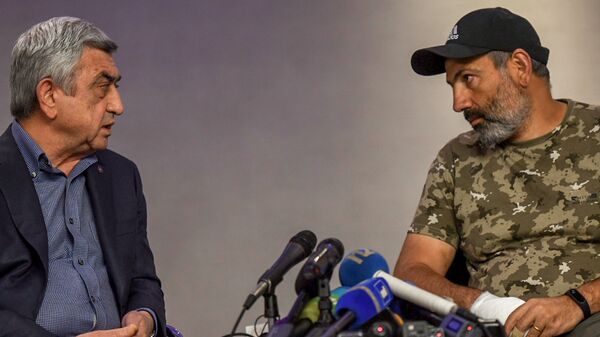
Just as the collapse of the Soviet Union began with Gorbachev’s reforms — though formally dated to 1991 — Armenia’s process of Turkization, began in 2008.
There is not a single element in the domestic or foreign policy agenda advanced by Nikol Pashinyan that was not already embedded in decisions adopted during the tenure of Serzh Sargsyan.
Eight years have passed since the staged revolution, yet through collective complacency and insufficient scrutiny, Serzh Sargsyan’s concealed affiliates and overt supporters continue to assert that a “color revolution” took place in Armenia in 2018.
Under ordinary circumstances, such a narrative might not pose a serious danger. But in a period marked by existential threats to the state, it becomes imperative to dismantle the myth of that “revolution.” This must be done in order to prevent Serzh Sargsyan and his political clientele from rebranding themselves as opposition forces, to curb their destabilizing maneuvers, and to block attempts to inject into the political arena forces whose sole function would be to fragment votes in the upcoming elections—ultimately ensuring Nikol Pashinyan’s political reproduction.
However belated it may seem eight years on, exposing the fabricated nature of the 2018 “revolution” is a priority. Otherwise, Serzh Sargsyan’s camp may succeed in siphoning off 4–7% of the vote — depending on turnout — a margin that could prove decisive.
Revolutions typically carry a civilizational and geopolitical subtext. In post-Soviet states, their axis has often been westernization and the reduction, if not elimination, of Russia’s role. Applied to Armenia’s reality, however, 2018 neither demanded a civilizational pivot nor posed the task of nullifying Russia’s influence. What the current authorities pursue today largely mirrors what Serzh Sargsyan advanced, albeit with tactical variations. Therefore, claims that a classic “color revolution” occurred in 2018 lack seriousness.
Moreover, following Nikol Pashinyan’s ascent to power, representatives of the former regime were not held meaningfully accountable — an undisputed fact. In several instances, what occurred was merely a redistribution of positions.
Individuals directly linked to Serzh Sargsyan continue to occupy high-ranking posts — another indisputable reality - starting from the son of the owner of Jermuk Group to Anna Vardapetyan, who combines her position with an illegal export of tobacco products jointly with Mikael Minasyan [ed. Serzh Sargsyan’s son-in-law]. This topic will be addressed separately.
If there was a color revolution in Armenia, it happened unconventionally in 2008, when Serzh Sargsyan rose to power, presenting himself as the successor to Robert Kocharyan’s course—only to execute a 180-degree turn shortly thereafter. That turn began with the policy known as “football diplomacy,” an initiative that, in effect, enabled Turkey to neutralize the international recognition of the Armenian Genocide as a political impediment on its path toward European integration. At the time, the European Union had cited genocide denial among the concerns affecting Turkey’s accession process. It continued with the program to transform Armenia into a transit hub linking North-South and East-West corridors — a strategy later reflected in Article 38 of the Comprehensive and Enhanced Partnership Agreement (CEPA).
ARTICLE 38
- Cooperation shall also aim at improving the movement of passengers and goods, increasing fluidity of transport flows between the Republic of Armenia, the European Union, and third countries in the region, promoting open borders with cross-border movement by removing administrative, technical, and other obstacles, enhancing the operation of the existing transport networks and developing infrastructure, in particular on the main networks connecting the Parties.
- Cooperation shall include actions to facilitate border crossings, taking into account the specificities of landlocked countries as referred to in the relevant international instruments.
- Cooperation shall include information exchange and joint activities: at regional level, in particular taking into consideration progress achieved under regional transport cooperation arrangements such as the Transport Corridor Europe-Caucasus-Asia.