GOLOS ARMENII: 5 YEARS OF BLATANT LIE ABOUT 44 DAYS OF WAR
27.09.2025. Golos Armenii Newspaper reports:
The 44-day war began on September 27, 2020. The first official report came from the Republic of Artsakh at 7:10 a.m. Over the past five years, the ruling regime has failed to provide answers to the many pressing questions that arose during the hostilities - questions that have been repeatedly addressed to Prime Minister Pashinyan since the defeat and the signing of the trilateral ceasefire statement on November 9, 2020. From the outset, the "supreme commander-in-chief" offered two mutually contradictory responses to the very first of these questions.
ON OCTOBER 14, 2020, PASHINYAN STATED, VERBATIM: “The war against Artsakh did not begin unexpectedly for us. We were aware of the possibility and were anticipating it. The only question was when and from where the enemy would attack.” Yet, after the war, in response to a question posed by MP Agnessa Khamoyan of the "Hayastan" parliamentary faction, Pashinyan said the following: “As of September 25, 2020, inclusive, the relevant institutions of the Republic of Armenia, in their assessments, considered the resumption of war unlikely.” The question remains unresolved to this day: Did Pashinyan know about the impending aggression, or did he not?
Back in August 2020, Lilit Makunts - then head of the ruling "My Step" parliamentary faction and future ambassador of Armenia to the United States - confidently asserted that in the event of Azerbaijani aggression against the Republic of Artsakh, Turkey would not intervene. Why did she make such a statement? What gave her such certainty? Was it based on the assessments of Armenia’s “relevant institutions,” which, by then, were already staffed with appointees loyal to Pashinyan? In reality, Ankara immediately backed Azerbaijan’s military actions. Numerous reports at the time pointed to the involvement of Turkish military instructors and the recruitment and transfer of mercenaries from Syria to Azerbaijan. Throughout our war coverage, we have repeatedly documented the presence of these terrorist units fighting in Artsakh. So, we will not re-list them here. Instead, we return to the unanswered questions.
Why has Nikol Pashinyan’s interview with Public Television, during which he promised to reveal information that would expose Azerbaijan from within, still not reached the Armenian public? Why did Azerbaijan’s aggression lead to the cancellation of the interview’s broadcast?
Another critical question remains unanswered: Why did Pashinyan halt the reinforcement of frontline troops as early as the third day of the war, even as soldiers in the trenches were urgently calling for support? This allegation has been repeatedly raised by the former Chief of the General Staff, General Movses Hakobyan, who called the decision - criminal.
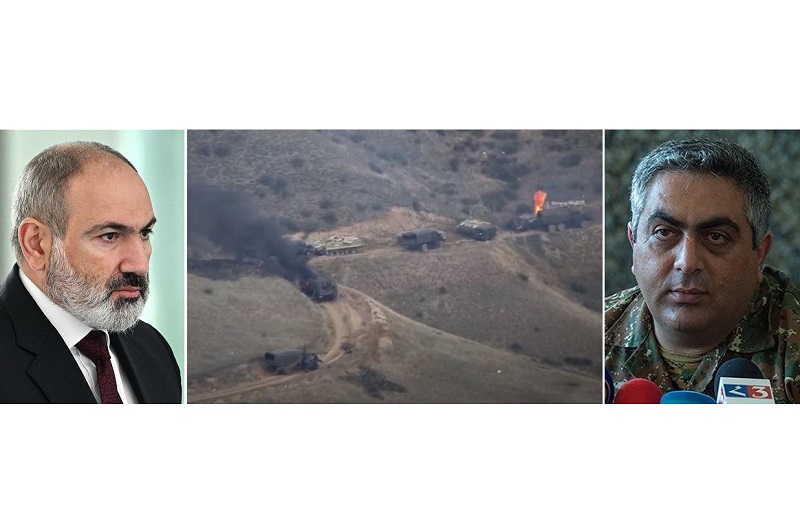
On September 28, 2020, the Defense Ministry of Artsakh published the names of 28 servicemen killed at the very outset of the aggression. However, a full list of war casualties has not been released to date. On the same day, Azerbaijani President Ilham Aliyev issued a decree declaring partial mobilization. For propaganda purposes, the Azerbaijani state media circulated video footage showing the destruction of Armenian OSA-AK missile systems. In response, the Armenian side released images of downed unmanned combat aerial vehicles (UCAVs) and burning Azerbaijani tanks. In the evening, Defense Ministry representative Artsrun Hovhannisyan reported a major Azerbaijani offensive in the Mataghis–Talish area. According to him, the Artsakh Defense Army had destroyed 22 Azerbaijani tanks and more than 10 other military vehicles, while inflicting approximately 370 enemy casualties.
Yet a question arises: If the situation on the battlefield appeared so favorable for the Armenian side, why did General Onik Gasparyan, Head of the General Staff, deliver a report at the Security Council meeting on the fourth day of fighting, urging an immediate halt to hostilities in order to preserve lives and military equipment? According to General Gasparyan, it was time to transition to diplomatic efforts to resolve the conflict. Notably, references to this report did not meet with public denial in the post-war period; on the contrary, media outlets frequently cited it. However, following the events of February 25, 2021, when a statement of the General Staff signed by 40 high-ranking military officials called for Prime Minister Pashinyan’s resignation, Gasparyan’s wartime report was suddenly dismissed as fake.
To disprove the existence of General Onik Gasparyan’s report, the Secretary of the Security Council, Armen Grigoryan, released video footage from the Security Council meeting in question, showing no record of Gasparyan delivering such a report. However, David Tonoyan, the Defense Minister during the 44-day war, not only confirmed that the report had indeed taken place, but also stated that Gasparyan had discussed the contents with him prior to presenting it at the meeting. Question: If Prime Minister Pashinyan himself later admitted that he could have saved the lives of thousands of soldiers but chose not to - so as to avoid being branded a traitor - why did he order the video of the Security Council meeting to be edited?
In the early hours of the war, Pashinyan addressed the public via Facebook, urging citizens not to question his capabilities as "supreme commander-in-chief." Question: Where exactly did he demonstrate those skills and capabilities? Why does the attempted assault on Lele-Tepe still remain a blind spot in the official chronicle of the 44-day war? Later, speaking in parliament, Pashinyan claimed he had only acted as a moderator during military decision-making and that the final calls were made by the generals. He did not, however, name any of those generals. Meanwhile, media reports repeatedly stated that the idea to storm Lele-Tepe came directly from Pashinyan himself, who allegedly aimed to prove that his predecessor, Serzh Sargsyan, had refrained from capturing the height during the April 2016 clashes, while he, in contrast, had the will to do so. The assault on Lele-Tepe reportedly resulted in the position being held by Armenian forces for just one hour, but at a staggering cost: estimates put Armenian casualties from the battle at 600–700 killed. Notably, during subsequent legal proceedings against participating servicemen, Lele-Tepe was referred to under a different name. Why?
WHY DID THE “SUPREME COMMANDER-IN-CHIEF,” WHO SPOKE OF THE USELESSNESS OF FRONTIER POSITIONS on mountains that remain snow-covered for most of the year, suddenly express such interest in capturing a height that many competent military officers did not consider strategically important?
Speaking from the parliamentary tribune, in response to a question from Gegham Manukyan, an MP from the Hayastan Parliamentary Faction, regarding the arrest of former Defense Army Commander Mikael Arzumanyan, Prime Minister Nikol Pashinyan stated that certain commanders, during the 44-day war, had followed “military orders from another General Staff” (implying the Russian General Staff) instead of his own. Meanwhile, the official charges brought against General Arzumanyan and his predecessor, General Jalal Harutyunyan, pertain to neglect of duty during military operations. Question: Why is there not a single official allegation stating that any commander followed the military orders of a “different General Staff” during the 44-day war? Why, after five years of accusations and investigations against commanders, has there been no mention at all of actions taken under the direction of a "different General Staff"?
There are many unanswered questions regarding the agenda of Prime Minister Pashinyan’s meeting with representatives of extra-parliamentary forces. The meeting took place immediately after his rejection of President Putin’s October 19 proposal, which offered a ceasefire agreement that would have preserved Shushi and Hadrut under the control of the Armenian Armed Forces. During the meeting, Pashinyan presented the real situation on the frontline, as well as a certain letter from Artsakh President Arayik Harutyunyan concerning the handover of the 5+2 regions. Pashinyan reportedly asked those present not to disclose the content of the letter, arguing that its publication could harm Armenia’s national interests. Later, however, some media outlets reported that no such letter from Harutyunyan existed. In Artsakh, discussions were reportedly taking place around a different document, allegedly signed by the sitting president along with all former presidents, but this document was never made public. The answer to why the head of the ruling elite referred to a fabricated document seems clear: He aimed to shift the blame for the defeat onto the leadership of the Second Armenian Republic.
Many developments from the 44-day war remain behind closed doors, and a number of pressing questions still cannot be publicly raised due to the lack of access to original sources. As for the information that has been made public: speaking on Public Television, Prime Minister Nikol Pashinyan told an outrageous story about an officer in charge of a military depot who allegedly refused to provide weapons during an enemy attack, forcing soldiers to obtain the arms by force. In response, MP Gegham Manukyan sent numerous formal inquiries to all relevant institutions, seeking to clarify whether the officer in question had been held accountable for what amounted to open sabotage. However, all responses received stated that no such incident exists within the criminal cases initiated over the events of the 44-day war. Question: Why did Pashinyan lie?
FOR FIVE YEARS, WE HAVE BEEN TRYING TO UNCOVER THE BLATANT LIE THAT PASHINYAN, ARTSRUN HOVHANNISYAN, AND OTHERS TOLD regarding the well-known events of the 44-day war. Unfortunately, one layer of falsehood has been laid over another, year after year. These layers now seem endless. Among them is Ilham Aliyev’s claim about 11,000 Armenian deserters, a statement later repeated by Anna Hakobyan. But if that were true, where are the 11,000 criminal cases? Desertion during wartime is a serious criminal offense, isn't it?
In the heat of the war, speaking from the parliamentary tribune, Pashinyan declared: “My wife is fighting.” And yet, to this day, no one has been able to confirm where Anna Hakobyan’s so-called "Erato" squad actually fought. In one of his press conferences, Pashinyan claimed that a decision was made for his wife to visit the command bunker in Stepanakert, from which military operations were being coordinated. However, he did not say who participated in that decision, nor under what authority it was made. He simply stated that Hakobyan had visited the bunker "to boost the morale" of the armed forces. It is worth recalling that shortly after her visit, General Hakobyan—the very commander who reminded her that the presence of third parties in the bunker was strictly forbidden—was dismissed from his post. And General Hakobyan was not the only experienced commander removed during the course of the 44-day war. Why?
The 44-day war is still often referred to as a “negotiated war,” with numerous arguments suggesting that Pashinyan intended to cede Artsakh, but was prevented from doing so immediately by the deployment of Russian peacekeepers. This version is further supported by the fact that shortly before the war, the Defense Ministry’s arms procurement plan was altered — one of Pashinyan’s first decisions as Prime Minister.
The list of weapons that were removed from the procurement plan and replaced with systems that failed to function during the war has been repeatedly published in the media, including by Golos Armenii. Yet the number of unanswered questions far exceeds those addressed in this article. Five years of blatant lies about the 44 days of autumn 2020 risk turning into decades, unless the people take to the streets and support the impeachment process.
If Pashinyan’s party fails to secure a constitutional majority in the 2026 parliamentary elections, the outrageous facts surrounding the 44-day war will finally come to light, leaving no doubt about the true intentions of the so-called “supreme commander-in-chief.”
Everything is already in place: from audio recordings to witness testimony. The truth will emerge the moment Pashinyan is no longer Prime Minister. And then, a court free from political pressure will be able to answer the fundamental question: Is the one most responsible for the defeat also the one most guilty?