
RUBINYAN’S “POLITICAL GOSPEL”: ON PASHINYAN’S FOURTH TERM
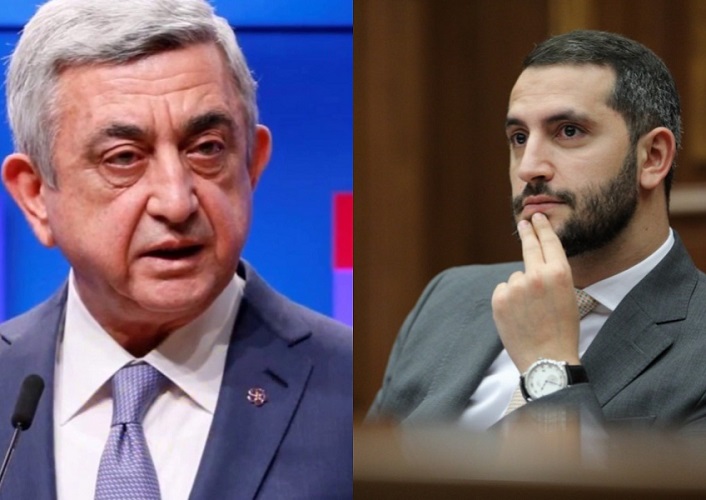
Political life in Armenia is rich in surprises, yet the recent statement by Ruben Rubinyan, Vice Speaker of the Armenian Parliament, was particularly remarkable. Not because Mr. Rubinyan said anything new, but because he voiced openly what many had long suspected and what the authorities themselves had preferred not to discuss so candidly.
It turns out that, politically speaking, Nikol Pashinyan is running not for a third term, but effectively for a fourth. This is not a matter of arithmetic, but of political interpretation. Mr. Rubinyan chose to apply a kind of “revolutionary accounting” and declared that Nikol Pashinyan had already been elected Prime Minister in 2018, then in 2019, and again in 2021, and that if elected in 2026, it would be his fourth term. According to Rubinyan, there is nothing unusual about this. After all, it fully aligns with the logic of a parliamentary republic.
Very well, let us not argue. Parliamentary republics have existed for a long time — some for longer than the political memory of certain local revolutionaries. Yet this raises a rather uncomfortable question.
What happened to those fiery speeches about the inadmissibility of perpetuating power? What about the revolutionary condemnations directed at Serzh Sargsyan? What about the claims that Armenia was tired of seeing the same political faces? And finally, what became of the struggle against the “third term,” which was presented almost as a matter of national salvation?
Nor is this the only interesting aspect of the story. Recently, Armenia’s third president, Serzh Sargsyan, effectively challenged accusations regarding Nikol Pashinyan’s alleged pursuit of a third term. According to his reasoning, it is incorrect to speak of a third term at all, since the previous re-elections resulted from snap elections and the particularities of Armenia’s parliamentary system.
His arguments were, to put it mildly, unusual. Yet Mr. Rubinyan refuted them with revolutionary straightforwardness. Without delving into legal nuances or recalling the circumstances of the snap elections, he simply counted the successive terms and arrived at four instead of three.
It was unexpected to see a representative of the Civil Contract party strike such a sensitive blow against the arguments of the third president. While Serzh Sargsyan sought to explain why there could be no third term, Rubinyan effectively acknowledged that there had already been a third term and that the country is now preparing for a fourth.
This naturally raises another question. If the parliamentary system allows a politician to seek as many terms as the political situation permits, then what exactly was the struggle that culminated in the 2018 Velvet Revolution about?
Rubinyan has an answer to that question as well. According to him, Serzh Sargsyan was criticized not for remaining in power too long, but for breaking his promise not to seek the post of prime minister after the constitutional reforms. In other words, the issue was not the reproduction of power itself.
Mr. Rubinyan’s argument deserves particular attention. If Serzh Sargsyan’s principal offense was breaking a promise, then what should be said about Nikol Pashinyan?
Judging by the number of promises that have gone unfulfilled, the current prime minister is a strong contender for a special place in Armenian political history. He promised to abolish the oppressive system of fines. Instead, both the number and size of fines have increased. The authorities promised to protect borrowers from the banking system and relieve them of the heavy burden of penalties and accrued charges. Yet during the most difficult period of the COVID pandemic, they failed to provide citizens with a comprehensive loan repayment moratorium. What about the promised peace that ultimately coincided with the loss of Artsakh? What about the promised victory over corruption and the recovery of the “stolen billions,” which never materialized?
Finally, it is impossible to forget one of Nikol Pashinyan’s most famous promises. He vowed to cut off his hand if even a single vote were rigged. Yet during the most recent parliamentary elections, numerous violations were reported, including administrative interference, pressure on employees of state-funded institutions, the use of state resources in the interests of the ruling party, and allegations of vote manipulation, particularly regarding votes cast for the Prosperous Armenia Party. Nevertheless, no one has yet seen Pashinyan’s severed hand.
Therefore, Mr. Rubinyan’s logic leads to a rather unexpected conclusion. If broken promises are indeed the key criterion by which politicians should be judged, and if criticism should focus on unfulfilled commitments rather than repeated terms in office, then Nikol Pashinyan should be the first person subjected to such criticism.
Still, one question remains: does a politician who came to power on the strength of numerous promises, only to leave behind a markedly different reality, have the right to seek yet another mandate to govern the country?
It is, after all, not every day that a representative of the ruling authorities simultaneously refutes both the arguments of the third president and the revolutionary rhetoric of his own political camp.