“Why Didn’t the CSTO Respond?” Pashinyan’s Cynical Lies at the Kremlin
Pashinyan’s passion for pathological lying has long been known. Unfortunately, people have grown accustomed to it: some with frustration, others with resentment. Still, lying during an official meeting with Vladimir Putin goes beyond political ethics — it reflects a lack of basic dignity and regard for reputation. This affects not only the individual speaking, but also the country he represents and the people behind whom he hides.
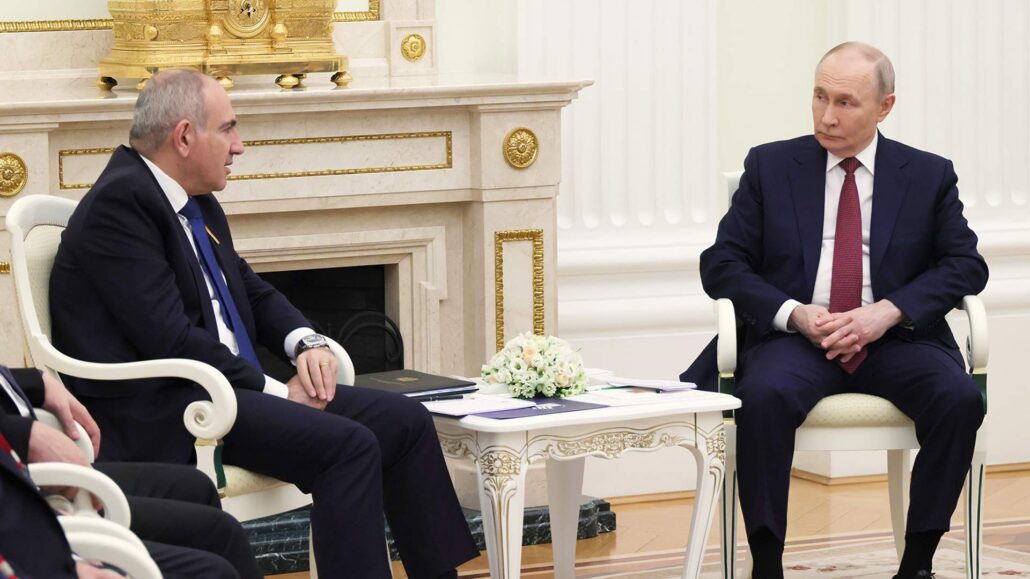
Vladimir Putin and Nikol Pashinyan met on April 1. The Russian president stated:
“It is obvious that following your recognition of Karabakh as part of Azerbaijan in Prague in 2022, it would be, at the very least, incorrect for the CSTO to interfere in a process that had taken on an intra-Azerbaijani dimension.”
In response, Pashinyan remarked nonchalantly:
“…we are still unable to explain to our people, our citizens, why the CSTO did not react…”
Pashinyan’s words might have been taken as an April Fools’ joke, were it not for the cynical and blatant nature of the lie — delivered with the confidence typical of those who believe themselves immune to consequences.
Yet nothing here is surprising. Once again, we observe the same old and painfully familiar pattern: first, decisions are made that inevitably lead to defeat; then, external causes for that defeat are fabricated; and finally, blame is assigned elsewhere.
To understand this, it is enough to reconstruct the chronology of events — something deeply inconvenient for those who prefer interpretation over facts.
April 2022: Nikol Pashinyan declares in parliament that Armenia must “lower its expectations” regarding the status of Karabakh. In a normal political culture, such a statement would provoke serious debate. In Armenia, however, it was framed as a sign of maturity and responsibility. In reality, it marked the beginning of a process whose outcome was evident from the start.
August of the same year: negotiations under European patronage. The public is told of diplomacy, peace, and opportunity. Yet it was precisely in this “peaceful” atmosphere that Armenia was placed in a position where it was expected to renounce the defense of Artsakh.
Everything proceeded as planned. The plan required one thing: to create conditions in which society would accept future concessions as inevitable.
September 2022 became that condition.
Azerbaijan’s aggression — attacks on Syunik, Gegharkunik, and Vayots Dzor, along with threats against Jermuk — was not merely an act of aggression, but an “argument” intended to convince the Armenian public that resistance was futile. Ilham Aliyev assumed the role of executor.
The behavior of the Armenian authorities was particularly telling. Neither martial law nor mobilization was declared. A country under attack effectively demonstrated its unwillingness to defend itself on a full scale. Such outcomes are not accidental.
Then came Prague, October 2022: recognition of Azerbaijan’s territorial integrity within its 1991 borders. This was the political formalization of a process long in the making through diplomatic maneuvering and military pressure.
After all this, blaming the CSTO for a “failure to respond” appears deeply cynical.
One must ask: what exactly was it supposed to respond to? A process consistently legitimized by the Armenian authorities themselves? A situation in which the key decisions had already been made and documented?
As usual, Pashinyan adopts a different approach — one that not only distorts reality but reverses cause-and-effect relationships entirely.
He claims that the September attacks were not a consequence of the Prague statement; instead, the lack of CSTO reaction is presented as the cause of everything.
He does not consider the failure to mobilize as a factor weakening defense capabilities; instead, he invokes “passive allies” as a universal justification.
And rather than analyzing his own policies, he continues to assign blame to external actors.
The final touch: this entire sequence of events unfolded alongside a steady escalation of anti-Russian rhetoric. Accusations, insinuations, and demonstrative gestures created a backdrop in which the eventual outcome appeared both logical and inevitable.
Now, these accusations are voiced not only in interviews or at rallies, but during an official meeting with the Russian president.
In this case, “consistency” is not a virtue — it is a diagnosis.
In conclusion, let us call things by their proper names:
Concessions were not forced — they were planned in advance.
The September escalation was not an unforeseen tragedy, but a convenient instrument of pressure on one’s own population.
The Prague statement was not a compromise, but an act of political capitulation.
Accusations against the CSTO were not an attempt to seek truth, but a cynical effort to evade responsibility and shift blame.
The objective of this policy is simple and transparent: to push Russia out of the South Caucasus. Everything else serves as a means to that end.
The question is not whether we understand what is happening. The question is whether Armenian society possesses the will and clarity to confront it. What is needed is a timely and resolute political conclusion — not a retrospective assessment. Otherwise, there may be nothing left to assess. The consequences of such a policy are not debated — they are recorded as a final verdict.