
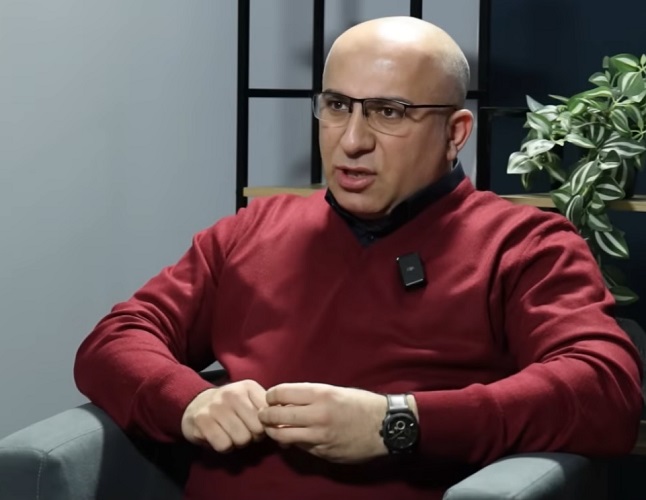
Alen Ghevondyan: “We Simply Do Not Realize the Scale of the Imminent Catastrophe.”
The secret of the success of Pashinyan’s populism does not lie in any exceptional political talent or strategic genius, as we are often told from screens and podiums. Its success stems from something far more prosaic, yet highly effective: the ability to work with people’s expectations and fears - and, importantly, society’s willingness to indulge in wishful thinking.
In recent months, we have been witnessing a phenomenon that could be interpreted as “a return of power to the people.” At least, that is how it is being portrayed. Live broadcasts of Pashinyan’s walks, meetings, smiles, and handshakes create, at first glance, an almost idyllic picture. Yet a closer look reveals familiar elements of well-established political technologies.
Political scientist Alen Ghevondyan aptly noted:
“This is a well-orchestrated political PR process.”
That alone speaks volumes. Perhaps if we had the habit of truly hearing — not merely listening — we would not need to revisit such obvious points again and again. Unfortunately, this is a habit we have yet to fully develop.
Meanwhile, it is clear that populism — a phenomenon that feeds on public sentiment — never arises out of nowhere. It requires a certain environment, where belief replaces knowledge, emotion replaces analysis, and perception replaces evidence. In this sense, responsibility lies not only with those who employ such technologies, but also with those who allow them to function.
Ghevondyan puts it plainly:
“Populist leaders tend to remain in power for a long time because part of society continues to live on hope.”
There is another, no less important component - interest. There are always individuals who benefit from such a system, finding it convenient and predictable. These people not only accept its rules but often become its informal defenders.
Fear also plays a crucial role in such circumstances. This fear is not abstract — it is specific, targeted, and framed with clearly defined consequences.
“This is a technology aimed at instilling fear in society.”
It is hard not to notice how rhetoric about “peace” is combined with the notion of inevitable war, subtly embedded in the public consciousness. This creates a vicious circle: peace is presented as possible only if the current state of affairs is preserved, while any change is framed as leading inevitably to catastrophe.
“If I am not in power, there will be war – that is the message.”
These technologies are not new. What is new is the persistence and consistency with which they are being applied today.
Against this backdrop, the state of the opposition remains, to put it mildly, ambiguous. On the one hand, there are signs of a possible awakening - efforts toward consolidation, recognition of the need to overcome electoral thresholds, and a more measured assessment of available resources. On the other hand, a chronic “disease” persists: the inability to place national priorities above personal ambitions.
This raises a fundamental question: are they fighting for power, or for the state? Today, much depends on the answer.
As experience shows, these are two very different struggles.
At the same time, developments beyond the domestic political sphere must not be underestimated. Escalations around Iran and scenarios involving potential ground operations could, as Ghevondyan warns, have devastating consequences not only for the immediate parties involved but for the entire region.
He offers a warning worth emphasizing:
“We simply do not realize the scale of the imminent catastrophe.”
It is difficult to overstate the risks posed by such developments. Mass displacement, destruction of infrastructure, and humanitarian crises are no longer abstract possibilities, but very real threats. It would therefore be naïve to assume that domestic political processes can unfold in isolation from external factors.
Moreover, in the event of serious regional escalation, there may be both the temptation - and the necessity - to introduce emergency regimes. Under such conditions, normal political mechanisms, including elections, could be postponed or fundamentally altered. In that scenario, current disputes, accusations, and political calculations would quickly become irrelevant, overtaken by a far harsher reality.
Ultimately, we are confronted with a simple, albeit uncomfortable truth: small states are particularly vulnerable in times of global upheaval. Their stability depends not only on internal dynamics, but also on their ability to assess external risks and respond appropriately.
This, in turn, requires qualities we too often lack - the ability to truly listen and to draw conclusions. Otherwise, the same truths will continue to be stated openly, and we will continue to pretend not to understand them, as we have done time and again.
Interview with Alen Ghevondyan is available here: