THE TRAITOR AND THE TRIBUNE: A LIVE CONFESSION OF HIGH TREASON
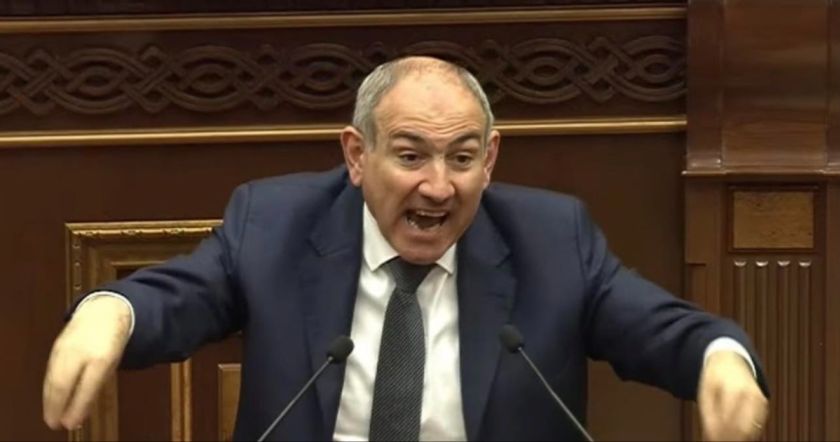
“In 2020, they consciously sacrificed themselves and attained statehood and independence. Before that, it was not we who made sacrifices; we were forced onto the scaffold and sacrificed for others’ interests. For the first time, we sacrificed ourselves for our own interests - for our state, our identity, and our future,” Nikol Pashinyan said in the National Assembly on March 26.
When such words are spoken not in private conversation or heated debate, but from the state tribune, they are no longer merely words. They demand understanding and assessment - but first and foremost, they demand that things be called by their proper names.
When the head of state speaks about war, he must tell the truth - not convenient, softened, carefully packaged phrases, but the truth that cost thousands of lives. When we hear justifications instead of truth, a question arises: is this an attempt to explain what happened, or a confession?
When the same person declares, “they consciously sacrificed themselves,” this is not a slip of the tongue. It is a formula - harsh, cynical, and strikingly candid. It reveals the essence: the sacrifice was deliberate, and it is being justified. These words amount to nothing less than a confession of a grave crime.
He goes further: “For the first time, we sacrificed ourselves for our own interests,” urging us to interpret catastrophe as a deliberate choice. We are being asked to accept that the deaths of thousands were not the result of a betrayal of national interests, but rather a step toward “statehood” and “the future.”
Are we truly being told this in order to convince us that defeat was a victory, loss an achievement, and capitulation salvation?
And yet, the facts - the consequences of the 44-day war - cannot be concealed or rewritten.
More than five thousand dead. Over eleven thousand wounded. Hundreds, perhaps thousands, missing. Hundreds of prisoners of war, including military and political leaders of Artsakh held in prisons in Baku. The loss of Artsakh. Around 140,000 forcibly displaced people. The surrender of strategic territories to the adversary. The presence of enemy forces on Armenia’s sovereign territory. The ceding of a strategically vital section of the Goris–Kapan road, which once ensured a crucial link to Iran.
Is that all? No, this is only the beginning.
In the aftermath of the war, Ilham Aliyev has continued to advance ever-expanding demands - less diplomacy than diktat. Changes to Armenia’s Constitution. The removal of any reference to Artsakh. The imposition of the narrative of the so-called “three thousand Azerbaijani refugees,” a figure inflated to absurdity by Azerbaijani propaganda. The promotion of multi-billion-dollar “reparations.” Pressure over the so-called “Zangezur corridor,” implying loss of control over part of Armenia’s own territory. And daily, state-sponsored anti-Armenian rhetoric.
All of this is presented as a “movement toward peace.”
What kind of peace is this, when each new day since the war has brought fresh concessions? This is not independence, but the steady contraction of sovereign space - despite Nikol Pashinyan’s attempts to claim otherwise. This is not “salvation from the scaffold,” as the prime minister asserts; it is a tightening noose - slow, incremental, and ultimately suffocating for Armenia.
Is it the “result of self-sacrifice?” Is this what people “sacrificed themselves” for?
Political analyst Argishti Kiviryan writes in a Facebook post:
“It is obvious that a nation, following defeat, should act with restraint and caution, limiting its foreign policy ambitions. Yet many fail to grasp this, because this policy is being pursued by Nikol Pashinyan - a man who came to power with diametrically opposed slogans, led the country into war at least through incompetence and personal ambition, and brought Armenia to a humiliating defeat and ongoing degradation. Imagine if, after World War II, Hitler had remained in power and sought ‘friendship’ with the Soviet Union. Such a concept of peace would never have been accepted; people would have asked: why the bloodshed, if this was your vision? In the same way, people now ask Pashinyan: if you thought this way, why did you send an entire generation to its death, destroy the Armenian Army, and leave no room for dignified agreements?”
To be clear, this is not about denying the necessity of difficult or even tragic decisions. History has known many painful compromises. But none were justified by declaring the victims as deliberate and necessary sacrifices in order to achieve “sovereignty” through defeat and capitulation. None involved the intentional provocation of war only to later present it as an “achievement” of statehood and independence through bloodshed and loss. None.
Yet today, we are being asked to accept precisely such logic — and this raises a fundamental moral question: where is the limit? Where is the red line beyond which a nation must say “no,” regardless of risk?
There is also another question - far more severe and concrete, not moral but legal. When a country’s leader publicly speaks of “conscious sacrifice” in the context of defeat, he is effectively acknowledging and justifying the deaths of thousands of citizens in order to persuade the Armenian people to accept painful concessions. This is not merely an evaluation - it is a confession. And not of a mistake or miscalculation, but of an act that, in any normal country, would be defined as high treason.
This leads to the next question.
Where is the parliamentary majority of the Civil Contract party? Why has the issue of accountability not been raised immediately? Where is the Prosecutor General’s Office? Where are the heads of the security services? Where are they all when such statements - amounting to confessions with elements of high treason - are made publicly? Where are the criminal cases? The legal assessments? The basic fulfillment of duty?
Meanwhile, as Pashinyan’s statements and actions spark growing outrage, parents of soldiers killed in the 44-day war have organized a protest in front of the Prosecutor General’s Office. According to News.am, they intend to file a formal complaint regarding the prime minister’s statements and demand a legal assessment of both his words and actions.
Silence in such circumstances is not mere inaction - it is complicity.
This demonstrates that the problem with calls for peace lies not in the idea itself, but in the person advancing it and the motives behind it. For Pashinyan, peace is not an end, but a means of retaining power. There is no genuine pursuit of reconciliation with the Azerbaijani people - only the preservation of his position, regardless of national cost. In this light, each new concession reinforces the perception of betrayal, and the phrase “self-sacrifice for the state” takes on its true, grim meaning.
The final question remains: where is the limit? And if Pashinyan’s Civil Contract party is re-elected in the upcoming parliamentary elections, will there be anything left that can still be called a state?