
Hayk Nahapetyan: From Baku’s Statements to Domestic Blackmail — How Fear Shapes Armenia’s Agenda
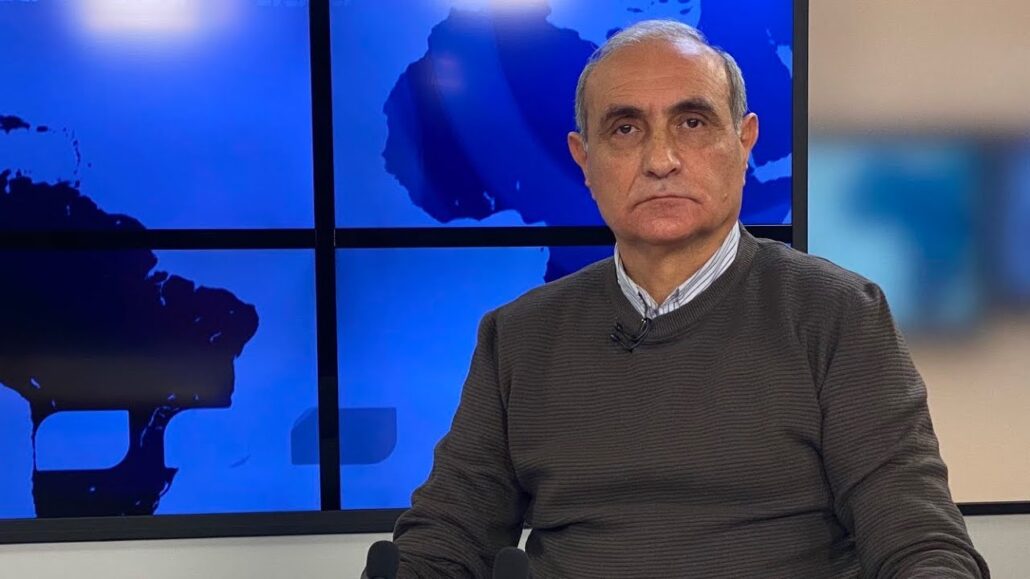
Military expert Hayk Nahapetyan, in his author’s program on the politik.am website, addressed an issue that public attention is actively being diverted from — the real meaning of statements made by the Azerbaijani leadership and how they are distorted within Armenia. This is not a matter of misinterpretation, but of deliberate substitution. In effect, society is presented with a convenient illusion of “peace,” while the real agenda is being shaped through pressure and coercion.
The expert’s analysis focuses on statements by the Azerbaijani president, which, despite attempts to portray them as “outdated,” remain relevant. According to Nahapetyan, Baku’s core position has not changed: it still refuses to definitively recognize Armenia’s territorial integrity and remains ready to revise any agreement depending on circumstances.
These statements contain two fundamental points. First, Baku explicitly asserts that no agreement carries guaranteed legal force and can be revised at any time. Second, its declared “readiness for peace” is accompanied by a failure to recognize Armenia’s territorial integrity. In such a context, Nahapetyan views discussions of “durable peace” as deliberate attempts to mislead society.
One of the key issues he highlights is the de facto opening of an air “corridor” over Armenia’s territory without its consent. Not only has Aliyev acknowledged this, but he has also publicly justified it by referring to “norms of international aviation law,” stating that Azerbaijan is already using Armenia’s airspace for its own purposes. This is not a diplomatic nuance or interpretation; it is, in essence, a claim that part of Armenia’s sovereign airspace has been effectively appropriated.
This raises a critical question: when and on what grounds did Armenia lose control over its airspace? The authorities have provided no answer. Why have the government, parliament, and so-called international partners not deemed it necessary to respond — even publicly — to such statements? In this context, silence is not neutrality; it amounts to consent.
Against this backdrop, discussions about the “Zangezur Corridor” take on a different meaning. These are no longer hypothetical routes but part of a process that has effectively begun — first in the airspace, and potentially on land as well. If the initial step met no resistance, there is little reason to expect future steps to encounter any.
According to Nahapetyan, Baku’s subsequent demands fit logically into this framework of pressure. Among them is the proposed return of “hundreds of thousands of Azerbaijani refugees,” although historical figures are significantly lower. This framing serves as a tool of demographic and territorial pressure. Under international law, such claims could obligate the receiving country to provide housing, security, and social infrastructure — requirements that Armenia lacks the resources to fulfill. As such, this constitutes an inherently unfulfillable demand that may later be used as a pretext for coercive pressure.
At the same time, there is a financial and legal dimension. Baku has raised the issue of compensation claims amounting to tens or even hundreds of billions of U.S. dollars. These figures are not incidental; they are deliberately set at unattainable levels, paving the way for an alternative scenario — territorial compensation. The underlying logic is stark: if you cannot pay, you concede territory.
Another issue of particular concern is the discourse surrounding so-called “war reparations” and related accusations. These statements are not intended solely for a domestic audience; they aim to establish a legal basis for future claims. Such narratives do not disappear amid information noise — they become part of a long-term strategic framework.
A central element of Nahapetyan’s argument is his rejection of the claim that war is inevitable if Pashinyan’s Civil Contract party fails to secure victory in the upcoming parliamentary elections. He characterizes such assertions as instruments of political blackmail, designed to maintain power through fear. In his view, decisions regarding large-scale military action are not made in isolation but depend on the broader balance of power among major global actors. From this perspective, claims of “inevitable war” constitute domestic propaganda rather than an accurate reflection of the military reality. Society, he argues, is being presented with a simplified and coercive formula: either the continuation of the current authorities or war. At the same time, the authorities themselves acknowledge that even massive increases in military spending cannot guarantee security.
In a broader context, Nahapetyan also challenges the narrative of a “hybrid war” allegedly waged by Russia against Armenia. According to him, the real pressure is concrete and originates from Azerbaijan and Turkey across military, economic, and informational domains. Attempts to portray Russia as the primary source of threat, he argues, serve to politically misorient society.
Ultimately, the picture that emerges is clear: steadily escalating demands backed by force and legal claims, concessions made without public debate, and a domestic policy built on instilling fear. This constitutes a unified trajectory leading toward a loss of sovereignty.
The Public Tribunal's Conclusion
The current situation is not solely about external pressure from Azerbaijan and Turkey; it also reflects a domestic policy aimed at suppressing public vigilance. Under the guise of a “peace agenda,” Pashinyan is systematically distorting reality and downplaying evident threats. Efforts to draw attention to these risks are labeled as revanchism, panic, or provocation.
Our conclusion is unequivocal: Nikol Pashinyan is deliberately shaping an informational and political environment in which Armenian society loses its instinct for self-preservation. Threats are normalized, concessions are reframed as achievements, and the erosion of sovereignty is presented as the inevitable cost of “stability.” As a result, society is being misled, becoming less capable of responding adequately to challenges, and unprepared to defend its national interests.
The Public Tribunal’s key conclusion is explicit: Nikol Pashinyan and his team constitute a threat to Armenia’s national security. The sooner Armenia removes what is described as an anti-national leadership, the sooner it can emerge from the situation created by the “velvet revolutionaries.”