
Analysis of the IRI Public Opinion Poll in Armenia, February 2026
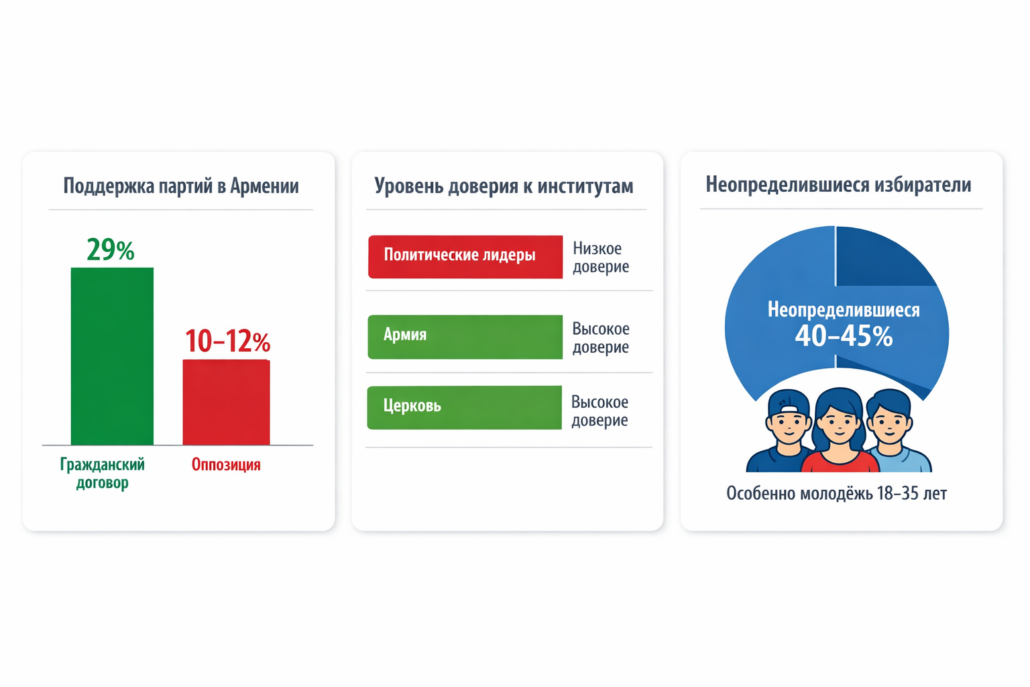
A survey conducted by Breavis on behalf of the International Republican Institute’s (IRI) Center for Insights in Survey Research from February 3–13, 2026, using CATI-administered telephone interviews, found that 29% of respondents in Armenia stated they would vote for the ruling Civil Contract Party if elections were held in the week following the survey. The results of the survey are presented in the table below.
| Indicator | Value | Comments |
| Support for Civil Contract Party | 29% | The data show that a baseline level of support persists, which may secure a relative advantage in conditions of low turnout. |
| Support for opposition forces | 10–12% (in total) | Low levels of trust in opposition forces limit their ability to convert protest sentiment into electoral support. |
| Undecided voters | 40–45% | A significant proportion of undecided respondents, particularly among the youth (aged 18-35), creates a significant potential for vote redistribution. |
| Probable turnout (declared willingness to participate) | 65–70% | Traditionally elevated as compared to the actual turnout may be accounted for by the effect of socially desirable response. |
| Trust in political leaders | Low | Most of the respondents (mainly aged 18-35) failed to name a trustworthy politician. |
| Trust in non-political institutions | High | The Army and the Church are traditionally trusted institutions and sources of legitimacy |
| Key public priorities | Social and economic issues (poverty, incomes) — 55%; security — 30% | A shift of attention from security to social and economic issues reflects the change in public expectations. |
| Perception of the country’s development course | “Right” — 48%, “wrong” — 44%, could not answer — 8% | Almost equal distribution of opinions reflects polarization of opinions and a lack of consensus. |
| Core of support for the incumbent authorities | 25–30% | A stable proportion of support even amid low trust in particular politicians. |
| Influence of media environment | High | Digital platforms and information agenda shape stable narratives that influence the interpretation of political reality. |
The survey makes it possible to identify a number of stable features in Armenia’s social and political sentiments; however, it requires critical analysis, particularly regarding the internal consistency of the data and comparisons with previous electoral cycles.
One of the first issues that stands out is the discrepancy between respondents’ declared willingness to participate in elections and actual voter turnout. In previous electoral periods, public opinion polls consistently reported significantly higher levels of intended participation than were reflected in official turnout statistics. This suggests a systematic inconsistency, which may stem either from the specifics of respondent selection or from the influence of socially desirable responses. Consequently, the potential turnout indicated by this survey cannot be considered a reliable forecast.
An important indicator of the condition of the political system is the level of trust in political institutions and individual actors. The survey data point to a high degree of distrust: a substantial proportion of respondents were unable to name a single politician they trust. This trend is particularly pronounced among respondents aged 18–35, indicating a crisis of representation, whereby existing political forces are not perceived as adequately representing public interests.
Further evidence of this is the large share of undecided voters. The high proportion of respondents without clear political preferences signals electoral instability and a significant potential for vote redistribution during the campaign period. Notably, many of these respondents are young, which further increases uncertainty.
At the same time, the survey records a stable core of support for the incumbent authorities. Despite declining personal trust in individual politicians, a certain baseline level of support persists, which may secure a relative advantage in conditions of low turnout. This effect is reinforced by the apathy of voters who are not actively engaged in political processes.
An analysis of thematic priorities indicates a shift in the structure of public demands. The importance of socio-economic issues, particularly poverty, appears to have increased. At the same time, the proportion of respondents identifying security as a priority has declined. This dynamic may reflect either a genuine shift in public opinion or the influence of the prevailing information agenda. In any case, a degree of inconsistency is evident between objective challenges and their subjective perception.
Some of the survey’s indicators appear contradictory. For example, rising concern about social issues is accompanied by relatively stable or only moderately declining levels of support for the incumbent authorities. This may point to a fragmentation of perception, whereby evaluations of specific issues do not translate directly into political behavior.
Finally, perceptions of political competition remain a significant factor. The survey suggests that the opposition has failed to present a convincing alternative to the authorities on key issues, including security and development. Low levels of trust in opposition forces limit their ability to convert protest sentiment into electoral support.
Additionally, the influence of the information environment on the formation of public opinion should be taken into account. A high level of media influence, including the active use of digital platforms, can contribute to the formation of stable narratives that shape the interpretation of political reality. Under such conditions, public opinion polls may reflect not only genuine preferences but also the effects of the current information agenda.
An analysis of attitudes toward institutional structures shows relatively high levels of trust in non-political institutions, such as the church and the army. This suggests the preservation of traditional sources of legitimacy amid declining trust in political actors.
An important element is the perception of the country’s development trajectory. The distribution of assessments between the “right” and “wrong” directions in which Armenia is heading is nearly equal, with positive assessments prevailing only marginally. This indicates a polarized public opinion and the absence of a dominant consensus regarding the current political course.
Thus, the data suggest several general conclusions.
- First, the political system is characterized by a high level of distrust and a substantial proportion of undecided citizens.
- Second, baseline support for the incumbent authorities persists and may translate into an electoral advantage in the case of low turnout.
- Third, the opposition currently lacks sufficient public trust to effectively mobilize protest-oriented voters.
- Fourth, public priorities have shifted toward socio-economic issues, while perceptions of security remain ambiguous.
Overall, the survey reflects a state of political uncertainty, in which the outcome of future electoral processes will largely depend on voter engagement and the ability of political actors to mobilize undecided citizens.
To succeed in the 2026 parliamentary elections, the opposition should focus on developing an alternative agenda that offers concrete solutions to socio-economic problems; intensifying engagement with young and undecided voters through local initiatives and digital platforms; building coalitions and consolidating smaller forces to project the image of a united and competent team; increasing transparency and openness in its activities to build trust; actively responding to information attacks and manipulation; and encouraging citizen participation in elections through educational campaigns. These steps could help transform passive protest sentiment into tangible electoral support.