
Criminal Case as a Performance: Why Did Serzh Sargsyan’s Brother Come in Useful to the Authorities
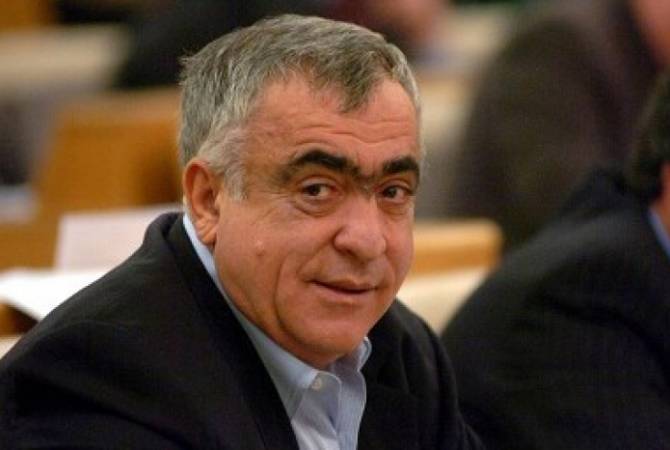
The judge of the Anti-Corruption Court, Sargis Petrosyan, has granted the investigators’ motion to place Alexander Sargsyan, the brother of Armenia’s third president, on the wanted list.
Formally, everything appears flawless: the court has no information about the location of the accused and therefore considers it possible to prevent his escape. If Sargsyan is found to be on the territory of the country, the issue of his arrest will be reconsidered.
In the language of law, this looks like a routine procedure. In the language of politics, it is another episode in a long-running performance.
In the spring of 2018, when the streets of Yerevan were crowded with people demanding justice, many believed the country was truly on the verge of a historic turning point. From tribunes and public squares, loud promises were made. The new “revolutionaries,” led by Nikol Pashinyan, claimed the mantle of national hero Monte Melkonyan, assuring the public that corruption would be eradicated, those responsible would be punished, justice would prevail, and everything that had been stolen would be returned to the people.
Eight years have passed, and the outcome is telling. No high-profile cases against members of the former authorities’ inner circle have resulted in a guilty verdict. Serzh Sargsyan has not spent a single day in a detention facility. “Revolutionary justice” has turned out to be an endless process without a conclusion.
For this reason, the court’s current decision can hardly be viewed as non-political.
Today, Armenian society is discussing revelations that challenge the fundamental myth of the current authorities - the myth of a complete break with the former regime. More and more people are asking the question: was the “velvet revolution” truly a mass uprising of the people, or was it part of a carefully orchestrated political scenario in which Serzh Sargsyan’s resignation was not a defeat, but a controlled transfer of power?
If the truth about the events of 2018 even partially takes root in the public consciousness, the entire eight-year propaganda narrative of the “revolution” may prove meaningless. In that case, the fight against corruption would appear to be a carefully constructed façade rather than a genuine effort.
In this context, the image of the former president’s brother becomes particularly useful, helping to address two tasks simultaneously.
The first task is tactical. Amid declining approval ratings ahead of elections, the authorities need to send a loud and clear signal to disappointed voters: “the fight continues.” Serzh Sargsyan’s family is an ideal symbol of the “old system,” and protest emotions can once again be mobilized against it.
The second task is strategic and much more important. This step can also be interpreted as a demonstrative response to concerns that a possible political arrangement between Pashinyan and Sargsyan might be exposed. Harsh and public actions against the third president’s close relative serve to visibly sever any perceived ties and demonstrate an absolute and irreconcilable antagonism. The message is simple: “Would we act this way if we were part of his plan? We are not his project - we are his judges.” The problem is that such demonstrative actions are increasingly failing to convince the public. Over the past years, people have seen enough to understand that the fight against the past is often used as a tool for managing the present.
As a result, Armenian society is now facing a much more important question than the fate of individual figures involved in criminal cases. The real issue is whether the country will be able to break the vicious circle in which the current authorities and the former elites have spent years using each other as political bogeymen.
The Public Tribunal will not allow either Nikol Pashinyan or Serzh Sargsyan to mislead the Armenian people again. It will continue consistently and persistently informing society about ongoing developments and about crimes committed against the state and the people.
The future of Armenia should be determined not by political performances and mutual manipulation among elites, but by the informed choice of citizens who know the truth about their recent history.