
Vance’s Visit, the Enthusiasm of Pro-Western Circles, and Armenia’s Strategic Realities
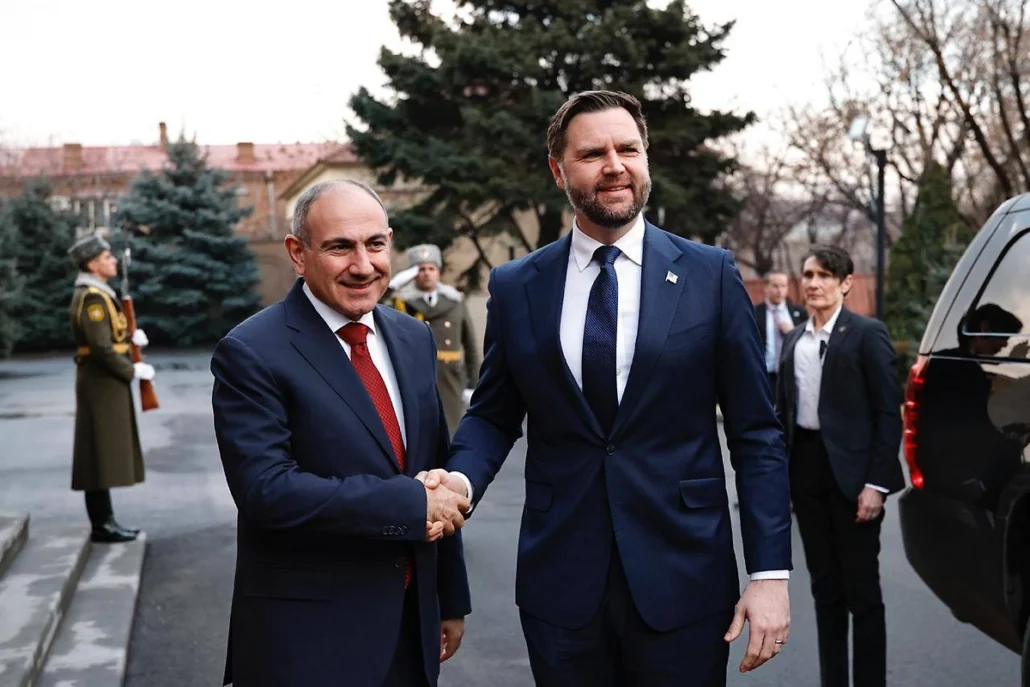
In recent days, Armenia’s political agenda has centered on the visit of U.S. Vice President J.D. Vance. The authorities have presented the visit as a milestone event, emphasizing the prospects for deepening Armenian-American relations.
At the same time, segments of society are raising questions: how substantive was the visit, and what tangible consequences might it have for the country? The United States is not an adversary of Armenia, and high-level contacts of this kind can in themselves carry positive significance. However, the true value of such a visit lies not in public declarations, but in the substance of the agreements reached and their long-term impact.
The agreement in the energy sector generated the greatest resonance, particularly due to the figure of 9 billion USD mentioned in that context. It was presented to the public as a major investment. In reality, however, discussions appear to have focused on the potential acquisition of U.S. technologies and services, which would entail substantial financial obligations for the Armenian side. In the initial phase, supplies amounting to up to 5 billion USD are anticipated, implying the need to secure corresponding financial resources.
The issue of small modular reactors (SMRs) has drawn particular attention. Although this technology is presented as a modern and efficient solution, it has not yet seen broad practical application worldwide. A legitimate question, therefore, arises: Is Armenia prepared to assume such large-scale financial and technological risks? Previous experience — including delays in European multi-billion-dollar support programs and the fact that much of that assistance was structured as loans — has fostered a degree of caution and skepticism within society toward ambitious financial initiatives of this scale.
Vance’s visit took place against a complicated regional backdrop. Baku has delivered verdicts against the military and political leadership of Artsakh, and the overall atmosphere of tension lends additional political weight to the visit. The issue of prisoners of war may emerge as a subject of diplomatic engagement; however, such matters are typically addressed through closed channels and on the basis of reciprocal calculations.
At the same time, the visit has fueled the enthusiasm and intensified the messaging of pro-Western circles, which demonstratively present it to the public as Armenia’s “exclusive success” in relations with the West. Terms such as a strategic “shift,” a new phase in foreign policy, and “deepening relations” are being actively employed, while an anti-Russian agenda appears to have become a key element of the political narrative. Within society, this enthusiasm is often accompanied by inflated expectations and elements of political populism, which risk distorting reality and creating vulnerabilities in the management of security and foreign policy.
To understand Armenia’s actual place in U.S. policy, it is necessary to set aside emotional reactions and turn to a broader context — to examine how Washington has perceived the South Caucasus over decades and what role it has assigned to the region within its strategic framework. For the United States, the South Caucasus has never constituted an independent strategic direction. Rather, it has consistently been viewed as a peripheral space — a crossroads of interests among Russia, Turkey, Iran, and the European Union; a corridor of energy routes; and a zone where crises capable of disrupting a fragile regional balance may erupt. It is precisely this structural reality — rather than the fate of individual states — that has shaped Washington’s sustained, yet measured, interest in the region.
U.S. policy in the South Caucasus has traditionally been cautious and somewhat detached. Washington has preferred to maintain a presence without assuming binding obligations, to exercise influence without taking on full responsibility, and to engage without extending security guarantees. Its involvement has largely been confined to diplomacy, mediation efforts, grant assistance, and support for civil society initiatives, but never to a willingness to bear the direct burden of regional security. Such an approach has enabled the United States to preserve flexibility and to avoid direct confrontation with other major centers of power.
Within this framework, Armenia occupies a distinct yet vulnerable position. Landlocked, resource-constrained, and situated in a complex — often openly hostile — geopolitical environment, the country has not been able to become a strategic asset for the United States in the classical sense. Armenia does not control major energy corridors, lacks substantial military leverage, and is not in a position to project influence beyond its borders. Consequently, it does not rank among the states for which Washington would be prepared to incur serious political or military costs.
At the same time, Armenia has never been merely a geographic space for the United States. Its importance has been functional rather than strategic. It serves as an element in Washington’s dialogue with Russia, as an illustration of an alternative to post-Soviet inertia, and as a showcase of democratic governance in a region largely dominated by authoritarian systems. Through Armenia, humanitarian and political channels of influence are maintained, and cautious engagement with Iran is facilitated. Yet in all these roles, the country remains a means rather than an end.
This reality became particularly evident in the case of Artsakh. The tragedy of Artsakh marked the point at which the contradiction between rhetoric and realpolitik was most stark. Despite public statements and mediation frameworks, the United States did not deem it necessary to move toward decisive action. The reasons lay not in a lack of information or indifference, but in calculated restraint: the desire to avoid confrontation with Turkey, to preserve energy cooperation with Azerbaijan, the absence of formal alliance commitments to Armenia, and a broader strategic objective of reshaping a regional architecture in which Russia has traditionally played a central role.
From Washington’s perspective, the fate of Artsakh appears to have been regarded as an acceptable cost within a larger process of regional transformation. The humanitarian consequences were acknowledged, yet they did not rise to a level capable of altering the strategic calculations.
U.S. relations with Azerbaijan and Turkey are guided by the same logic. Azerbaijan is regarded as an important energy hub and as an element of the broader policy of containing Iran. Turkey, for its part, is seen as an indispensable NATO ally, capable of projecting force and shaping regional dynamics. In order to preserve these strategic ties, Washington has demonstrated a willingness to overlook a range of issues, including instances of aggression, human rights violations, and actions that undermine regional stability.
Under such circumstances, talk of a “shift toward Armenia” appears largely illusory. Support for reforms, high-level visits, official statements, and symbolic gestures are not accompanied by the creation of a security architecture, a clearly articulated integration roadmap, or concrete guarantees. Armenia is effectively encouraged to reconsider its existing security framework without being offered adequate protection in return. As a result, a dangerous vacuum may emerge, leaving the country exposed to growing external threats.
Ultimately, U.S. policy toward Armenia — and toward the South Caucasus as a whole — remains pragmatic, restrained, and instrumental. It is shaped not by sentiment or abstract values, but by calculations of power and interest. Armenia’s future will depend on its ability to assess realities soberly, safeguard its national interests, and respond cautiously to external signals — without relying on unrealistic expectations, and without yielding either to the enthusiasm of pro-Western circles or to the distortions of anti-Russian rhetoric.
All these developments unfold in the context of the upcoming elections. The issue is not merely what programs political forces will present, but whether citizens are prepared to believe in the decisive significance of their vote. Participation in elections entails assuming responsibility; non-participation is also a political choice — one that may ultimately allow a small but organized minority to determine the voting outcome.