
Church in an Era of Splits: Where Is the Line Between Faith and Politics?
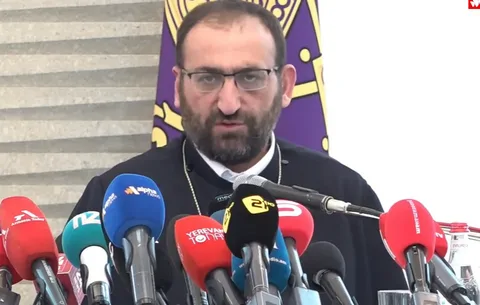
Unprecedented tensions have emerged between the Armenian Apostolic Church and the government led by Prime Minister Nikol Pashinyan. Speaking at a press conference today, the Head of the Mother See of Holy Etchmiadzin Chancellery, Archbishop Arshak Khachatryan, sharply criticized clergymen who have aligned themselves with the government. His remarks were not merely about internal church disputes - they signal a deepening rift in which the very identity of the Armenian Apostolic Church (AAC) is at stake. Below are key narratives from Archbishop Arshak Khachatryan’s press conference:
“Cooperation with the Government — Complicity in Destruction?”
The archbishop’s main argument is strikingly severe: any clergyman who cooperates with the current authorities “effectively assumes part of the responsibility for the Armenian leadership’s destructive political course.” This is more than simple criticism; it is an ethical indictment that elevates the political debate to the level of spiritual accountability.
According to Archbishop Khachatryan, these words do not stem from personal grievance but from a fear of losing canonical integrity. For a church with a 1700-year history, safeguarding unity and apostolic succession is a matter of survival. Thus, when some hierarchs choose rapprochement with the government, it is perceived as a betrayal of centuries-old traditions.
The Catholicos’s Name: A Symbol or a Formality?
Particularly noteworthy were the remarks concerning the “ignoring of the Catholicos’s name” during the liturgy. The Archbishop stressed that this was not a minor oversight, but a deliberate rejection of the Church’s authority itself. In his view, omitting the name of the head of the AAC is the first step toward creating “a separate religious organization”—a move that signals the onset of a split.
It is essential to understand that for the faithful, the name of the Catholicos is not a bureaucratic formality but a spiritual anchor. Mentioning him in prayers is a sign of loyalty to the unified Church. When this ritual is disrupted, it is not only tradition that suffers, but also the deeper sense of unity among believers.
Who Has the Authority to Replace the Catholicos?
The Archbishop explained unambiguously: the Catholicos of All Armenians cannot be removed from his seat at the whim of “dubious circles” or even by a group of bishops. His election is the exclusive prerogative of the Church–National Assembly. Therefore, any attempts at external or internal pressure are illegitimate.
This emphasis on procedural clarity is not mere legal casuistry; it is a safeguard against the politicization of the Church. Amid the ongoing turbulence within the state and society, the Church seeks to preserve its autonomy by reminding all parties that its rules stand above momentary political interests.
Unity or Illusion?
Statements about the “unity of the clergy” do not sound convincing. If true unity existed, then:
- why did ten bishops publicly oppose the Catholicos’s course?
- Why do some congregations disregard his instructions?
- Why has an atmosphere of suspicion and denunciation taken hold within the church environment?
This is not unity — it is a façade behind which a real split is taking shape. When hierarchs begin dividing the faithful into “insiders” and “outsiders,” the Church ceases to be the House of God.
Diplomats’ Silence: A Sign or a Strange Coincidence?
The Archbishop expressed concern over the lack of reaction from foreign diplomatic missions to what he described as an “anti-Church campaign.” He called this silence “strange,” suggesting that forces interested in weakening the Church may be playing a role in the unfolding events.
The Public Tribunal's Conclusion
In an era of geopolitical competition, the Church often becomes a “battleground.” Its influence over society makes it a target for forces seeking to reshape Armenian identity. If foreign actors remain silent, this may suggest that:
- they do not perceive the issue,
- they are consciously ignoring it, or
- they consider a church split an acceptable price for other interests.
The conflict within the AAC is not merely a set of “disputes” among hierarchs. It is a symptom of a profound crisis in Armenian identity. At a time when the country is searching for support and stability, the Church has traditionally served as an anchor, preventing societal fragmentation. Today, however, Nikol Pashinyan has succeeded in drawing the Church into this whirlpool of contradictions.
Possible scenarios:
- Consolidation around the Catholicos - if the clergy succeeds in overcoming internal disagreements and preserving canonical integrity.
- A Hidden Split - if discrepancies continue to deepen beneath a veneer of formal unity.
- An Open Split - if a group of hierarchs ultimately decides to form an alternative ecclesiastical structure.
Archbishop Khachatryan speaks not as a state official, but as someone who feels a deep responsibility for preserving centuries-old traditions. His words serve as a warning: when politics penetrates the sanctuary, everyone loses. The question now is whether the people will hear him. If the Church fails to find a way to safeguard its unity, society risks losing one of its last remaining links between the past and the future.
The time for compromises has passed. The moment has come for bold decisions to protect these centuries-old traditions.