
Failure of Peace Agenda: Armenian Opposition Criticizes Pashinyan’s UN Statement
28.09.2025. Sputnik Armenia reports::
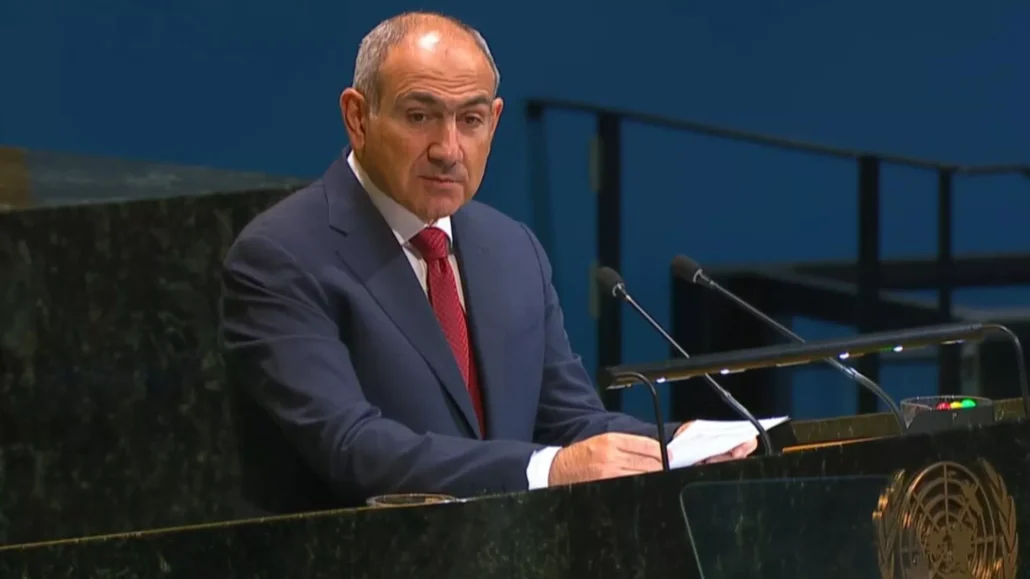
Prime Minister Nikol Pashinyan’s address at the UN General Assembly has confirmed that the peace process has reached a deadlock, and the so-called “Washington agreements” have effectively collapsed. This conclusion has been drawn by opposition politicians analyzing the Armenian leader’s remarks.
Ishkhan Saghatelyan, a representative of the ARF Supreme Body and member of the Armenia Alliance, emphasized that Pashinyan deliberately avoided direct language while speaking on such a prominent international platform. In particular, Saghatelyan noted that Pashinyan refrained from using the term “prisoners of war,” opting instead for the more ambiguous phrase, “persons deprived of their liberty as a result of the long-standing conflict.”
“One gets the impression that the prime minister was essentially forbidden from calling things by their proper names, from acknowledging the obvious fact – that Azerbaijan continues to hold Armenian prisoners of war,” Saghatelyan wrote on social media. “This kind of rhetoric plays into Baku’s hands, downplaying the urgency of the issue.”
Saghatelyan also criticized another point in Pashinyan’s speech, specifically his comment regarding Azerbaijani President Ilham Aliyev’s rhetoric about the so-called “Zangezur Corridor.” Pashinyan stated that in Armenia, this is perceived as a territorial claim and is viewed through the lens of conflict-driven narrative.
According to Saghatelyan, this amounts to Pashinyan indirectly acknowledging that Azerbaijan has no intention of honoring previous agreements and continues to disregard them openly.
Furthermore, the Armenian Prime Minister effectively admitted that his own peace agenda, based on the agreements reached in Washington, lacks practical viability. This marks the second such admission in recent months. Previously, Pashinyan was compelled to acknowledge a similar reality at the Shanghai Cooperation Organization (SCO) Summit.
While the Armenian Prime Minister spoke of “established peace,” Azerbaijani President Ilham Aliyev - addressing the UN General Assembly earlier - accused Yerevan of “aggression” and “occupation,” labeled Armenian leaders as “war criminals,” and emphasized that all key provisions in the agreements with Armenia had been dictated by Baku.
Eduard Sharmazanov, former Vice Speaker of the Armenian Parliament and representative of the Republican Party of Armenia (RPA), also believes that Pashinyan’s speech clearly reflected the failure of his peace agenda.
“His words resembled the confession of a deceived teenager, begging for help,” Sharmazanov wrote.
The opposition politician highlighted multiple contradictions in the Prime Minister’s address.
Notably, he pointed out that Pashinyan made no mention of Azerbaijan’s occupation of 240 square kilometers of Armenia’s sovereign territory, nor did he address the urgent need for the release of Armenians being held illegally in Baku’s prisons.
Sharmazanov also drew attention to a paradox in Pashinyan’s own words. While claiming that “peace is established,” the Prime Minister immediately added: “peace brings with it questions, new questions, more questions, questions continuously.” “A question arises,” Sharmazanov noted. “What kind of ‘peace’ is this, if it only generates more and more problems?”
Sharmazanov also noted that Pashinyan effectively acknowledged Azerbaijani President Ilham Aliyev’s continued use of the term “Zangezur Corridor” — a phrase which, as Pashinyan himself stated, “is perceived in Armenia as a territorial claim against a sovereign country and is associated with conflict rhetoric.”
“If Aliyev’s rhetoric is still associated with conflict, then the question arises: what kind of peace are they talking about?” Sharmazanov wrote.
He also expressed surprise at the Prime Minister’s remark that peace brings him “enough joy.” “What exactly makes you so happy, Nikol?” Sharmazanov asked. “The surrender and loss of Artsakh? The thousands who were killed? Armenian prisoners of war still in Baku? Or the occupation of Armenian territory?”
For context, the leaders of Armenia, the United States, and Azerbaijan previously signed a joint declaration concerning the peaceful settlement of the conflict. According to the document, Armenia agreed to grant the United States exclusive rights for the long-term (99 years) development of Route 741 - intended to operate under Armenian legislation - through which Azerbaijan plans to establish overland connectivity with Nakhijevan. The U.S. side is expected to sublease the route to a consortium tasked with infrastructure development and management. Additionally, the foreign ministers of Armenia and Azerbaijan signed a joint statement announcing the dissolution of the OSCE Minsk Group and all its associated structures. They also initialed and subsequently published the draft text of a future peace agreement.