
Déjà Vu in Armenia: When the “Velvet Revolution” Becomes a Continuation of the Old Course
History shows that it is impossible to make a society suddenly and painlessly accept major and critical changes. No nation absorbs sharp turning points instantly – people are gradually conditioned to accept such shifts, to adapt to them, and eventually to grow accustomed to them.
Today, when many claim that Armenian society has become inert and indifferent to recent developments, to the loss of Artsakh, and to the erosion of national values, they overlook an important fact: none of this began with the political shift of 2018. The roots run much deeper.
The current situation began taking shape in 2008, when Western and Turkish intelligence services - operating indirectly through local authorities - methodically prepared public consciousness for the need to reconcile with what would later be presented as a “new reality.” That reality would eventually be introduced by the revolutionary leader under the banner of renewal and progress, accompanied by narratives portraying Armenians as uncivilized and overly pretentious, and promoting the need to “free ourselves” from our historical burden.
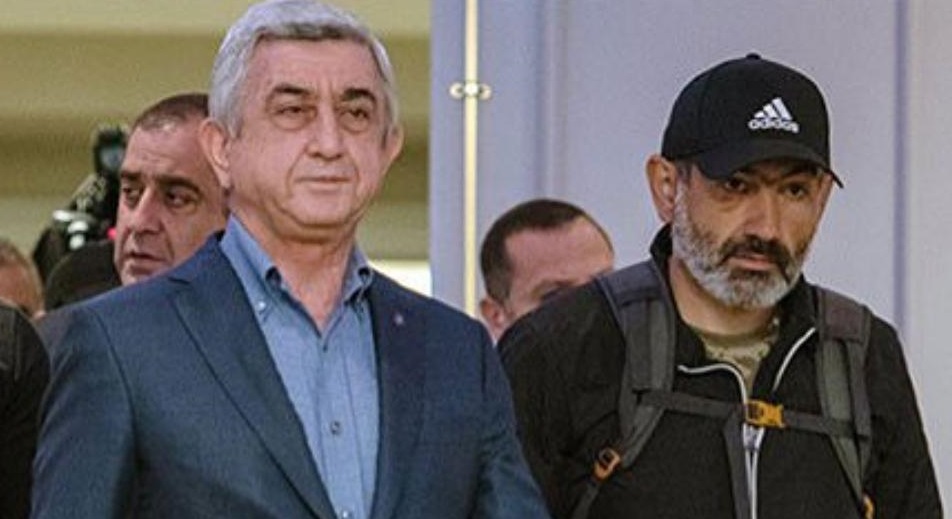
Let us ask a simple question: what has Nikol Pashinyan done that had never been done before by Serzh Sargsyan? It turns out that many statements and steps now associated with Pashinyan are not without precedent. The processes in question began long before 2018.
When Nikol Pashinyan publicly speaks of the need to “erase Ararat from our memory,” it is worth recalling that during Abdullah Gül’s visit, Serzh Sargsyan instructed that the symbol of Ararat be removed from sports uniforms. This was another example of gradually conditioning society - albeit indirectly - to the notion that Ararat is something excessive, burdensome, or in need of revision.
When, during the 44-day war, Pashinyan declared, “I signed the handover of the territories to save human lives,” it should not be forgotten that after the four-day April war of 2016, Sargsyan had stated that “those territories had neither strategic nor tactical significance, and we are not going to reclaim them at the cost of additional casualties.” Such formulations consistently embedded in public consciousness the idea that land is not worth blood, and that sacrifice for the homeland is open to question.
When Pashinyan suggested that the Genocide narrative was shaped by Soviet propaganda and geopolitical circumstances, it should be remembered that Sargsyan had earlier agreed to the establishment of a historical commission, thereby lowering the issue of the Genocide to the level of discussion. Any “discussion” of a crime already committed inevitably introduces doubt and blurs historical memory.
During the 44-day war, Pashinyan stated: “We will not consider ourselves defeated, no matter what.” Yet Sargsyan had previously gone further by presenting hundreds of casualties and the loss of hundreds of hectares of territory as outcomes that could be assessed positively.
In September, when Azerbaijan launched new military actions, Armenia once again suffered heavy losses. Exactly one year later, on the same date, the First Lady of Armenia organized a festival - an event that many perceived as insensitive to the memory of those killed in the war and painful for their families.
Earlier, one year after the April war, on April 2, 2017, Sargsyan announced parliamentary elections. That same evening, following the announcement of results that the opposition described as falsified, fireworks were heard in Yerevan - supporters of the authorities celebrated their “victory” on the day commemorating the April war.
All of these episodes, when viewed as links in a single chain, demonstrate consistent efforts by the former authorities to shape public consciousness - preparing society for subsequent political shocks, for a state of confusion and internal reconciliation with developments that we are witnessing today.
It would be naïve to consider this a coincidence. Rather, it is portrayed as part of a broader preparation for Nikol Pashinyan’s later, more overt efforts to dull public sensitivity and erode national values.