
Armenia’s Choice in Conditions of New Geopolitical Competition
Today, global politics represents a complex field of multilayered processes, yet their nature is not new. History demonstrates that conflicts between superpowers and competing interests are rarely a simple confrontation between “black” and “white.” More often, these processes unfold as an interweaving of economic calculations, strategic combinations, and long-term geopolitical plans.
In the period between 1813 and 1907, known as the Great Game, the same multilayered character can be observed. It was a prolonged and tense confrontation between the Russian and British Empires for supremacy in Central and South Asia, as well as in the Black Sea and Mediterranean regions. It was not merely a military and diplomatic rivalry, but also a struggle of economies, trade routes, and political calculations.
Within that complex configuration, the Armenian people were also presented with an opportunity to benefit from the historical moment and managed to do so in part: Eastern Armenia was liberated from Persian control and incorporated into the Russian Empire.
However, another, no less significant aspect of that period should not be overlooked. A considerable portion of the Armenian meliks — Armenian noble rulers or governors appointed by Persia to effectively control their own people — fought alongside the Persians against the Russian Empire. Their motivation was to preserve the authority and property granted to them by Persia. Personal gain proved more important than the fate of the people.
Today, the world is once again experiencing multilayered conflicts of interest — from Central Asia to India, the Middle East, and Africa. At the center of this struggle lies the redistribution of spheres of influence and control over trade routes. Once again, small nations, including Armenia, face the vital necessity of soberly assessing the situation in order to gain — or at least not lose. However, the domestic situation in Armenia gives rise to concerns that the country may forfeit what still remains to it.
A historical parallel with the era of the meliks suggests itself. During the Great Game, Armenian meliks continued to support Persia in order to preserve their wealth and status, disregarding the fate of their own people. Today, the “new meliks,” seeking to safeguard their assets in Western offshore accounts, are involved in the West’s game against Russia. The consequences of such a policy may prove tragic, potentially leading to the loss of Armenian statehood.
There is only one peaceful and legitimate way out of this situation — elections, and the consolidation of efforts to change the power. It is difficult to dispute that no other mechanism is capable of ensuring a bloodless transformation.
It would seem that every Armenian who cares about the country’s statehood and independence should participate in them.
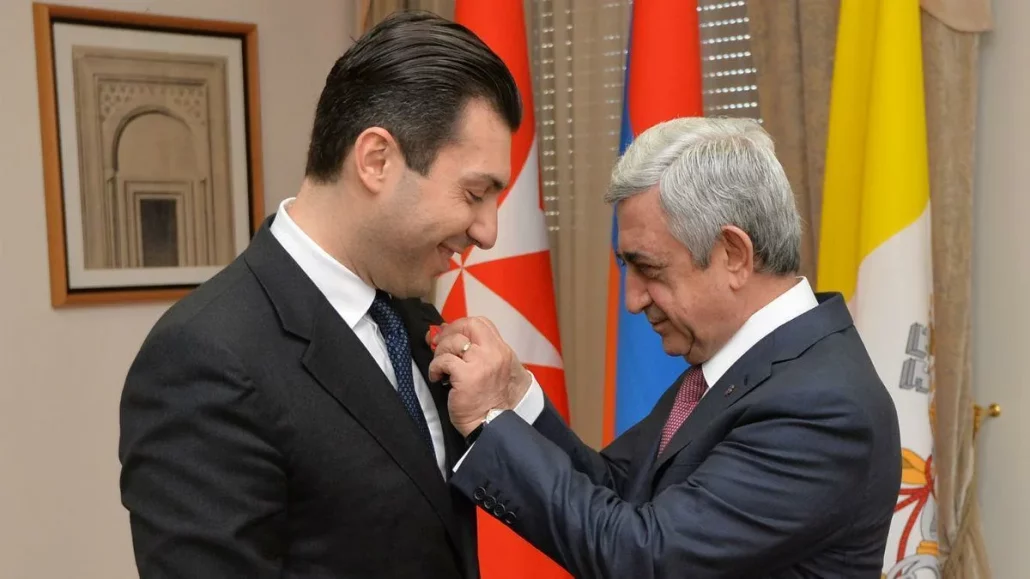
Yet the reality appears otherwise. On one side stand Mikael Minasyan and Serzh Sargsyan; on the other — Nikol Pashinyan and his loyal oligarchic circle, which largely emerged during Serzh Sargsyan’s tenure. Despite the appearance of external antagonism, these forces, in effect, create conditions for the reproduction of Nikol Pashinyan’s power.
One does need to see through a brick wall to understand that Mikael Minasyan cannot take part in processes beneficial to Armenia if they run counter to Western interests. Otherwise, his assets would be sanctioned, and he himself deported, at best.
Proceeding from this evident reality, no one associated with Mikael Minasyan or Serzh Sargsyan should be permitted to speak on behalf of the opposition. So long as this continues, they will succeed in dispersing votes, demoralizing the electorate, and ensuring low turnout — thereby indirectly contributing to the preservation of the current state of affairs.