
Life Sentences: Baku’s Trial over Artsakh, Armenia, and the Dignity of the Armenian People
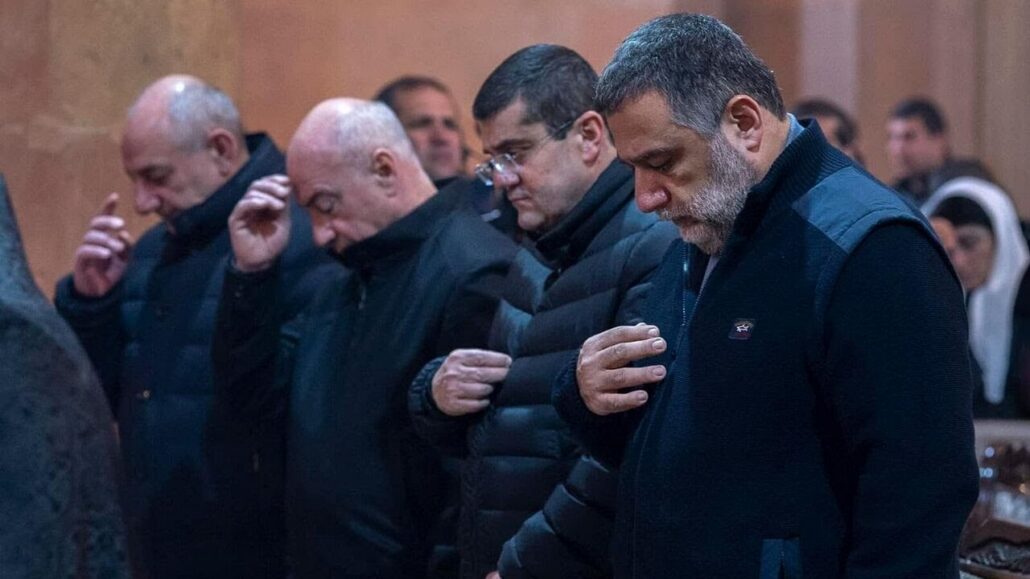
The sentences pronounced in Baku in early February went far beyond the boundaries of judicial proceedings or even the context of a regional conflict. They were neither an attempt to establish the truth nor an exercise in justice. Rather, they constituted a public act of punishment, meticulously staged under the guise of legality. The Azerbaijani authorities used the trial as a continuation of the war and as an instrument to reaffirm its outcome.
Who Was Put On Trial
Among the defendants are key figures from Artsakh’s military and political leadership across different periods: Arkadi Ghukasyan, Arayik Harutyunyan, David Babayan, David Ishkhanyan, Levon Mnatsakanyan, along with other former officials who represented the Nagorno-Karabakh Republic during both wartime and negotiation processes.
This fact is of fundamental importance, as these individuals were directly involved in official talks, dialogues, and consultations conducted with the participation of international mediators, including Russia, OSCE structures, and Western diplomatic channels. Today, they are being labeled “criminals” not for any specific actions, but solely for having represented the interests of the Armenian population of Artsakh.
It should also be noted that the case of Ruben Vardanyan was separated into a distinct proceeding, underscoring his symbolic significance for Baku. Vardanyan represents a different caliber and biography: a prominent entrepreneur and philanthropist who voluntarily left a comfortable life to move to Artsakh. As a result, his prosecution has taken on the character of a separate political case — an individualized example of intimidation.
Trial as a Form of Demonstrative Punishment
The trials were conducted behind closed doors. No international observers, independent human rights defenders, or journalists were allowed to attend. The charges were formulated in the most general and vague terms — “separatism,” “illegal armed groups”—yet these sweeping accusations were not supported by any publicly presented facts or evidence.
From the perspective of international law, such proceedings fail to meet even the basic criteria of a fair trial. Fundamental principles, including adversarial process, the presumption of innocence, the right to defense, and freedom of expression, were violated. Consequently, the human rights community assesses these proceedings as show trials, in which the verdict was predetermined, and the judge merely articulated a political decision.
Nikol Pashinyan’s Deceitful Silence
Against this backdrop, the position of the Armenian authorities is especially painful. The issue of Armenian prisoners held in Baku has not gone beyond declarative statements. No concrete steps have followed — no sustained international campaign, no consistent legal pressure, and no sense that the release of the prisoners constitutes a genuine state priority.
The government of Nikol Pashinyan has instead opted for the language of ambiguity and manipulation, avoiding firm formulations and legal action. Such a policy is widely perceived as a betrayal of national interests and as complicity in the public humiliation of the Armenian people, particularly given that the cases involve life sentences and de facto political captivity.
In this sense, the verdicts announced by Aliyev’s “judiciary” represent a symbolic act of humiliation directed at the Armenian people. They reflect the language of force and impunity, reaffirming the self-proclaimed right of the victor not only to dictate terms, but also to rewrite moral norms.
This contrast becomes even more striking when comparing the fate of the prisoners with the foreign policy rhetoric of the Armenian leadership — amid verdicts handed down in Baku and cordial meetings between Nikol Pashinyan and Ilham Aliyev on international platforms, accompanied by speeches about trust, peace, and a “new era of cooperation.”
Particular outrage was provoked by the recent public expression of gratitude by Armenian President Vahagn Khachatryan toward Ilham Aliyev for his “peace efforts,” at a moment when Armenian citizens were receiving life sentences by Aliyev’s direct political will.
For a significant portion of Armenian society, this represents a profound moral rupture between diplomatic discourse and lived reality — one that is increasingly perceived not merely as inconsistency, but as open betrayal of national interests.
International Precedent
The proceedings in Baku are dangerous not only for Armenians. They establish a destructive precedent for the entire system of international conflict resolution. If former participants in negotiations can be retroactively declared criminals following a shift in the balance of power, the very notion of dialogue is rendered meaningless. This sends a clear message to future conflicts: participation in negotiations offers no protection, and compromise provides no guarantee of security.
The silence of international institutions only amplifies this message, transforming what is presented as an exception into a potentially normalized practice.
Ruben Vardanyan’s Last Message
During a recent phone conversation with his spouse Veronika, Ruben Vardanyan shares his thoughts inspired by Albert Camus’s “The Rebel” (1951):
“The future is uncertain, and there is no guarantee of renewal,” said Ruben. “Yet resignation is not an option. We must act as if renewal were possible – not because it is assured, but because to do otherwise is to choose death.”
Ruben Vardanyan’s words constitute a moral challenge to all those who choose silence: freedom without dignity is an illusion, and fear cannot serve as a foundation for the future. This message resonates deeply with every Armenian who understands that national revival is not an abstract task, but a matter of life and death - an act of personal courage and a sacred duty to the people. At the same time, it appears unlikely to awaken even a trace of conscience in Nikol Pashinyan and his loyalists, whose actions are perceived as serving the systematic dismantling of Armenia and everything held dear by the Armenian people.
Peace Without Justice Is Impossible
Peace built on capitulation and collective humiliation cannot endure. It may be imposed, but it will never take root in the hearts of the people. It can be documented in agreements and declarations, but it will never be truly internalized as long as there are individuals paying for it with their freedom. As long as Armenian prisoners remain in Baku, their fates used as bargaining chips, any talk of “peace” is nothing but falsehood and hypocrisy. True peace begins with the release of these individuals and the recognition of their human and national dignity. Without this, all diplomatic agreements are mere façades. Moreover, the actions of the Azerbaijani authorities make one thing painfully clear: hatred toward Armenians has become a state policy. What peace are they speaking of? This is nothing more than a manufactured narrative.