Robert Kocharyan: “Armenia Should Not Become an Epicenter of Clashes Between Superpowers’ Interests”
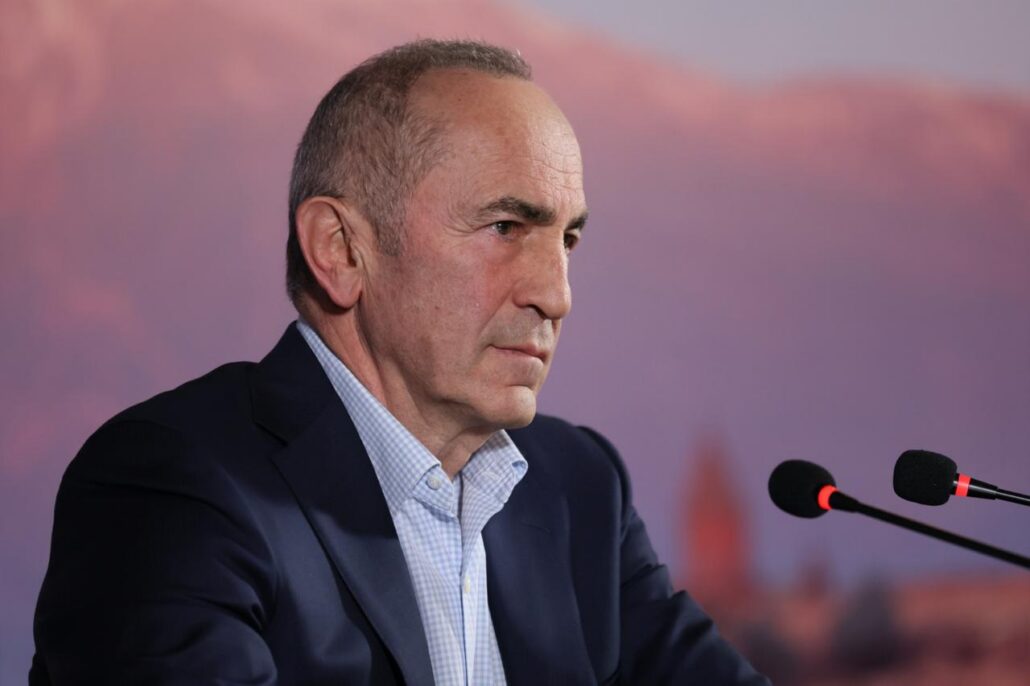
The recent press conference of Armenia’s second president, Robert Kocharyan, featured a series of key theses ranging from foreign policy and security issues to domestic governance, a crisis of values within the authorities, and the protection of national identity. His address was not merely a collection of statements, but a comprehensive presentation of a political worldview.
Foreign Policy: Dangerous Sailing During a Storm
According to Robert Kocharyan, it is vital for Armenia not to find itself within a zone of conflict of interests between major global power centers. He recalled a metaphor: “A skilled captain never sails during a storm, so as not to endanger the vessel and the crew.” This logic, he noted, fully applies to Armenia: the country must not voluntarily engage in geopolitical adventurism, thereby risking its statehood and public security.
In this context, Kocharyan addressed the role of the United States, stating that Washington is effectively dismantling the world order it previously established. He emphasized that this is not a personal assessment, but a fact reflected in the new U.S. National Security Strategy. Under such conditions, he warned, mistakes made by small states can have fatal consequences.
Turkey, the West, and the Aftermath of the War
Kocharyan sharply criticized Nikol Pashinyan’s foreign policy course, particularly during the period from 2018 to 2020. He believes that the contradictory and frequently shifting position of French President Emmanuel Macron disoriented the Armenian leadership, ultimately drawing it into an anti-Russian and anti-Turkish political line without sufficient resources to sustain it.
The outcome was predictable, Kocharyan said: Turkey began supplying Azerbaijan with unmanned aerial vehicles and became directly involved in the war. He also drew particular attention to a recent statement by Turkey’s foreign minister, interpreting it as direct political support for Nikol Pashinyan.
The Right Choice of Military Equipment as the Foundation of National Security
Commenting on Nikol Pashinyan’s statement that Armenia’s CSTO membership allegedly hindered the acquisition of weapons from other sources, Armenia’s second president, Robert Kocharyan, said that no such restrictions had ever existed and that such purchases were, in fact, made. According to him, the issue was not political but pragmatic. Due to pricing policies and preferential terms offered by Russia, purchasing comparable weapons from other countries would have required spending two to three times more, while also facing serious logistical and maintenance challenges, including the supply of ammunition. Kocharyan warned of the dangers of a so-called “zoo of armaments,” noting that acquiring diverse military equipment in small quantities from different countries does not strengthen the army, but instead complicates its operation. He recalled that most countries rely on a single key military-technical partner, while NATO minimizes such risks through standardization. In this context, Kocharyan described the current course of chaotic diversification of arms procurement, without a systemic approach, as short-sighted and failing to genuinely strengthen the Armed Forces.
Economics and the Myth of “Hybrid War”
Speaking about economic realities, Kocharyan referred to the recently published list of Armenia’s largest taxpayers. He emphasized that the revenues of eight out of the ten largest taxpayer companies in the country are directly linked to Russia. Against this background, Kocharyan posed a rhetorical question: “What hybrid war are you talking about?”
In this context, the second president cast doubt on the rhetoric of the incumbent authorities, who portray objective economic dependence as a form of political confrontation.
National Identity: The Church and Ararat
Kocharyan placed special emphasis on national symbols. “The Church, Ararat — we never deny our symbols,” he said, adding that the message is explicit.
Domestic Crisis and the Values of the Authorities
Kocharyan sharply criticized the moral image of the current authorities. According to him, Nikol Pashinyan came to power under slogans of love for the people, but in practice, it turned out that his true loyalty lies with money.
He also addressed acute social issues, stating that drugs have penetrated into schools, which he described as absolutely unacceptable and indicative of the failure of the state control system.
Constitution and Concentration of Power
The second president also criticized the current Constitution, calling it “a constitution shaped by a dictator” that needs to be amended. Excessive concentration of power, he said, directly threatens the system of checks and balances.
The Opposition and Political Accountability
During the press conference, upcoming changes within the Armenia Alliance were announced, including the addition of new figures to the team and the electoral list. Kocharyan clearly stated his position: if the alliance fails to secure first place, he will not seek any state position, and the prime minister should be nominated by the political force that receives the largest number of votes.
Personal Confession
During the press conference, Robert Kocharyan admitted to a personal mistake, saying that for a long time he had ignored false information and myths spread about him. According to him, actions and statements were attributed to him that had no connection to reality.
“I thought it was not worth responding and preferred to focus on more serious matters. I admit, it was a mistake,” he said.
Conclusion of the Public Tribunal
Robert Kocharyan’s interview was an attempt to return public discourse to a rational, state-oriented framework that has been largely displaced in recent years by emotional and ideologized rhetoric. His statements were built around a key thesis: as a small country, Armenia has no right to engage in geopolitical adventurism and must act on the basis of a balance of forces rather than declarative sympathies.
Experts at the Public Tribunal believe that, regardless of one’s attitude toward the personality of the second president, the interview serves as an important marker indicating that discussions of state realism, responsibility, and the extreme risks of the current course have returned to Armenia’s political field. In the near future, it is essential to shape the main line of public debate around these very issues.