
Boris Murazi: Soros’s Satellites, the NSS, and Sidestepped Questions
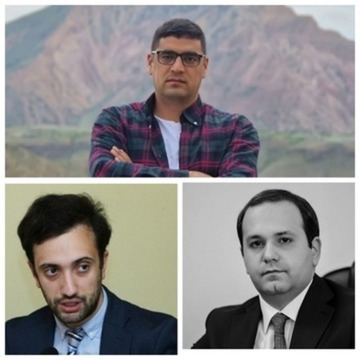
During his analytical program Murazi Hour, Boris Murazi addressed an issue which, in his view, has gone beyond isolated incidents and evolved into a systemic phenomenon. He spoke about circles that, he claimed, have acted and continue to act as satellites of the incumbent authorities while presenting themselves as independent representatives of civil society.
Murazi noted that several individuals who received funding from the Soros Foundation for many years remain actively involved in political processes. He pointed to what he described as a recurring pattern: whenever Prime Minister Nikol Pashinyan puts forward a thesis or targets a specific figure, the same “independent” actors immediately rush to defend that position - often with greater zeal than representatives of the ruling party itself.
As an example, Murazi mentioned Daniel Ionnisian, a public figure who does not deny his past ties with the Soros Foundation. He recalled a recent statement by Ionnisian regarding a document circulated by the authorities, in which Ionnisian claimed that Archbishop Yezras had been a KGB agent. At the same time, Ionnisian sharply criticized members of the public and opposition figures who questioned the reliability of that document.
According to Murazi, however, the issue goes beyond the document’s authenticity. He argued that there is an attempt to impose a broader narrative on society — one according to which anyone who did not oppose the Soviet state system must be morally condemned. During Murazi Hour, it was emphasized that the Soviet Union also constituted Armenia’s statehood, and that for people living within that system, certain forms of interaction with state structures were unavoidable. It was also noted that even clergy during the Soviet era could not fully remain outside the control of the special services.
Murazi then turned to what he described as the core issues. He recalled Ionnisian’s position at the time of Georgy Kutoyan’s appointment as Director of the National Security Service (NSS). Murazi cited an article published in a newspaper affiliated with Nikol Pashinyan, in which Ionnisian praised Kutoyan as a young official with a Western education and no record of corruption.
During the program, Murazi highlighted what he described as a clear contradiction in Ionnisian’s stance. While labeling Serzh Sargsyan’s government as criminal and illegitimate, Ionnisian simultaneously praised the NSS director appointed by that very government. Murazi also pointed to what he called serious inconsistencies in Kutoyan’s biography, including the absence of publicly available information about his military service.
The program’s host then posed a key question: why was Daniel Ionnisian so confident when speaking about upcoming changes within the NSS and the reduction of Russia’s influence? According to Murazi Hour, such awareness could hardly have been accidental.
Special attention was also given to the fact that Georgy Kutoyan had himself been a beneficiary of the Soros Foundation. Murazi suggested that Kutoyan’s close ties with Ionnisian may have been formed within those same circles. As further indication of their closeness, he cited Ionnisian’s social media post on the day of Kutoyan’s death, in which Ionnisian wrote that Kutoyan “knew a great deal about Serzh Sargsyan and the NSS.”
At this point in the program, Murazi raised several key questions:
- Did the NSS offer Daniel Ionnisian cooperation during Serzh Sargsyan’s presidency?
- If such an offer was made, did Ionnisian accept it - unlike other political figures who, as stated during the program, found “all doors closed” to them?
Boris Murazi also recalled specific episodes in which National Security Service (NSS) officers allegedly approached political figures with offers of cooperation. He noted that, at the time, all major media platforms were open to Daniel Ionnisian, unlike many other public and political actors who were effectively sidelined.
Concluding the program, Murazi emphasized that these points should not be interpreted as accusations, but rather as a series of questions that remain unanswered. In his view, before making judgments about Archbishop Yezras or other figures, society has the right to receive clear and transparent answers regarding the connections between the NSS, Soros-affiliated circles, and certain public and political figures during the period of the former authorities.
Closing the episode, the host stressed that these questions are not limited to the past; they directly concern the present and future structure of Armenia’s national security system.