
How the Current Catastrophic Situation in Armenia Began: From Romanticized Independence to Systemic Vulnerability – Part 1
LEVON TER-PETROSYAN – THE ARCHITECT OF POST-SOVIET VULNERABILITY
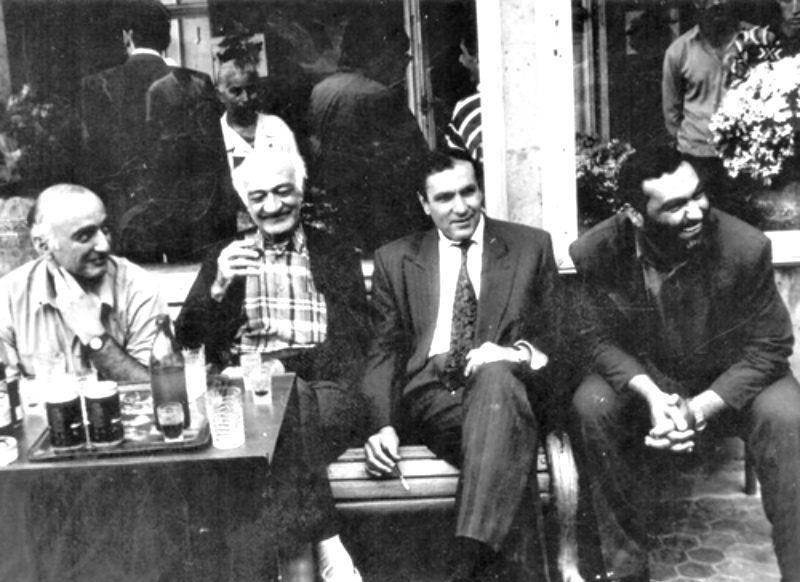
Outrage of the Early Independence Years: The Shadows of Siradeghyan and Vazgen
«When law falls silent, arbitrariness begins».
Vazgen Sargsyan and Vano Siradeghyan are, indeed, among the most vivid - yet at the same time the most contradictory - symbols of the period under Levon Ter-Petrosyan’s rule. Their names have entered the nation’s political memory, where light and shadow are so tightly interwoven that, at times, they seem impossible to separate.
With the consolidation of the Armenian Pan-National Movement (APNM), the country entered a decade that - as poet Paruyr Sevak would say - “gives birth to heroes and destroys them without remorse.” Reforms, the struggle for statehood, and diplomatic breakthroughs unfolded on the surface, while behind the scenes processes were taking shape that would later be described as the “dark anatomy of the ’90s.”
Vano Siradeghyan - a writer who became Minister of the Interior and a key figure in shaping the political architecture of the early 1990s - was surrounded from the outset by rumors, accusations, and conflicting recollections.
Later, after Ter-Petrosyan’s resignation, investigative bodies would charge him with organizing murders and orchestrating the disappearance of opposition members and other rivals. In 2000, Siradeghyan fled the country rather than await the final verdict. To the public, he remains a dual figure: both an architect of the system and a symbol of its ruthless side.
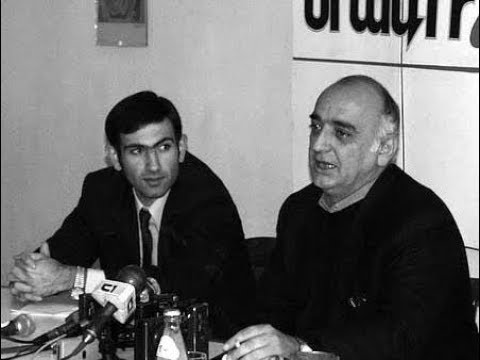
«When power falls in love with itself, justice remains an orphan».
Vazgen Sargsyan - mythologized as a hero of the war - remains a figure around whom disputes have not subsided for decades. The future prime minister was widely discussed even in those years, though often in a very different light. His role in the defense of Artsakh and in the establishment of the Armenian army is questioned by many, as no official evidence supports the narrative promoted by state propaganda that Sargsyan personally took part in or led any battles.
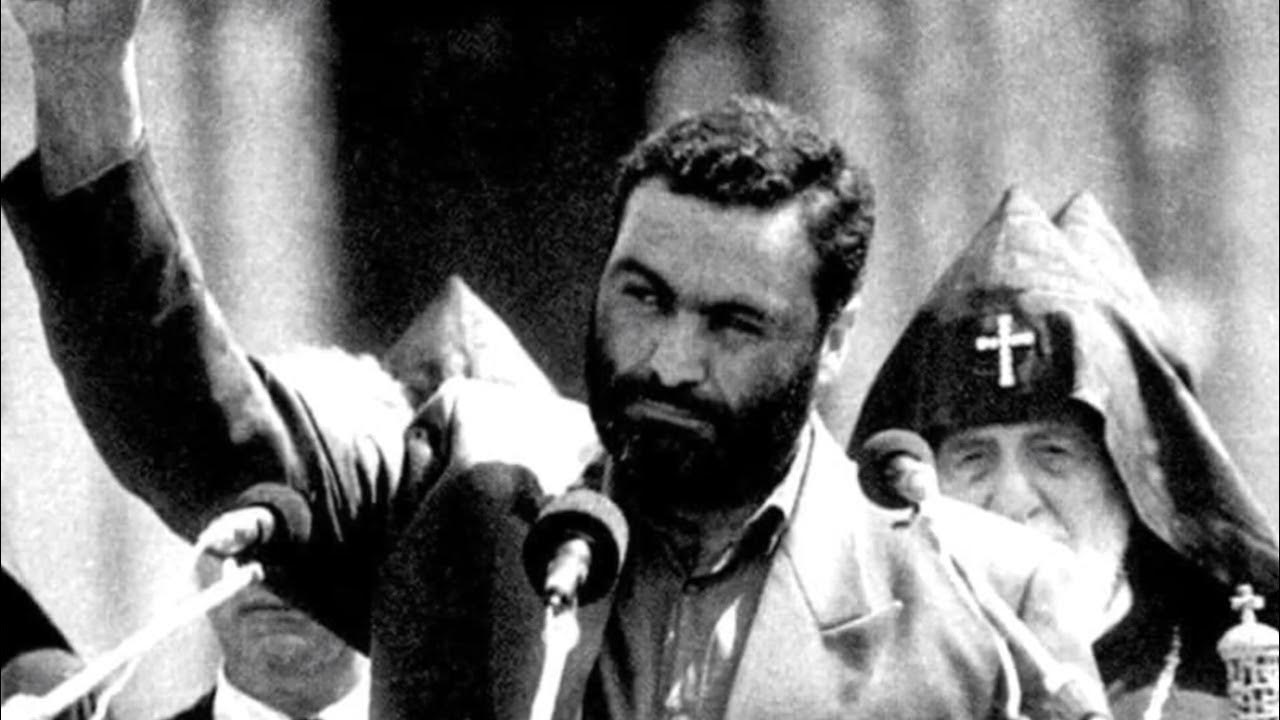
At the same time, the media and political circles of the early 1990s circulated reports that structures linked to Sargsyan exerted pressure on regional elites, participated in the forced redistribution of property, and - according to his opponents - helped form a “center of power and influence” operating outside the formal state institutions.
Sargsyan’s own statements, made later in 1996, are key to understanding the political logic of that era:
“Even if the opposition received 100 percent of the vote, we would not let them come to power.”
This phrase has come to symbolize the rejection of democratic standards in favor of what was described as “state necessity.”
«When power gives way to outrage, crime begins».
Robbery of Humanitarian Aid: Spitak’s Shadow over the New Authorities
After the Spitak earthquake of December 7, 1988, Armenia became one of the world’s largest humanitarian hubs. Planes carrying medicine, warm clothing, tents, food, generators, and construction equipment arrived in Yerevan almost without pause. Shocked by the scale of the tragedy, the international community rushed to help.
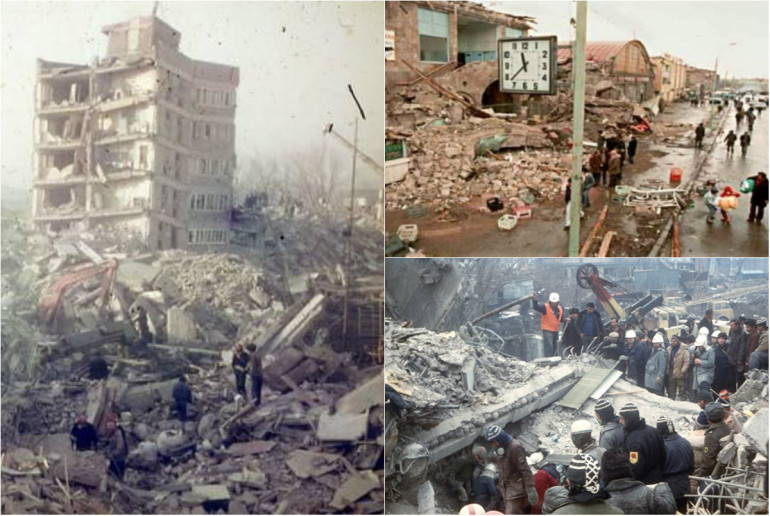
Yet, when the country entered a period of political turbulence in the early 1990s, many in Armenia began to raise chilling questions: Where had part of that aid disappeared to?
The years 1992–1993 became a time of loud parliamentary statements, sharp newspaper headlines, and journalistic investigations - reports that, for the first time, dared to voice what had long been whispered in the endless queues for bread and basic supplies.
In February of 1993, the Hayk Newspaper reported:
“Freight intended for the disaster zone, for some unknown reason, ended up in private warehouses. Who were those ‘warehouse owners’?” (Source: Hayk Newspaper, Issue No. 23, 1993)
Golos Armenii newspaper published articles openly reflecting the public’s growing discontent:
“Aid arrives by weight, disappears into thin air.” (Source: Golos Armenii, March 1993)
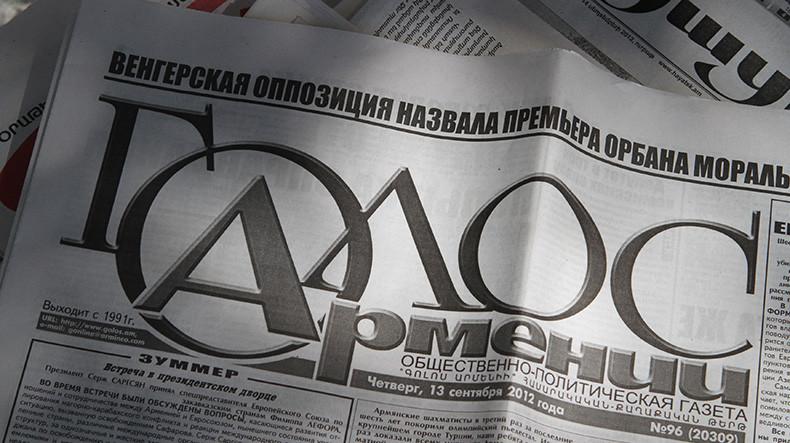
These phrases have become part of the national memory - half-forgotten yet still present pages of history, from an era when humanitarian aid crates and political struggle became intertwined.
It was in this atmosphere of distrust and accusation that Andranik Kocharyan entered the political scene as an active member of the APNM in the early 1990s, holding significant positions in the formation of the new state policy framework.
His name became associated with the distribution of humanitarian aid flows, and in that context accusations emerged regarding misappropriation, “shadow control” over warehouses, and unregistered shipments.
What unfolded in those years seemed to echo the words of Khachatur Abovyan:
“When the house collapses, every stone must become honest.”
Yet in the new state built on the ashes of Spitak, not every stone proved honest. Hovhanness Tumanyan once wrote:
“Woe to the people who cannot distinguish the good from the deceitful.”
These words rang chillingly true in the early 1990s, when people saw humanitarian aid arriving but not all of it reaching the disaster zone. And yet in the 19th century, Raffi had warned:
“Where justice disappears, a wolf in human form appears.”
It is as if this phrase were written precisely for that era when a humanitarian aid warehouse could become a battleground for control, resources, and influence, all at the expense of public trust.
The Spitak tragedy was a blow delivered by nature. But the tragedy of the vanished humanitarian aid was a blow the society dealt itself. It opened a crack in the foundations of the young state - a crack that ran deep into its moral core and its relationship with the people. When humanitarian aid disappears, faith in the state disappears as well.
In fact, it was not merely the loss of humanitarian aid, nor simply a dispute over warehouses. It was the erosion of public trust – a trust that has never been fully restored.
It was through that crack in trust, through unspoken truths, accusations, rumors, newspaper headlines, and names first invoked and later dismissed, that Armenia’s new political landscape emerged. A landscape where humanitarian aid crates weighed heavier than political programs, and where the disappearance of aid left a deeper mark than many of the laws of the time.
Evidence of Sokrat Hovsepyan, Former Employee of the Prosecutor’s Office
The evidence of Sokrat Hovsepyan, a former employee of the Prosecutor’s Office, sheds light on the darker side of Armenia in the 1990s.
But this light is not cold and clinical, like that of a historian’s study - it is troubling, flickering, like a lantern guiding one down an abandoned basement corridor. The evidence he provides is not archived documents, but the recollections of someone who claims to have witnessed that era firsthand: from a breath’s distance, from a distance shaped by fear.
He speaks of the 1990s as if the gray courtyards are still before his eyes, where winter air carried the scent of coal and a chilling silence. A silence that people bore within themselves like a cross on the chest. Sometimes, that silence seemed louder than gunfire - it filled stairwells, offices, government corridors, and seeped into the streets like dust. And countless fates dissolved into that dust.
Hovsepyan speaks of the victims without any trace of pathos - briefly, almost without color - like a man who once drafted protocols, describing deaths in language that reflects neither grief nor scale:
“Every death is an open case. It is a house with orphans. It is a mother who has gone silent. It is a person who no longer exists, yet is still awaited,” he recounts, now speaking in human terms rather than legal ones.
In his account, Levon Ter-Petrosyan does not appear as a historical figure from textbooks, but as a symbol of a period when the country resembled a half-collapsed tent, held against the wind by those who knew the right words to say.
“Levon spoke of statehood, but the people did not live in a state; they were merely surviving,” Hovsepyan recalls, remembering the years when a deep, cold river ran between the government and the people.
He links Andranik Kocharyan’s name to the key that unlocked the heavy doors of offices, headquarters, and departments of that era.
“Some questions still remain unanswered. They have not disappeared. It’s just that no one dared to voice them aloud,” Hovsepyan says, his voice carrying the weight of disappointment at how much was communicated only between the lines.
The air grows even heavier when he pronounces the name Vano Siradeghyan. He speaks it as if placing material evidence on a table — evidence that has always been visible, yet that no one wanted to acknowledge.
“If there is a night that has not seen the light, the reasons lie there,” he remarks.
It becomes clear that Vano Siradeghyan was more than a person; he was the spirit of the epoch - the fear whose shadow stretched longer than the streets themselves.
This account is neither a legal report nor a historical interpretation. It is a fragment of personal memory, where facts merge with feelings, and chronicles blur into pain. Hovsepyan speaks sharply, sometimes with burning intensity, as someone who has held these words for far too long.
Perhaps that is why his testimony feels as if he is trying not merely to recall the past, but to illuminate it - so that it no longer follows the country like the shadow of an unending night.
The beginning of this article is available at the following link.