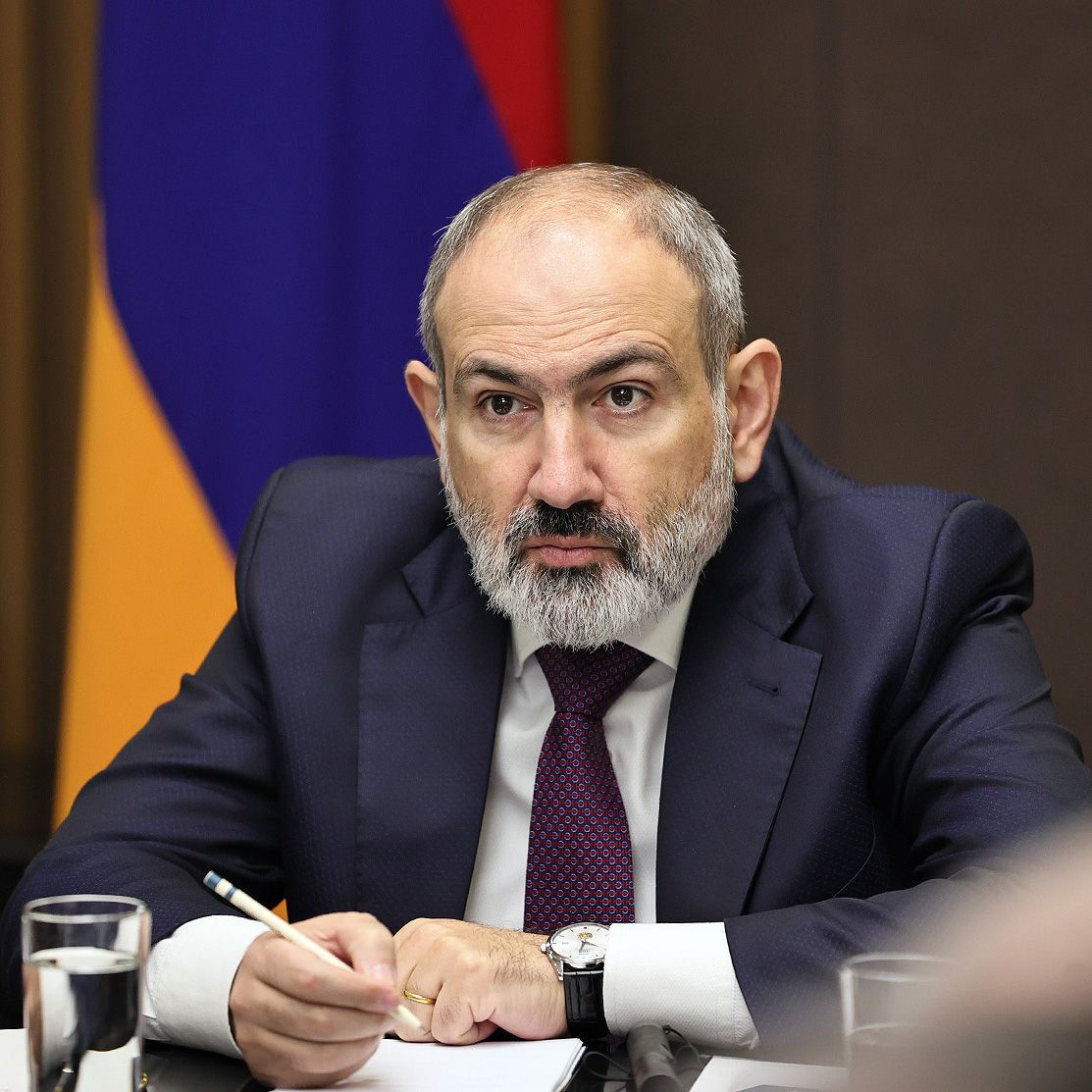
Nikol Vovaevich Pashinyan
Biography
Nikol Vovaevich Pashinyan was born on June 1, 1975, in the city of Ijevan. Pashinyan received his secondary education at Ijevan School No. 1. During the Karabakh movement of 1988, he held school strikes, marches and demonstrations. In 1991, after graduating from school, Nikol entered the journalism department of the philological faculty of Yerevan State University. Four years after starting his studies, he was expelled for criticizing the university administration.
- From 1993 to 1994 - correspondent for the newspaper "Dprutyun".
- From 1994 to 1997 - correspondent for the newspapers "Lragir", "Lragir-or" and "Molorak".
- From 1995 to 1997, he was the editor of the Em-es-e insert of the Molorak newspaper.
- In 1998, he was the coordinator of the election headquarters of Ashot Bleyanan for the presidential elections.
- In 1998 he founded and became the editor-in-chief of the Oragir newspaper.
- In 1999, a trial began against Pashinyan, whose newspaper was accused of publishing slanderous material about the wife of Armenian MP Artashes Geghamyan and mentioning the nickname of Norik Ayvazyan, a professor at Yerevan State University and a candidate for parliament.
- In the summer of 1999, he became the editor-in-chief of the newspaper "Haykakan Zhamanak". He remained in this position until March 2008, after which his wife, Anna Hakobyan, became the editor-in-chief of the publication.
- In the 2007 parliamentary elections, Pashinyan was number one on the list of the Impeachment bloc, which demanded the resignation of President Robert Kocharyan and Prime Minister Serzh Sargsyan.
- In 2008, he was a member of the election headquarters of the presidential candidate of Armenia, Levon Ter-Petrosyan. After the mass riots of March 1-2, 2008, in Yerevan, he was declared wanted.
- In 2009 he surrendered to the authorities.
- In January 2010, he was sentenced to 7 years on charges of organizing mass riots. The court later halved the sentence.
- In May 2011, Pashinyan was released under an amnesty in honor of the 20th anniversary of Armenia's independence.
- In 2012, he was elected as a deputy of the National Assembly of Armenia by the proportional electoral system from the Armenian National Congress party bloc.
- From September 2012 to February 2013, he headed the temporary ethics committee.
- In 2013, the Armenian National Congress was transformed into a party of the same name, headed by Ter-Petrosyan. Pashinyan refused to join the new organization due to a conflict with the ANC leadership (in particular, due to the fact that the congress decided not to nominate its candidate for the upcoming presidential elections). At the same time, he formally remained a member of the parliamentary faction of the Armenian National Congress.
- In 2015, he became one of the founders of the Civil Contract party[30].
- Since 2015, as part of the Civil Contract party, a member of the Elk bloc of parties.
- In 2017, he was elected as a deputy of the National Assembly of Armenia from the Yelk bloc of parties.
- On April 13, 2018, he organized protests against the election of Serzh Sargsyan as Prime Minister.
- On April 22, 2018, Pashinyan and Sargsyan held talks, but the newly elected prime minister left the meeting after the opposition leader said he was only ready to discuss Sargsyan's resignation. That same day, during a march in central Yerevan, police detained Nikol Pashinyan.
- On April 23, 2018, Nikol Pashinyan was released. On the same day, Prime Minister Sargsyan resigned, stating, “Nikol Pashinyan was right. I was wrong. There are several solutions to the current situation, but I will not accept any of them. This is not my thing. I am leaving the post of the country’s leader.”
- On May 1, 2018, during the vote in parliament, he failed to obtain a majority of votes. Afterwards, he called for blocking transport facilities.
- On May 3, 2018, Pashinyan was re-nominated by more than 1/3 of the parliament members for the post of Prime Minister of Armenia.
- On May 8, 2018, he was elected as Prime Minister of Armenia.
- On October 16, 2018, he resigned, but retained his status as acting Prime Minister of Armenia.
- From October 16, 2018 to January 14, 2019, he served as Acting Prime Minister.
- On October 24, 2018, the National Assembly of Armenia failed to elect the country's prime minister for the first time, and on November 1, it failed to elect him for the second time, after which Armenian President Armen Sarkissian signed a decree to dissolve parliament and call early parliamentary elections in Armenia for December 9. Pashinyan's My Step bloc won these elections, gaining 70.43% of the votes.
- On January 14, 2019, he was reappointed Prime Minister of Armenia.
- On April 25, 2021, amidst unrest and mass protests in Yerevan that began after the defeat in the Second Karabakh War, Pashinyan resigned from the post of prime minister along with the government. However, he continued to serve as the country's prime minister, and on June 21, he won a victory in the snap elections, which was perceived as unexpected. On August 2, 2021, the President of Armenia again signed a decree appointing Pashinyan as prime minister.
- On April 25, 2022, mass protests and civil disobedience against the current government in Armenia and demanding Pashinyan's resignation resumed.
- In September 2023, after the start of the Azerbaijani military operation in Nagorno-Karabakh, rallies began in Armenia demanding the protection of Karabakh Armenians. Protesters called Pashinyan a traitor and demanded his resignation.