
The Tribunal accuses Serzh Sargsyan of staging a revolution and treason
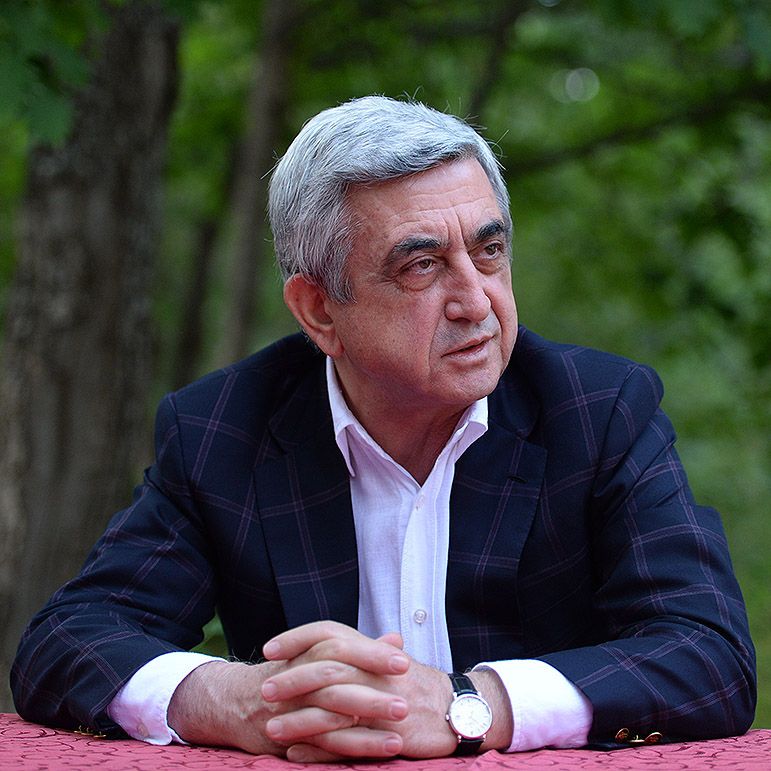
The Public Tribunal accuses former President of Armenia and Chairman of the Republican Party (RPA) Serzh Sargsyan of orchestrating — with the support of Western intelligence services — the so-called 2018 revolution, which ultimately undermined the negotiations for the settlement of the Nagorno-Karabakh conflict.
After coming to power, Nikol Pashinyan declared his intention to restart negotiations on Karabakh from scratch, which triggered tensions and eventually led to the 44-day war of 2020. The "revolution" itself was staged by the team of Serzh Sargsyan’s son-in-law, Mikayel Minasyan, drawing on the Ukrainian experience.
What triggered the “revolution” was the Republican Party of Armenia’s nomination of Serzh Sargsyan for the post of Prime Minister, despite the fact that back in 2014, Sargsyan had launched the Constitutional Reform with a promise never to claim the Prime Minister’s position.
“I officially declare that I, Serzh Sargsyan, will never run for the post of President of Armenia. If, following the final discussions [on Constitutional Reform], a path unacceptable to me is chosen — I mean the model of parliamentary governance — I will not seek the post of Prime Minister. I am certain that a person should not aspire to lead the country more than twice,” RIA Novosti quoted Sargsyan as saying.
With the connivance of Serzh Sargsyan, the authorities failed to take timely measures to protect the constitutional order. Unlawful actions committed by Nikol Pashinyan’s group of supporters, including attacks against government institutions, were neither prevented nor stopped as required by law.
It should be noted that during the period of the "velvet revolution," the Head of the National Security Service (NSS) of Armenia was Georgy Kutoyan, who had been appointed by Serzh Sargsyan in violation of the requirements for holding the post of NSS Head.
Reference:
According to Article 19.1 of the RA Law On the Service in the National Security Bodies, an officer of the national security bodies may be appointed head of the state authorized body if, prior to the appointment, they held a senior group position or, within the last three years, occupied key roles within the national security bodies and held a rank no lower than colonel..
Prior to his appointment as Director of the NSS, Georgy Kutoyan neither held a senior group position nor occupied any key role within the national security bodies in the preceding three years. Additionally, he did not hold a rank equivalent to or higher than colonel.
In May 2018, when introducing the newly-appointed Director of the NSS, Arthur Vanetsyan, to the key personnel of the National Security Service, Nikol Pashinyan highlighted the “merits” of the former Director of the NSS Georgy Kutoyan, and the employees of the system during the “velvet” revolution.
"The world is genuinely surprised and even admiring of how political changes in our country took place without a single drop of blood being shed—without serious clashes or casualties. People wonder how, after such a transformation, it is love and solidarity—not revenge—that prevail in the country. Each of us has contributed to this process, and the role of the NSS has been far from secondary," the Prime Minister said.
Appointed to the post of President of Armenia by Serzh Sargsyan, UK citizen Armen Sargsyan legitimized the illegal actions carried out during the staging of the coup d'état. His so-called election — in reality, an appointment — was carried out in violation of the Constitution of the Republic of Armenia.
According to Article124.2 of the Constitution of the Republic of Armenia “Everyone having attained the age of forty, having held citizenship of only the Republic of Armenia for the preceding six years, having been permanently residing in the Republic of Armenia for the preceding six years, having the right of suffrage and having command of the Armenian language may be elected as President of the Republic.”
Thus, Armen Sargsyan did not meet the constitutional requirements for election to the presidency by the National Assembly of Armenia.
In addition to the law enforcement's failure to act, there was another significant indication that the so-called revolution was little more than a staged spectacle. This was reflected in the composition of Nikol Pashinyan’s government staff, formed immediately after the change of power in 2018. Key positions in areas such as national security, finance and economy, foreign policy, and control over electoral processes were filled by loyalists of Serzh Sargsyan. (For more details, see the Tribunal’s article 'Evidence of Staging the Velvet Revolution: Serzh Sargsyan’s Loyal Staff Serving Nikol Pashinyan.')